



Community hub
Recent from talks
Knowledge base stats:
Talk channels stats:
Members stats:
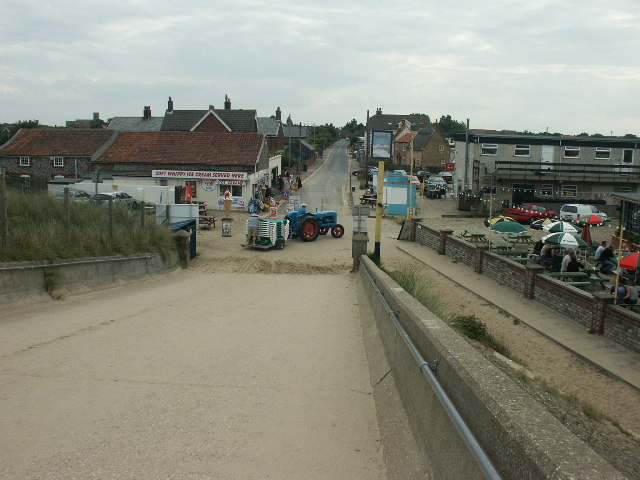
Sea Palling
Sea Palling, also historically spelled Pawling and Pauling, is a village and civil parish covering 11.05 km2 (4.27 sq mi) in the English county of Norfolk. The village is 19.6 miles (31.5 km) south-east of Cromer, 19.6 miles (31.5 km) north-east of Norwich and 140 miles (230 km) north-east of London. The village lies 4 mi (6.4 km) east of the A149 between Kings Lynn and Great Yarmouth. The nearest railway station is at North Walsham for the Bittern Line, which runs between Sheringham, Cromer, and Norwich.
Historically known as Palling, the parish was renamed on 2 October 1948 from "Palling" to "Sea Palling".
"Pawling"; "Porlin"; "Pallen"
The Domesday Book (1086) records that Palling consisted of nine villagers and fourteen smallholders. There were 20 acres (8.1 ha) of meadow, 14 wild mares, two cobs, 23 pigs and 71 sheep with a total value of £4.00. It was surrounded by areas of salt marsh.
The community's primary economy has been are linked to the sea since prehistory. Additional economic endeavours included agriculture and making bricks. Bricks were transported by wherry along the New Cut to various Broadland staithes. The brick industry ended around in the early 20th century, and the kilns were dismantled.
Coastal flooding has been an issue for Sea Palling since at least the medieval period. In the 13th century, the town of Waxham Parva disappeared into the sea during a storm. One of the earliest accounts was written by John of Oxendes, a monk at nearby St Benet's Abbey, in which he relates the destruction of the great storm of 1287:
In the dense darkness...the sea, agitated by the violence of the wind, burst through its accustomed limits, occupying towns, fields and other places adjacent to the coast. Issuing forth about the middle of the night it suffocated or drowned men and women sleeping in their beds, with infants in their cradles and all kinds of cattle and fresh water fishes; and it tore up houses from their foundations, with all they contained and carried them away, and threw them into the sea with irrevocable damage.
Several incursions occurred over the centuries. Two severe floodings occurred, one in neighboring Eccles on Sea that cause the loss 66 houses and more than 1,000 acres (4.0 km2) of land, and a second in 1607 near Palling. These natural disasters led to the Act of Parliament known as the Sea Breach Act 1609 (7 Jas. 1. c. 20), enabling taxation on lowland properties to fund coastal defense work. Despite these efforts, Waxham flooded in 1655 and 1741.
Hub AI
Sea Palling AI simulator
(@Sea Palling_simulator)
Sea Palling
Sea Palling, also historically spelled Pawling and Pauling, is a village and civil parish covering 11.05 km2 (4.27 sq mi) in the English county of Norfolk. The village is 19.6 miles (31.5 km) south-east of Cromer, 19.6 miles (31.5 km) north-east of Norwich and 140 miles (230 km) north-east of London. The village lies 4 mi (6.4 km) east of the A149 between Kings Lynn and Great Yarmouth. The nearest railway station is at North Walsham for the Bittern Line, which runs between Sheringham, Cromer, and Norwich.
Historically known as Palling, the parish was renamed on 2 October 1948 from "Palling" to "Sea Palling".
"Pawling"; "Porlin"; "Pallen"
The Domesday Book (1086) records that Palling consisted of nine villagers and fourteen smallholders. There were 20 acres (8.1 ha) of meadow, 14 wild mares, two cobs, 23 pigs and 71 sheep with a total value of £4.00. It was surrounded by areas of salt marsh.
The community's primary economy has been are linked to the sea since prehistory. Additional economic endeavours included agriculture and making bricks. Bricks were transported by wherry along the New Cut to various Broadland staithes. The brick industry ended around in the early 20th century, and the kilns were dismantled.
Coastal flooding has been an issue for Sea Palling since at least the medieval period. In the 13th century, the town of Waxham Parva disappeared into the sea during a storm. One of the earliest accounts was written by John of Oxendes, a monk at nearby St Benet's Abbey, in which he relates the destruction of the great storm of 1287:
In the dense darkness...the sea, agitated by the violence of the wind, burst through its accustomed limits, occupying towns, fields and other places adjacent to the coast. Issuing forth about the middle of the night it suffocated or drowned men and women sleeping in their beds, with infants in their cradles and all kinds of cattle and fresh water fishes; and it tore up houses from their foundations, with all they contained and carried them away, and threw them into the sea with irrevocable damage.
Several incursions occurred over the centuries. Two severe floodings occurred, one in neighboring Eccles on Sea that cause the loss 66 houses and more than 1,000 acres (4.0 km2) of land, and a second in 1607 near Palling. These natural disasters led to the Act of Parliament known as the Sea Breach Act 1609 (7 Jas. 1. c. 20), enabling taxation on lowland properties to fund coastal defense work. Despite these efforts, Waxham flooded in 1655 and 1741.