



Community hub
Recent from talks
Contribute something to knowledge base
Content stats: 0 posts, 0 articles, 1 media, 0 notes
Members stats: 0 subscribers, 0 contributors, 0 moderators, 0 supporters
Subscribers
Supporters
Contributors
Moderators
Hub AI
Seax of Beagnoth AI simulator
(@Seax of Beagnoth_simulator)
Hub AI
Seax of Beagnoth AI simulator
(@Seax of Beagnoth_simulator)
Seax of Beagnoth
51°29′03″N 0°08′38″W / 51.484202°N 0.143874°W
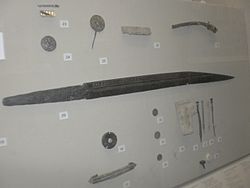
The Seax of Beagnoth, also known as the Thames scramasax, is a 10th-century Anglo-Saxon seax (single-edged knife). It was found in the inland estuary of the Thames in 1857, and is now at the British Museum in London. It is a prestige weapon, decorated with elaborate patterns of inlaid copper, brass and silver wire. On one side of the blade is the only known complete inscription of the twenty-eight letter Anglo-Saxon runic alphabet, as well as the name "Beagnoth" in runic letters. It is thought that the runic alphabet had a magical function, and that the name Beagnoth is that of either the owner of the weapon or the smith who forged it. Although many Anglo-Saxon and Viking swords and knives have inscriptions in the Latin alphabet on their blades, or have runic inscriptions on the hilt or scabbard, the Seax of Beagnoth is one of only a handful of finds with a runic inscription on its blade.
Henry J. Briggs, a labourer, found the seax in the inland estuary of the Thames near Battersea in early 1857. Briggs sold it to the British Museum, and on 21 May 1857 it was exhibited at the Society of Antiquaries of London by Augustus Wollaston Franks (an antiquary who worked at the Antiquities Department of the British Museum), when it was described as "resembling the Scramasax of the Franks, of which examples are very rare in England; and bears a row of runic characters inlaid in gold". Since then the weapon has usually been called the Thames scramasax; but the term scramasax (from Old Frankish *scrâmasahs) is only attested once, in the History of the Franks by Gregory of Tours, and the meaning of the scrama- element is uncertain, so recent scholarship prefers the term long seax or long sax for this type of weapon.
The seax is an iron knife with a single cutting edge and a long tapering point. It is 72.1 cm (28.4 in) in length, of which the tang is 17 cm (6.7 in) and the blade is 55.1 cm (21.7 in). The tang would have been attached to a handle, which has not survived.
The blade is a prestige weapon, decorated on both faces with geometric patterns created by hammering strips of twisted copper, brass and silver wire into grooves cut into the blade, as well as with inlaid triangles and lozenges of copper, brass and silver. The technique of inlaying wire to create decorative patterns and inscriptions was widely used on Germanic and Anglo-Saxon seaxes and spear heads from the 9th and 10th centuries, and is also found on Viking swords from about the same period.
On both sides of the seax is a deep median groove running the length of the blade, above which is a long rectangular panel bordered at the top and bottom with inlaid copper strips. The panel on one side of the seax is filled with a lozenge pattern in silver and copper, which may have been meant to simulate pattern welding. The panel on the other side bears two runic inscriptions inlaid with brass and silver wire. The inscription on the left comprises the twenty-eight letters of the Anglo-Saxon runic alphabet or futhorc. The inscription on the right, separated from the other by a herringbone design in silver and brass, is the male personal name Beagnoþ or Beagnoth ᛒᛠᚷᚾᚩᚦ, which is assumed to be that of the maker or original owner of the blade.
The inscription of the futhorc is as follows:
There are a number of unusual features about this inscription. Firstly, the order of the runes does not exactly match the traditional sequence of the earlier twenty-four letter runic alphabet or that of the twenty-eight letter Anglo-Saxon futhorc preserved in the Vienna Codex. The first nineteen runes are in the correct order, but the next four (20–23: ᛝᛞᛚᛗ) are in a confused sequence which does not match that found in any other source. The last two runes (27–28: ᚣᛠ) are swapped with regard to their order in the Vienna Codex, but as these are later additions to the original twenty-four letter runic alphabet their order may have been less stable, especially as the last letter ᛠ is very rare in Anglo-Saxon inscriptions (elsewhere it occurs in the name Jɨslheard ᛄᛇᛋᛚᚻᛠᚱᛞ on a stone found in Dover).
Seax of Beagnoth
51°29′03″N 0°08′38″W / 51.484202°N 0.143874°W
The Seax of Beagnoth, also known as the Thames scramasax, is a 10th-century Anglo-Saxon seax (single-edged knife). It was found in the inland estuary of the Thames in 1857, and is now at the British Museum in London. It is a prestige weapon, decorated with elaborate patterns of inlaid copper, brass and silver wire. On one side of the blade is the only known complete inscription of the twenty-eight letter Anglo-Saxon runic alphabet, as well as the name "Beagnoth" in runic letters. It is thought that the runic alphabet had a magical function, and that the name Beagnoth is that of either the owner of the weapon or the smith who forged it. Although many Anglo-Saxon and Viking swords and knives have inscriptions in the Latin alphabet on their blades, or have runic inscriptions on the hilt or scabbard, the Seax of Beagnoth is one of only a handful of finds with a runic inscription on its blade.
Henry J. Briggs, a labourer, found the seax in the inland estuary of the Thames near Battersea in early 1857. Briggs sold it to the British Museum, and on 21 May 1857 it was exhibited at the Society of Antiquaries of London by Augustus Wollaston Franks (an antiquary who worked at the Antiquities Department of the British Museum), when it was described as "resembling the Scramasax of the Franks, of which examples are very rare in England; and bears a row of runic characters inlaid in gold". Since then the weapon has usually been called the Thames scramasax; but the term scramasax (from Old Frankish *scrâmasahs) is only attested once, in the History of the Franks by Gregory of Tours, and the meaning of the scrama- element is uncertain, so recent scholarship prefers the term long seax or long sax for this type of weapon.
The seax is an iron knife with a single cutting edge and a long tapering point. It is 72.1 cm (28.4 in) in length, of which the tang is 17 cm (6.7 in) and the blade is 55.1 cm (21.7 in). The tang would have been attached to a handle, which has not survived.
The blade is a prestige weapon, decorated on both faces with geometric patterns created by hammering strips of twisted copper, brass and silver wire into grooves cut into the blade, as well as with inlaid triangles and lozenges of copper, brass and silver. The technique of inlaying wire to create decorative patterns and inscriptions was widely used on Germanic and Anglo-Saxon seaxes and spear heads from the 9th and 10th centuries, and is also found on Viking swords from about the same period.
On both sides of the seax is a deep median groove running the length of the blade, above which is a long rectangular panel bordered at the top and bottom with inlaid copper strips. The panel on one side of the seax is filled with a lozenge pattern in silver and copper, which may have been meant to simulate pattern welding. The panel on the other side bears two runic inscriptions inlaid with brass and silver wire. The inscription on the left comprises the twenty-eight letters of the Anglo-Saxon runic alphabet or futhorc. The inscription on the right, separated from the other by a herringbone design in silver and brass, is the male personal name Beagnoþ or Beagnoth ᛒᛠᚷᚾᚩᚦ, which is assumed to be that of the maker or original owner of the blade.
The inscription of the futhorc is as follows:
There are a number of unusual features about this inscription. Firstly, the order of the runes does not exactly match the traditional sequence of the earlier twenty-four letter runic alphabet or that of the twenty-eight letter Anglo-Saxon futhorc preserved in the Vienna Codex. The first nineteen runes are in the correct order, but the next four (20–23: ᛝᛞᛚᛗ) are in a confused sequence which does not match that found in any other source. The last two runes (27–28: ᚣᛠ) are swapped with regard to their order in the Vienna Codex, but as these are later additions to the original twenty-four letter runic alphabet their order may have been less stable, especially as the last letter ᛠ is very rare in Anglo-Saxon inscriptions (elsewhere it occurs in the name Jɨslheard ᛄᛇᛋᛚᚻᛠᚱᛞ on a stone found in Dover).
Recent media
Recent media