Hubbry Logo
search
logo
2198189

Secret sharing

logo
Community Hub0 Subscribers
Read side by side
from Wikipedia
A piece of visual cryptography: When two component images (showing the letters A and B) are brought together, they reveal the secret letter S. The secret cannot be determined from a single component alone.

Secret sharing (also called secret splitting) refers to methods for distributing a secret among a group, in such a way that no individual holds any intelligible information about the secret, but when a sufficient number of individuals combine their 'shares', the secret may be reconstructed. Whereas insecure secret sharing allows an attacker to gain more information with each share, secure secret sharing is 'all or nothing' (where 'all' means the necessary number of shares).

In one type of secret sharing scheme there is one dealer and n players. The dealer gives a share of the secret to the players, but only when specific conditions are fulfilled will the players be able to reconstruct the secret from their shares. The dealer accomplishes this by giving each player a share in such a way that any group of t (for threshold) or more players can together reconstruct the secret but no group of fewer than t players can. Such a system is called a (t, n)-threshold scheme (sometimes it is written as an (n, t)-threshold scheme).

Secret sharing was invented independently by Adi Shamir[1] and George Blakley[2] in 1979.

Importance

[edit]

Secret sharing schemes are ideal for storing information that is highly sensitive and highly important. Examples include: encryption keys, missile launch codes, and numbered bank accounts. Each of these pieces of information must be kept highly confidential, as their exposure could be disastrous; however, it is also critical that they should not be lost. Traditional methods for encryption are ill-suited for simultaneously achieving high levels of confidentiality and reliability. This is because when storing the encryption key, one must choose between keeping a single copy of the key in one location for maximum secrecy, or keeping multiple copies of the key in different locations for greater reliability. Increasing reliability of the key by storing multiple copies lowers confidentiality by creating additional attack vectors; there are more opportunities for a copy to fall into the wrong hands. Secret sharing schemes address this problem, and allow arbitrarily high levels of confidentiality and reliability to be achieved.[3]

Secret sharing also allows the distributor of the secret to trust a group 'in aggregate'. Traditionally, giving a secret to a group for safekeeping would require that the distributor completely trust all members of the group. Secret sharing schemes allow the distributor to securely store the secret with the group even if not all members can be trusted all the time. So long as the number of traitors is never more than the critical number needed to reconstruct the secret, the secret is safe.

Secret sharing schemes are important in cloud computing environments. Thus a key can be distributed over many servers by a threshold secret sharing mechanism. The key is then reconstructed when needed.

Secret sharing has also been suggested[by whom?] for sensor networks where the links are liable to be tapped, by sending the data in shares which makes the task of the eavesdropper harder.[citation needed] The security in such environments can be made greater by continuous changing[how?] of the way the shares are constructed.[citation needed]

"Secure" versus "insecure" secret sharing

[edit]

A secure secret sharing scheme distributes shares so that anyone with fewer than t shares has no more information about the secret than someone with 0 shares.

Consider for example the secret sharing scheme in which the secret phrase "password" is divided into the shares "pa––––––", "––ss––––", "––––wo––", and "––––––rd". A person with 0 shares knows only that the password consists of eight letters, and thus would have to guess the password from 268 = 208 billion possible combinations. A person with one share, however, would have to guess only the six letters, from 266 = 308 million combinations, and so on as more persons collude. Consequently, this system is not a "secure" secret sharing scheme, because a player with fewer than t secret shares is able to reduce the problem of obtaining the inner secret without first needing to obtain all of the necessary shares.

In contrast, consider the secret sharing scheme where X is the secret to be shared, Pi are public asymmetric encryption keys and Qi their corresponding private keys. Each player J is provided with {P1(P2(...(PN(X)))), Qj}. In this scheme, any player with private key 1 can remove the outer layer of encryption, a player with keys 1 and 2 can remove the first and second layer, and so on. A player with fewer than N keys can never fully reach the secret X without first needing to decrypt a public-key-encrypted blob for which he does not have the corresponding private key – a problem that is currently believed to be computationally infeasible. Additionally we can see that any user with all N private keys is able to decrypt all of the outer layers to obtain X, the secret, and consequently this system is a secure secret distribution system.

Limitations

[edit]

Several secret-sharing schemes are said to be information-theoretically secure and can be proven to be so, while others give up this unconditional security for improved efficiency while maintaining enough security to be considered as secure as other common cryptographic primitives. For example, they might allow secrets to be protected by shares with entropy of 128 bits each, since each share would be considered enough to stymie any conceivable present-day adversary, requiring a brute force attack of average size 2127.

Common to all unconditionally secure secret sharing schemes, there are limitations:[citation needed]

  • Each share of the secret must be at least as large as the secret itself. This result is based in information theory, but can be understood intuitively. Given t − 1 shares, no information whatsoever can be determined about the secret. Thus, the final share must contain as much information as the secret itself. There is sometimes a workaround for this limitation by first compressing the secret before sharing it, but this is often not possible because many secrets (keys for example) look like high-quality random data and thus are hard to compress.
  • All secret-sharing schemes use random bits for constructing the shares.[citation needed] To distribute a one-bit secret shares with a threshold of t shares, t − 1 random bits are needed.[citation needed] To distribute a secret of b bits, entropy of (t − 1) × b bits is necessary.[citation needed]

Trivial secret sharing

[edit]

Note: n is the total number of 'players', among whom the shares are distributed, and t is the minimum number of players required to reveal the secret.

t = 1

[edit]

t = 1 secret sharing is trivial. The secret can simply be distributed to all n participants.

t = n

[edit]

There are several (t, n) secret-sharing schemes for t = n, when all shares are necessary to recover the secret:

  1. Encode the secret as a binary number s of any length. For each player i, where i is one fewer than the total number of players, give a random binary number pi of the same length as s. To the player without a share, give the share calculated as pn = sp1p2 ⊕ ... ⊕ pn−1, where ⊕ denotes bitwise exclusive or. The secret is the bitwise exclusive-or of all the players' numbers (pi, for 1 ≤ in).
  2. Instead, (1) can be performed using the binary operation in any group. For example, take the cyclic group of integers with addition modulo 232, which corresponds to 32-bit integers with addition defined with the binary overflow being discarded. The secret s can be partitioned into a vector of M 32-bit integers, which we call vsecret. Then (n − 1) of the players are each given a vector of M 32-bit integers that is drawn independently from a uniform probability distribution, with player i receiving vi. The remaining player is given vn = vsecretv1v2 − ... − vn−1. The secret vector can then be recovered by summing across all the players' vectors.

1 < t < n

[edit]

The difficulty[clarification needed] lies in creating schemes that are still secure, but do not require all n shares.

When space efficiency is not a concern, trivial t = n schemes can be used to reveal a secret to any desired subsets of the players simply by applying the scheme for each subset. For example, to reveal a secret s to any two of the three players Alice, Bob and Carol, create three () different t = n = 2 secret shares for s, giving the three sets of two shares to Alice and Bob, Alice and Carol, and Bob and Carol.

t belonging to any desired subset of {1, 2, ..., n}

[edit]

For example, imagine that the board of directors of a company would like to protect their secret formula. The president of the company should be able to access the formula when needed, but in an emergency any 3 of the 12 board members would be able to unlock the secret formula together. One of the ways this can be accomplished is by a secret-sharing scheme with t = 3 and n = 15, where 3 shares are given to the president, and one share is given to each board member.

Efficient secret sharing

[edit]

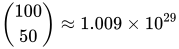
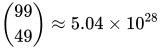
The trivial approach quickly becomes impractical as the number of subsets increases, for example when revealing a secret to any 50 of 100 players, which would require schemes to be created and each player to maintain distinct sets of shares for each scheme. In the worst case, the increase is exponential. This has led to the search for schemes that allow secrets to be shared efficiently with a threshold of players.
Shamir's scheme

[edit]

In this scheme, any t out of n shares may be used to recover the secret. The system relies on the idea that one can construct a unique polynomial of degree t − 1, such that each of the t points lies on the polynomial. It takes two points to define a straight line, three points to fully define a quadratic, four points to define a cubic curve, and so on. That is, it takes t points to define a polynomial of degree t − 1. The method is to create a polynomial of degree t − 1 with the secret as the first coefficient and the remaining coefficients picked at random. Next find n points on the curve and give one to each of the players. When at least t out of the n players reveal their points, there is sufficient information to fit a (t − 1)th degree polynomial to them, the first coefficient being the secret.

Blakley's scheme

[edit]

Two nonparallel lines in the same plane intersect at exactly one point. Three nonparallel planes in space intersect at exactly one point. More generally, any n nonparallel (n − 1)-dimensional hyperplanes intersect at a specific point. The secret may be encoded as any single coordinate of the point of intersection. If the secret is encoded using all the coordinates, even if they are random, then an insider (someone in possession of one or more of the (n − 1)-dimensional hyperplanes) gains information about the secret since he knows it must lie on his plane. If an insider can gain any more knowledge about the secret than an outsider can, then the system no longer has information theoretic security. If only one of the n coordinates is used, then the insider knows no more than an outsider (i.e., that the secret must lie on the x-axis for a 2-dimensional system). Each player is given enough information to define a hyperplane; the secret is recovered by calculating the planes' point of intersection and then taking a specified coordinate of that intersection.

One share Two shares intersecting on a line Three shares intersecting at a point
Blakley's scheme in three dimensions: each share is a plane, and the secret is the point at which three shares intersect. Two shares are insufficient to determine the secret, although they do provide enough information to narrow it down to the line where both planes intersect.

Blakley's scheme is less space-efficient than Shamir's; while Shamir's shares are each only as large as the original secret, Blakley's shares are t times larger, where t is the threshold number of players. Blakley's scheme can be tightened by adding restrictions on which planes are usable as shares. The resulting scheme is equivalent to Shamir's polynomial system.

Using the Chinese remainder theorem

[edit]

The Chinese remainder theorem can also be used in secret sharing, for it provides us with a method to uniquely determine a number S modulo k many pairwise coprime integers , given that . There are two secret sharing schemes that make use of the Chinese remainder theorem, Mignotte's and Asmuth-Bloom's Schemes. They are threshold secret sharing schemes, in which the shares are generated by reduction modulo the integers , and the secret is recovered by essentially solving the system of congruences using the Chinese remainder theorem.

Proactive secret sharing

[edit]

If the players store their shares on insecure computer servers, an attacker could crack in and steal the shares. If it is not practical to change the secret, the uncompromised (Shamir-style) shares can be renewed. The dealer generates a new random polynomial with constant term zero and calculates for each remaining player a new ordered pair, where the x-coordinates of the old and new pairs are the same. Each player then adds the old and new y-coordinates to each other and keeps the result as the new y-coordinate of the secret.

All of the non-updated shares the attacker accumulated become useless. An attacker can only recover the secret if he can find enough other non-updated shares to reach the threshold. This situation should not happen because the players deleted their old shares. Additionally, an attacker cannot recover any information about the original secret from the update files because they contain only random information.

The dealer can change the threshold number while distributing updates, but must always remain vigilant of players keeping expired shares.

Verifiable secret sharing

[edit]

A player might lie about his own share to gain access to other shares. A verifiable secret sharing (VSS) scheme allows players to be certain that no other players are lying about the contents of their shares, up to a reasonable probability of error. Such schemes cannot be computed conventionally; the players must collectively add and multiply numbers without any individual's knowing what exactly is being added and multiplied. Tal Rabin and Michael Ben-Or devised a multiparty computing (MPC) system that allows players to detect dishonesty on the part of the dealer or on part of up to one third of the threshold number of players, even if those players are coordinated by an "adaptive" attacker who can change strategies in realtime depending on what information has been revealed.

Computationally secure secret sharing

[edit]

The disadvantage of unconditionally secure secret sharing schemes is that the storage and transmission of the shares requires an amount of storage and bandwidth resources equivalent to the size of the secret times the number of shares. If the size of the secret were significant, say 1 GB, and the number of shares were 10, then 10 GB of data must be stored by the shareholders. Alternate techniques have been proposed for greatly increasing the efficiency of secret sharing schemes, by giving up the requirement of unconditional security.

One of these techniques, known as secret sharing made short,[4] combines Rabin's information dispersal algorithm[5] (IDA) with Shamir's secret sharing. Data is first encrypted with a randomly generated key, using a symmetric encryption algorithm. Next this data is split into N pieces using Rabin's IDA. This IDA is configured with a threshold, in a manner similar to secret sharing schemes, but unlike secret sharing schemes the size of the resulting data grows by a factor of (number of fragments / threshold). For example, if the threshold were 10, and the number of IDA-produced fragments were 15, the total size of all the fragments would be (15/10) or 1.5 times the size of the original input. In this case, this scheme is 10 times more efficient than if Shamir's scheme had been applied directly on the data. The final step in secret sharing made short is to use Shamir secret sharing to produce shares of the randomly generated symmetric key (which is typically on the order of 16–32 bytes) and then give one share and one fragment to each shareholder.

A related approach, known as AONT-RS,[6] applies an All-or-nothing transform to the data as a pre-processing step to an IDA. The All-or-nothing transform guarantees that any number of shares less than the threshold is insufficient to decrypt the data.

Multi-secret and space efficient (batched) secret sharing

[edit]

An information-theoretically secure k-of-n secret-sharing scheme generates n shares, each of size at least that of the secret itself, leading to the total required storage being at least n-fold larger than the secret. In multi-secret sharing designed by Matthew K. Franklin and Moti Yung,[7] multiple points of the polynomial host secrets; the method was found useful in numerous applications from coding to multi-party computations. In space efficient secret sharing, devised by Abhishek Parakh and Subhash Kak, each share is roughly the size of the secret divided by k − 1.[8]

This scheme makes use of repeated polynomial interpolation and has potential applications in secure information dispersal on the Web and in sensor networks. This method is based on data partitioning involving the roots of a polynomial in finite field.[9] Some vulnerabilities of related space efficient secret sharing schemes were pointed out later.[10] They show that a scheme based on interpolation method cannot be used to implement a (k, n) scheme when the k secrets to be distributed are inherently generated from a polynomial of degree less than k − 1, and the scheme does not work if all of the secrets to be shared are the same, etc.[11]

Other uses and applications

[edit]

A secret-sharing scheme can secure a secret over multiple servers and remain recoverable despite multiple server failures. The dealer may act as several distinct participants, distributing the shares among the participants. Each share may be stored on a different server, but the dealer can recover the secret even if several servers break down as long as they can recover at least t shares; however, crackers that break into one server would still not know the secret as long as fewer than t shares are stored on each server.

This is one of the major concepts behind the Vanish computer project at the University of Washington, where a random key is used to encrypt data, and the key is distributed as a secret across several nodes in a P2P network. In order to decrypt the message, at least t nodes on the network must be accessible; the principle for this particular project being that the number of secret-sharing nodes on the network will decrease naturally over time, therefore causing the secret to eventually vanish. However, the network is vulnerable to a Sybil attack, thus making Vanish insecure.[12]

Any shareholder who ever has enough information to decrypt the content at any point is able to take and store a copy of X. Consequently, although tools and techniques such as Vanish can make data irrecoverable within their own system after a time, it is not possible to force the deletion of data once a malicious user has seen it. This is one of the leading conundrums of digital rights management.

A dealer could send t shares, all of which are necessary to recover the original secret, to a single recipient. An attacker would have to intercept all t shares to recover the secret, a task which is more difficult than intercepting a single file, especially if the shares are sent using different media (e.g. some over the Internet, some mailed on CDs).

For large secrets, it may be more efficient to encrypt the secret and then distribute the key using secret sharing.

Secret sharing is an important primitive in several protocols for secure multiparty computation. Secret sharing can also be used for user authentication in a system.[13]

See also

[edit]

References

[edit]
[edit]
Revisions and contributorsEdit on WikipediaRead on Wikipedia
from Grokipedia
Secret sharing is a cryptographic method for distributing a secret among a group of participants, each of whom receives a share, such that the secret can be reconstructed only by combining a predefined minimum number of shares—known as the threshold—while any smaller number of shares provides no information about the secret.[1][2] The concept was independently introduced in 1979 by Adi Shamir and George Blakley as a solution to the problem of secure key distribution without relying on a single trusted party.[1] Shamir's scheme, often called Shamir's Secret Sharing, employs polynomial interpolation over a finite field: a random polynomial of degree k1k-1 is constructed with the secret as the constant term, and shares are points on this polynomial evaluated at distinct integers, allowing reconstruction via Lagrange interpolation when kk points are available.[1] In contrast, Blakley's geometric approach represents the secret as a point in a kk-dimensional vector space, with each share being a hyperplane passing through that point; the secret is recovered at the unique intersection of any kk such hyperplanes.[3] In a general (k,n)(k, n)-threshold secret sharing scheme, the secret is divided into nn shares distributed to nn participants, and any subset of at least kk shares suffices to reconstruct it, while subsets of size less than kk yield no information due to the scheme's perfect secrecy properties.[1][2] These schemes can be extended beyond thresholds to arbitrary access structures, where specific authorized coalitions can reconstruct the secret, often using monotone span programs or linear algebra over fields.[2] Secret sharing forms a foundational primitive in modern cryptography, enabling applications such as secure multi-party computation, threshold signatures and decryption, distributed storage systems, and blockchain consensus mechanisms by mitigating single points of failure and enhancing resilience against adversarial compromise.[2] Variants include verifiable secret sharing to detect malicious dealers or participants, proactive schemes for share refreshment over time, and quantum-resistant constructions based on lattice problems.[2]

Fundamentals

Definition and Basic Concepts

Secret sharing is a cryptographic method for distributing a secret among a group of participants such that the secret can only be reconstructed by authorized subsets of those participants, while unauthorized subsets gain no information about it. Formally, in a secret sharing scheme, a dealer distributes shares of a secret $ S $ to $ n $ participants, ensuring that only qualified subsets can recover $ S $, and any unqualified subset learns nothing about $ S $. This concept was independently introduced in 1979 by Adi Shamir and George Blakley as a solution to securely safeguarding sensitive information like cryptographic keys.[4][5] A prominent form is threshold secret sharing, parameterized by integers $ (t, n) $ with $ 1 \leq t \leq n $, where any group of at least $ t $ participants can reconstruct the secret $ S $, but any group of fewer than $ t $ participants obtains no information about it. The dealer generates the shares during a share distribution phase, assigning one unique share to each of the $ n $ participants, who are assumed to hold their shares privately. This setup ensures perfect secrecy for unauthorized coalitions in information-theoretic schemes, meaning security holds unconditionally against unbounded adversaries. More generally, secret sharing can be defined over arbitrary access structures, which specify the qualified subsets authorized to reconstruct the secret. An access structure is typically monotone, meaning that if a subset is qualified, then any superset of it is also qualified; the minimal qualified subsets, known as minimal authorized sets, fully characterize the structure. In such schemes, shares are distributed so that participants in any qualified set can pool their shares to recover $ S $, while those in unauthorized sets cannot. Basic notation in secret sharing often assumes the secret $ S $ is an element from a finite field $ \mathbb{F} $, with shares represented as points on a polynomial or vectors in a vector space over $ \mathbb{F} $. Schemes are classified by security type: information-theoretic (or perfect) security, where unauthorized sets have zero information about $ S $ regardless of computational power, versus computational security, where security relies on the hardness of computational problems and unauthorized sets have negligible information under polynomial-time attacks.

Importance and Motivations

Secret sharing schemes address critical needs in distributed systems where a single point of failure or compromise could lead to catastrophic loss of confidentiality, by distributing a secret among multiple parties such that reconstruction requires collaboration from a predefined threshold of participants.[6] This motivation stems from the desire to mitigate risks associated with collusion or unauthorized access in multi-party environments, such as key escrow systems where no single entity holds full control over sensitive cryptographic keys.[7] Originally proposed in 1979 by Adi Shamir and George Blakley independently, these schemes were designed to protect high-stakes secrets from partial disclosures, ensuring that even if some shares are compromised, the secret remains secure.[8] In practice, secret sharing underpins threshold cryptography, enabling operations like multi-signature schemes where a group must collectively authorize actions, such as in secure multiparty computation protocols that tolerate faulty or malicious participants up to a certain threshold.[9] It enhances data protection in cloud environments by fragmenting sensitive information across distributed storage, preventing any single provider from accessing the full secret and thus improving resilience against breaches.[10] Unlike simple replication, which duplicates the secret and exposes it fully upon any compromise, secret sharing maintains confidentiality by rendering individual shares meaningless without the required quorum, thereby balancing availability with security in fault-tolerant systems.[11] Real-world applications illustrate its versatility, for instance in conceptual designs for the safeguarding of nuclear launch codes, where shares are distributed among authorized personnel to prevent unilateral action.[12] In corporate settings, it supports quorum-based decision-making for confidential board actions, ensuring that collective agreement is needed without risking exposure from isolated leaks.[13] Blockchain consensus mechanisms leverage secret sharing for threshold signatures in decentralized networks, enhancing privacy and resistance to node failures in protocols like those used for cryptocurrency wallets.[14] The evolution of secret sharing reflects its integration into modern standards, from early cryptographic primitives to its formal inclusion in ISO/IEC 11889 for Trusted Platform Modules (TPMs), which use it for secure key management and attestation in hardware-based security.[15] This standardization underscores its role in building reliable systems for Byzantine fault tolerance, where it helps maintain agreement among distributed parties despite potential adversities.[16]

Security Classifications

Secure Versus Insecure Schemes

Secret sharing schemes are classified as secure or insecure based on the strength of their security guarantees against adversaries. Secure schemes, often termed perfect or information-theoretic, ensure that any unauthorized set of at most t-1 participants reveals no information about the secret S, even if the adversary possesses unlimited computational power. This absolute privacy is formalized using entropy measures, where the conditional entropy H(S | shares of unauthorized set) equals the entropy H(S), meaning the shares provide zero mutual information about S.[17] Such schemes satisfy two core criteria: the reconstruction property, where any qualified set of at least t participants can exactly recover S, and the privacy property, where the distribution of shares for unauthorized sets is independent of S.[1][10] In contrast, insecure schemes offer weaker protections, typically relying on computational or statistical assumptions rather than unconditional security. Computational secret sharing provides security only against polynomial-time adversaries, where distinguishing the secret from random is computationally infeasible, often based on hardness assumptions like pseudorandom functions or encryption schemes.[18] Statistical security allows negligible leakage, measured by small statistical distance or epsilon-approximate privacy, where unauthorized sets gain only a tiny amount of information about S with overwhelming probability.[10] These models are considered insecure in the information-theoretic sense because a sufficiently powerful adversary could potentially extract the secret. Adversary models further delineate security levels in secret sharing. Passive adversaries, also known as honest-but-curious, eavesdrop on or collude with up to t-1 participants but follow the protocol without tampering, aiming solely to infer information from observed shares.[10] Active adversaries, conversely, may maliciously alter shares or deviate from the protocol to disrupt reconstruction or inject faulty information, requiring additional mechanisms like verification for robustness. Many secure schemes assume an honest majority, where more than t participants remain uncorrupted, ensuring that qualified sets can still reconstruct S despite adversarial interference.[19] Trivial examples illustrate insecure schemes lacking proper obfuscation. In direct distribution, the secret S is simply replicated and given to all n participants without encoding, violating the privacy property as any single participant (an unauthorized set for t > 1) immediately knows S.[1] Alternatively, distributing S only to one participant fails the reconstruction property, as groups of t > 1 cannot recover it, rendering the scheme insecure for threshold access. These cases highlight how basic schemes without mathematical randomization expose S to unauthorized access or prevent legitimate recovery.

Inherent Limitations

In information-theoretically secure secret sharing schemes, a fundamental constraint is that the size of each share must be at least as large as the size of the secret itself. This lower bound arises from the perfect privacy requirement, where any unauthorized set of shares reveals no information about the secret, implying that the entropy of an individual share cannot be smaller than that of the secret. Consequently, schemes achieving this bound, such as those based on polynomials over finite fields, are considered ideal in terms of share efficiency. Reconstruction in threshold secret sharing requires collaboration among at least t participants out of n, which introduces significant communication overhead. In typical models where shares are elements of a finite field of size greater than n to ensure distinct evaluation points, each share has size O(log n) bits. Thus, when t parties transmit their shares to a reconstructor, the total communication cost is O(t log n) bits.[20] This cost scales linearly with the threshold t, making high-threshold schemes particularly burdensome in distributed settings with limited bandwidth.[20] A core limitation of perfect threshold secret sharing is its binary nature: authorized sets recover the full secret, while unauthorized sets obtain no information whatsoever, precluding partial or graded reconstruction without additional mechanisms. This all-or-nothing property ensures strong privacy but limits flexibility in applications requiring incremental access or hierarchical information release. Secret sharing schemes are inherently vulnerable to share loss or unavailability, as the secret becomes irrecoverable if more than n - t shares are lost. In a (t, n)-threshold scheme, this tolerance threshold means that even a small number of failures or compromises beyond n - t can render the system useless, highlighting the need for redundancy in deployment. For general access structures beyond simple thresholds, realizing arbitrary monotone collections of authorized sets often leads to exponential growth in share sizes. The seminal construction decomposes the access structure into its minimal authorized subsets and applies threshold sharing to each, resulting in shares whose size is proportional to the number of such subsets containing a given participant, which can be up to 2^{n-1} in the worst case.[21] Moreover, optimizing share sizes or finding minimal representations for these structures, such as through linear span programs, is NP-hard in general.[7] This scalability issue restricts the practical use of general schemes to access structures with limited complexity.[21]

Trivial Schemes

Extreme Threshold Cases (t=1 and t=n)

In the extreme threshold case where $ t = 1 $ in a (t,n)(t, n)-threshold secret sharing scheme, the secret $ S $ is simply replicated and distributed identically to all $ n $ participants, such that any single participant possesses the full secret and can reconstruct it unilaterally.[4] This approach requires no encoding or computational overhead, as each share is exactly $ S $, making it mathematically trivial with a constant "polynomial" of degree 0 in generalized schemes like Shamir's. However, it offers no privacy protection, as even one compromised participant reveals the entire secret, rendering it insecure against individual breaches but useful in scenarios demanding immediate solo access or broadcast distribution in fully trusted groups.[4] At the opposite extreme, where $ t = n $, the scheme ensures that only the complete set of all $ n $ participants can reconstruct the secret, while any subset of $ n-1 $ or fewer reveals no information about $ S $. A trivial realization uses additive (or XOR) sharing: the dealer selects $ n-1 $ random values $ s_1, s_2, \dots, s_{n-1} $ from the appropriate domain (e.g., a finite field or bit strings for XOR), computes $ s_n = S \oplus (s_1 \oplus \dots \oplus s_{n-1}) $ (or equivalently for addition), and distributes $ s_i $ to participant $ i $. Reconstruction involves combining all shares via XOR (or summation modulo the field size), yielding $ S $. This provides perfect privacy for subsets, as each individual share is uniformly random and independent of $ S $, but it lacks collusion resistance beyond $ n-1 $ and offers redundancy only through full participation. Both cases achieve threshold reconstruction by design but highlight fundamental trade-offs in secret sharing: the $ t=1 $ variant prioritizes accessibility at the cost of all privacy, suitable for non-adversarial distribution like key broadcasts in small trusted teams, while $ t=n $ emphasizes maximal security against defection, ideal for consensus-driven applications such as unanimous board approvals where no partial group should access sensitive data. Their simplicity—no advanced cryptography or polynomial interpolation needed—makes them baseline implementations, though they fail to balance privacy and efficiency for intermediate thresholds.[4]

Intermediate Threshold Schemes (1 < t < n)

In intermediate threshold schemes, where 1 < t < n, the goal is to distribute a secret S among n parties such that any group of t parties can reconstruct S, while any group of t-1 parties obtains no information about S. A trivial method to achieve this uses a combinatorial construction based on the minimal authorized sets, which are all possible t-subsets of the n parties. For each such t-subset, the dealer creates an independent (t, t)-threshold sharing of S and distributes the shares only to the parties in that subset. This ensures that only complete t-subsets can reconstruct S from their dedicated sharing, while smaller groups lack sufficient pieces from every instance, and the independence of the sharings provides perfect information-theoretic security. A simple way to implement the (t, t)-sharing for each subset is additive sharing modulo a prime p (with p > n \cdot |S| to avoid wrap-around issues in practice). The dealer selects t-1 random values r_1, \dots, r_{t-1} \in {0, \dots, p-1}, computes r_t = S - (r_1 + \dots + r_{t-1}) \mod p, and assigns r_i to the i-th party in the subset. The t parties in the subset can then sum their r_i values modulo p to recover S. However, this additive approach in isolation is insecure for the full (t, n)-threshold if applied naively to all n parties (e.g., splitting S into n random addends summing to S mod p), as it only enforces reconstruction with all n shares; partial sums from fewer than n reveal no information but fail to allow reconstruction with just t shares, violating the threshold requirement. The combinatorial repetition amplifies this to support any t-subset, but at a severe cost: each party belongs to exactly \binom{n-1}{t-1} t-subsets and thus receives \binom{n-1}{t-1} additive shares (one per relevant instance), making the total share size per party \binom{n-1}{t-1} times the size of S. For intermediate t (e.g., t \approx n/2), this binomial coefficient grows exponentially as \Theta(2^n / \sqrt{\pi n / 2}) by Stirling's approximation, rendering the scheme computationally and storage-intensive for even moderate n (e.g., for n=20, t=10, \binom{19}{9} \approx 92{,}000). Unauthorized sets of t-1 parties cannot reconstruct any instance fully, preserving security, but the exponential overhead makes the approach suitable only for tiny n or theoretical analysis.[22] These trivial methods are occasionally useful in low-security, small-scale contexts, such as simple data backups where n is small and exponential growth is tolerable, but they offer no protection against collusion beyond the threshold and lack randomization against adaptive adversaries without additional layers. The inherent inefficiencies—large share sizes, high distribution complexity, and vulnerability to partial information leakage in non-modular variants—highlight the necessity for non-trivial encodings to enable practical deployment in cryptographic applications.[22]

General Access Structures

In secret sharing, general access structures provide a framework beyond threshold schemes, enabling arbitrary collections of participant subsets to qualify for secret reconstruction while maintaining monotonicity. Formally, an access structure Γ2P\Gamma \subseteq 2^P over a participant set P={P1,,Pn}P = \{P_1, \dots, P_n\} is a monotone collection of non-empty subsets, where a subset BPB \subseteq P is qualified if BΓB \in \Gamma and unauthorized otherwise; monotonicity requires that if BΓB \in \Gamma and BCPB \subseteq C \subseteq P, then CΓC \in \Gamma. The minimal qualified sets, denoted minΓ\min \Gamma, are the members of Γ\Gamma with no proper subsets in Γ\Gamma, serving as the foundational building blocks for the structure.[23] A trivial realization of a general access structure can be attempted by identifying the minimal qualified sets and distributing the secret directly (i.e., fully) to all participants within each such set. This ensures that any qualified subset, which contains at least one minimal qualified set, can access the secret. However, this approach is insecure across the overall structure, as individual participants or unauthorized subsets intersecting multiple minimal sets receive the complete secret, enabling reconstruction by sets smaller than required by Γ\Gamma. Key challenges include the combinatorial explosion in the number of minimal qualified sets, which can reach up to (nn/2)2n/πn/2\binom{n}{\lfloor n/2 \rfloor} \approx 2^n / \sqrt{\pi n/2} for certain structures, necessitating shares that simultaneously enforce privacy and correctness for exponentially many subset conditions.[23] For instance, consider a key predistribution scenario where the qualified sets are those including a designated leader (e.g., the president) and at least two out of three supporting roles (advisors); here, the minimal qualified sets are the three-element combinations {president,advisori,advisorj}\{\text{president}, \text{advisor}_i, \text{advisor}_j\} for 1i<j31 \leq i < j \leq 3. This structure cannot be captured by a single threshold scheme but highlights the need for tailored distribution. Limitations of such trivial extensions include severe inefficiency in share size and computation without more sophisticated methods, often leading practical implementations to approximate the structure as a union of multiple threshold schemes, though this increases overhead proportionally to the number of minimal sets.[24]

Core Efficient Schemes

Shamir's Polynomial-Based Scheme

Shamir's polynomial-based scheme, introduced in 1979, is a foundational threshold secret sharing method that enables the distribution of a secret SS among nn participants such that any tt or more shares can reconstruct SS, while any fewer than tt shares reveal no information about SS.[4] The scheme leverages polynomial interpolation over a finite field, ensuring perfect security where unauthorized sets gain zero knowledge of the secret.[4] In the share generation phase, the dealer selects a random polynomial f(x)f(x) of degree at most t1t-1 over a finite field Fq\mathbb{F}_q (where q>nq > n), with the constant term f(0)=Sf(0) = S. The coefficients a1,a2,,at1a_1, a_2, \dots, a_{t-1} are chosen uniformly at random from Fq\mathbb{F}_q, excluding a0=Sa_0 = S. For each participant i=1i = 1 to nn, a share (i,f(i))(i, f(i)) is computed and distributed privately. This process ensures that the shares are points on the polynomial, and the secret is embedded as the y-intercept.[4] To reconstruct the secret from any tt shares (x1,y1),,(xt,yt)(x_1, y_1), \dots, (x_t, y_t) where xj0x_j \neq 0, the scheme employs Lagrange interpolation. The formula yields S=f(0)=j=1tyjj(0)S = f(0) = \sum_{j=1}^t y_j \cdot \ell_j(0), where the Lagrange basis polynomial is j(x)=k=1,kjtxxkxjxk\ell_j(x) = \prod_{k=1, k \neq j}^t \frac{x - x_k}{x_j - x_k}. This interpolation uniquely determines the polynomial of degree at most t1t-1 passing through the tt points, thereby recovering SS.[4] The security of the scheme relies on the properties of polynomials over finite fields. Any set of t1t-1 shares determines at most a polynomial of degree at most t2t-2, which provides no information about the constant term f(0)=Sf(0) = S, as the constant term can vary freely while fitting those points. Thus, the scheme achieves information-theoretic security, independent of computational assumptions.[4] Operations must be performed in a finite field Fq\mathbb{F}_q with q>nq > n to ensure distinct evaluation points (typically xi=ix_i = i) and avoid singularities in interpolation. Prime fields Fp\mathbb{F}_p with p>np > n are commonly used for simplicity.[4] Regarding efficiency, share generation requires evaluating the polynomial at nn points, costing O(tn)O(t n) field operations, while reconstruction via Lagrange interpolation over tt points costs O(t2)O(t^2) operations. The scheme provides perfect security with these quadratic complexities, making it practical for moderate tt and nn.[4]

Blakley's Geometric Scheme

Blakley's geometric scheme, introduced in 1979, provides a threshold-based approach to secret sharing using linear algebra over a finite field, where the secret is encoded as a point in a t-dimensional space and shares are defined as hyperplanes passing through that point.[25] This method contrasts with algebraic techniques like polynomial interpolation by relying on the geometric property that the intersection of exactly t hyperplanes uniquely determines the point, while fewer hyperplanes yield only a higher-dimensional subspace containing infinitely many possible points when the field is sufficiently large.[26] The scheme achieves information-theoretic security for (t, n)-threshold access structures, ensuring that unauthorized sets of t-1 or fewer participants gain no information about the secret.[25] In the algorithm, the dealer represents the secret as the first coordinate of a point x=(s,x2,,xt)Ft\mathbf{x} = (s, x_2, \dots, x_t) \in \mathbb{F}^t in a t-dimensional vector space over a finite field F\mathbb{F} of large characteristic, with the remaining coordinates x2,,xtx_2, \dots, x_t chosen randomly from F\mathbb{F}.[26] For each of the n participants, the dealer generates a random coefficient vector ai=(ai1,ai2,,ait)Ft\mathbf{a}_i = (a_{i1}, a_{i2}, \dots, a_{it}) \in \mathbb{F}^t, and computes the constant bi=aixb_i = \mathbf{a}_i \cdot \mathbf{x}. The i-th share is then the pair (ai,bi)(\mathbf{a}_i, b_i), representing the hyperplane equation aix=bi\mathbf{a}_i \cdot \mathbf{x} = b_i, which contains the secret point x\mathbf{x}.[26] These shares are distributed privately, and the coefficients ai\mathbf{a}_i may be made public if desired, as they do not reveal information about x\mathbf{x} in the presence of perfect secrecy.[25] Reconstruction occurs when any t participants pool their shares (ai,bi)(\mathbf{a}_i, b_i) for iSi \in S where |S| = t, forming the system of linear equations:
(ai1ait)x=(bi1bit). \begin{pmatrix} \mathbf{a}_{i_1} \\ \vdots \\ \mathbf{a}_{i_t} \end{pmatrix} \mathbf{x} = \begin{pmatrix} b_{i_1} \\ \vdots \\ b_{i_t} \end{pmatrix}.
If the t × t coefficient matrix is invertible (ensured with high probability by random choice of ai\mathbf{a}_i), solving this system via Gaussian elimination recovers x\mathbf{x}, from which the secret s is extracted as the first coordinate.[26] For security, any t-1 shares intersect in an affine subspace of dimension at least 1, containing F|\mathbb{F}| or more points, uniformly distributed over possible secrets, thus providing no advantage to an adversary beyond random guessing when |F\mathbb{F}| is large enough to embed the secret space.[25] Despite its conceptual elegance in leveraging geometric intersections, Blakley's scheme is less efficient than polynomial-based methods like Shamir's, primarily due to share size: each share requires t+1 field elements (the vector ai\mathbf{a}_i and scalar bib_i), compared to a single field element per share in Shamir's approach.[5] Reconstruction also incurs higher computational cost for large t, as it involves solving a full t × t linear system rather than evaluating a degree-t-1 polynomial at t points, making it impractical for high-dimensional thresholds.[5]

Chinese Remainder Theorem-Based Schemes

Chinese Remainder Theorem (CRT)-based secret sharing schemes utilize modular arithmetic to distribute a secret among participants, enabling reconstruction only when all shares are combined, or in threshold variants, when a sufficient number are pooled. These schemes are particularly suited for integer secrets and leverage the uniqueness property of solutions to systems of congruences under coprime moduli. The core idea involves selecting a set of pairwise coprime positive integers m1,m2,,mnm_1, m_2, \dots, m_n, where the product M=i=1nmiM = \prod_{i=1}^n m_i exceeds the secret SS in magnitude, ensuring a unique representation. Shares are then computed as si=Smodmis_i = S \mod m_i for each participant ii, providing partial information about SS confined to the respective modulus. Reconstruction proceeds by solving the system of congruences xsi(modmi)x \equiv s_i \pmod{m_i} for i=1i = 1 to nn using the CRT, which guarantees a unique solution xS(modM)x \equiv S \pmod{M}. Since 0S<M0 \leq S < M, this yields the exact secret SS. The explicit formula for the solution is
S=i=1nsiMiyi(modM), S = \sum_{i=1}^n s_i \cdot M_i \cdot y_i \pmod{M},
where Mi=M/miM_i = M / m_i and yiy_i is the modular inverse of MiM_i modulo mim_i, satisfying Miyi1(modmi)M_i y_i \equiv 1 \pmod{m_i}. This process relies on efficient integer arithmetic and is computationally straightforward for moderate-sized moduli.
From a security perspective, any single share sis_i reveals SS only modulo mim_i, disclosing no information about SS if mim_i is sufficiently small relative to the possible range of SS, as the entropy reduction is negligible. For fewer than all shares, the possible values for SS remain broadly distributed across the interval [0,M)[0, M), preserving perfect secrecy in the information-theoretic sense. This property holds because the coprimality ensures independent residue classes, preventing partial combinations from narrowing the secret's possibilities beyond the product of involved moduli. Threshold variants extend this framework to (t,n)(t, n)-schemes, where reconstruction requires at least tt shares. In Mignotte's approach, moduli are chosen in increasing order p1<p2<<pnp_1 < p_2 < \dots < p_n as a "Mignotte sequence," with the secret SS selected such that i=nt+2npi<S<i=1tpi\prod_{i=n-t+2}^n p_i < S < \prod_{i=1}^t p_i. Shares are si=Smodpis_i = S \mod p_i, and any tt shares reconstruct SS via CRT modulo their product, which exceeds SS, while t1t-1 shares constrain SS only modulo a smaller product insufficient to identify it uniquely. Similarly, the Asmuth-Bloom scheme selects coprime moduli p0<p1<<pnp_0 < p_1 < \dots < p_n with p0p_0 bounding the secret s[0,p0)s \in [0, p_0), constructs an offset S=s+αp0S = s + \alpha p_0 where α\alpha is random to place SS in a range allowing tt shares to reconstruct via CRT, but fewer to yield ambiguous results. These variants enable flexible access control while maintaining CRT's modular efficiency. CRT-based schemes excel in efficiency due to fast modular exponentiation and inversion operations, which are hardware-optimized in modern processors and cryptographic libraries. They are especially advantageous in resource-constrained environments, such as embedded systems or distributed ledgers, where polynomial interpolation (as in other schemes) may incur higher overhead. For instance, reconstruction scales linearly with the number of shares and bit-length of moduli, often outperforming field-based methods for large secrets.

Advanced Security Enhancements

Proactive Secret Sharing

Proactive secret sharing addresses the vulnerability of standard threshold secret sharing schemes, such as Shamir's polynomial-based method, to long-term adversaries that gradually accumulate corrupted shares over time without ever reaching the threshold in a single instance.[27] In conventional schemes, an adversary could compromise up to t-1 shares across extended periods, eventually reconstructing the secret after prolonged exposure, which poses risks for long-lived secrets like cryptographic keys.[27] Proactive schemes mitigate this by periodically refreshing the shares in a distributed manner, without reconstructing or revealing the underlying secret S, thereby rendering previously leaked information obsolete and forcing the adversary to start anew after each refresh phase.[27] The core protocol involves periodic re-sharing through additive or multiplicative updates to the existing shares. In an extension of Shamir's scheme, the participants collaboratively generate a random polynomial δ(x) of degree at most t-1 with constant term zero, which is added to the current share polynomial f(x), resulting in new shares from f(x) + δ(x) while preserving the secret.[27] For instance, if the original shares are derived from polynomial f(x) with f(0) = S, the refresh adds a random δ(x) where δ(0) = 0, resulting in new shares from f(x) + δ(x).[27] This process is performed collaboratively across all n participants in discrete time periods (e.g., weekly), using secure channels or encryption to distribute the updates, ensuring no single party learns others' shares.[27] The security model assumes a mobile adversary that can corrupt different subsets of up to t-1 participants across multiple phases but never more than t-1 in total at any single time, maintaining information-theoretic security as long as corruptions per phase remain below the threshold.[27] Herzberg et al. (1995) introduced a seminal proactive extension of Shamir's scheme that achieves semantic security and robustness under this model, with communication complexity of O(n²) per refresh round due to pairwise share updates.[27] This ensures the scheme remains secure indefinitely, provided refresh intervals are shorter than the adversary's corruption window.[27] Proactive secret sharing finds applications in long-lived distributed systems requiring sustained confidentiality, such as proactive digital signatures and certification authorities.[27] It is particularly suited for environments like wireless sensor networks, where nodes face ongoing risks of partial compromises over time, enabling secure key management without centralized reconstruction.[28] Recent advances include asynchronous dynamic-committee proactive secret sharing for scalable systems.[29]

Verifiable Secret Sharing

Verifiable secret sharing (VSS) addresses the vulnerability in standard secret sharing schemes where a dishonest dealer might distribute inconsistent or invalid shares to participants, potentially preventing correct reconstruction of the secret or allowing malicious manipulation during the process. In such scenarios, honest participants cannot detect the dealer's cheating without additional mechanisms, which could compromise the scheme's reliability. VSS augments the sharing protocol with cryptographic proofs that enable each participant to independently verify the correctness of their received share against publicly broadcast information, ensuring that only valid shares are used in reconstruction. This verification occurs during share distribution, and if cheating is detected, the protocol aborts, maintaining security even against a dishonest dealer or colluding participants.[30] The seminal construction for VSS, introduced by Paul Feldman in 1987, relies on computational commitments in a cyclic group of prime order qq generated by gg, assuming the hardness of the discrete logarithm problem. The dealer selects a secret ss and constructs a degree-tt polynomial f(x)=s+a1x++atxtf(x) = s + a_1 x + \cdots + a_t x^t over Zq\mathbb{Z}_q, then broadcasts commitments to the coefficients as c0=gsc_0 = g^s, c1=ga1c_1 = g^{a_1}, ..., ct=gatc_t = g^{a_t}. For each participant PiP_i (with distinct nonzero i{1,,n}i \in \{1, \dots, n\}), the dealer privately sends the share f(i)f(i) and the participant verifies it by checking whether gf(i)=j=0tcjijmodpg^{f(i)} = \prod_{j=0}^t c_j^{i^j} \mod p, where pp is a prime such that qq divides p1p-1. This non-interactive verification confirms that the share lies on the committed polynomial without revealing the secret. During reconstruction, any t+1t+1 verified shares allow interpolation of f(0)=sf(0) = s. The protocol is efficient, requiring only broadcast of t+1t+1 commitments and private share distribution, with verification computable in polynomial time.[30] Feldman's scheme provides computational security, where cheating by the dealer is detectable with overwhelming probability (negligible failure chance under the discrete log assumption), but it does not offer information-theoretic security against unbounded adversaries. For information-theoretic VSS, subsequent work by Torben Pedersen in 1991 extended the approach using non-interactive proofs based on multivariate polynomials and authentication tags, ensuring that even computationally unbounded cheaters can be detected with probability 1 after a constant number of rounds, while preserving perfect secrecy for the secret. In this variant, the dealer commits to shares using information-theoretically secure commitments, allowing participants to verify consistency without relying on computational hardness. Both paradigms detect malicious behavior during sharing or reconstruction, with the information-theoretic version suitable for settings requiring unconditional security.[31] Extensions of VSS to general access structures, beyond simple threshold schemes, incorporate commitments that respect the specified access structure, such as monotone predicates defining authorized subsets. For instance, in 2003, Javier Herranz and Germán Sáez proposed a distributed VSS protocol where multiple dealers collaboratively generate shares verifiable against the general structure, using homomorphic commitments to prove consistency for any qualified set without interaction among participants. This allows detection of cheating dealers or shareholders in scenarios like distributed proxy signatures, maintaining security for arbitrary access policies while inheriting the efficiency of threshold VSS. Such extensions ensure that only authorized coalitions can reconstruct the secret after verifying share validity.[32] Recent post-quantum VSS schemes based on lattice problems have been proposed to resist quantum attacks.[33]

Computationally Bounded Secure Sharing

Computationally bounded secure sharing, also known as computational secret sharing, relaxes the unconditional security of information-theoretic schemes to achieve greater efficiency, particularly in share size and computational cost. In information-theoretic secret sharing, such as Shamir's scheme, each share must be at least as long as the secret itself to ensure perfect security against unbounded adversaries. However, computational schemes assume adversaries are limited to polynomial-time computations, allowing the use of cryptographic primitives like pseudorandom functions (PRFs) and one-way functions to generate shares whose size is approximately logarithmic in the secret's domain size, often achieving shares of length O(log |S| + λ), where λ is the security parameter. This reduction in share size is crucial for practical applications involving large secrets or many parties, as it minimizes storage and communication overhead compared to the linear size required in perfect schemes.[11] Constructions for computationally bounded secure sharing typically rely on the existence of one-way functions or stronger assumptions like the Decisional Diffie-Hellman (DDH) assumption in cyclic groups. A common approach involves splitting the secret into smaller pieces and protecting them with computationally secure encryption, while distributing decryption keys via an information-theoretic scheme. For instance, one can divide the secret S into t short pieces using an information dispersal algorithm, generate a symmetric key K, share K among the n parties using a perfect t-out-of-n threshold scheme (e.g., Shamir's), and then provide each party i with an encrypted version of the i-th piece using a PRF seeded by K. During reconstruction, t parties recover K information-theoretically and decrypt their pieces to reassemble S. This hybrid method ensures that individual shares remain compact, as the encrypted pieces are short and the key share adds only O(λ) bits. Schemes based on DDH, often used in more advanced variants like homomorphic secret sharing, generate shares as group elements where unauthorized sets cannot distinguish the shared secret from random values due to the hardness of deciding Diffie-Hellman tuples. Variants include homomorphic secret sharing allowing computations on encrypted shares under computational assumptions.[34][33] The security of these schemes is defined by computational indistinguishability: for any two secrets S and S' of equal length, and any set of at most t-1 shares, no probabilistic polynomial-time adversary can distinguish the distribution of those shares under S from under S' with non-negligible advantage. This implies that t-1 shares reveal computationally negligible information about the secret, as extracting it would require inverting one-way functions or solving hard problems like DDH. The security holds as long as the underlying primitives (e.g., PRFs or encryption schemes) are secure against chosen-plaintext attacks in the appropriate model.[34] A seminal example is Hugo Krawczyk's "Secret Sharing Made Short" scheme from 1993, which achieves t-out-of-n threshold sharing with share size roughly |S|/t + λ, assuming a secure symmetric encryption scheme derived from one-way functions. For simpler cases, early constructions leveraged the hardness of integer factorization, such as encrypting shares modulo an RSA modulus where recovering the secret from fewer than t shares equates to solving the RSA problem. These provide efficient alternatives for low-threshold settings but require careful parameter selection to match the security level.[34] While computationally bounded schemes offer significant efficiency gains—such as reduced share sizes and faster distribution/reconstruction compared to information-theoretic methods—their security depends on unproven computational assumptions, making them susceptible to advances in algorithms or computing power, including quantum attacks like Shor's algorithm that can break factoring-based or discrete logarithm-based primitives. This trade-off prioritizes practicality over unconditional security, suitable for scenarios where adversaries are resource-limited but breakthrough attacks remain a risk.[34]

Specialized and Efficient Variants

Multi-Secret Sharing

Multi-secret sharing schemes enable the distribution of multiple independent secrets S1,,SkS_1, \dots, S_k among nn participants such that any qualified subset of at least tt participants can reconstruct all secrets, while any subset of t1t-1 or fewer reveals no information about any secret, leveraging shared randomness to correlate the shares across secrets.[35] These schemes generalize single-secret threshold sharing by allowing joint reconstruction of all secrets from the same set of shares, ensuring that the privacy of each secret is preserved individually and collectively.[36] Constructions for multi-secret sharing extend foundational polynomial-based methods, such as Shamir's scheme, to multivariate polynomials; for instance, a bivariate polynomial F(x,y)F(x, y) of degree t1t-1 in each variable encodes the secrets as coefficients, with shares computed as F(xi,y)F(x_i, y) for participant ii at public point xix_i, allowing reconstruction via interpolation over both variables.[37] Alternatively, schemes based on the Chinese Remainder Theorem (CRT) use pairwise coprime moduli corresponding to multiple secrets, combining them into a single composite value xx such that each secret aia_i satisfies xai(modmi)x \equiv a_i \pmod{m_i}, with shares distributed as modular components that enable group-specific reconstruction.[38] These approaches achieve efficiency gains over running independent single-secret sharings, which would require share sizes linear in kk; instead, multi-secret constructions yield shares of constant or O(logk)O(\log k) size per participant, with reconstruction complexity dominated by O(t2)O(t^2) operations for polynomial interpolation or modular solving, reducing overall storage and communication overhead for correlated data batches.[36] For example, in the bivariate polynomial method, shares remain fixed size regardless of ktk \leq t, avoiding redundant randomness generation.[37] Lower bounds establish that unconditionally secure schemes require share lengths at least proportional to the entropy of all secrets combined, but computational variants circumvent this with sublinear overhead.[39] Applications include secure distribution of related encryption keys in multi-policy cryptographic systems, where multiple keys must be jointly managed without independent overhead, and batched database secrets in distributed storage, enabling efficient access control for interrelated data.[39] CRT-based variants are particularly suited for scenarios with group-specific thresholds, such as hierarchical key management in networks.[38] Security in multi-secret sharing ensures joint privacy, where any t1t-1 shares leak negligible information about all secrets under computational assumptions like the Computational Diffie-Hellman problem, with verifiable extensions allowing detection of malicious dealers or participants during reconstruction.[36] Strong unconditional security, as defined in early models, protects against information-theoretic adversaries but mandates linear share sizes, while weaker notions permit more efficient designs. Recent advances include enhanced schemes using low-density parity-check (LCD) codes for improved efficiency as of 2025.[40]

Space-Efficient and Batched Sharing

Ramp schemes represent a class of space-efficient secret sharing protocols that relax the perfect privacy condition of traditional threshold schemes to allow partial information leakage from intermediate-sized coalitions, thereby enabling smaller share sizes relative to the secret. Introduced independently by Blakley and Meadows in 1984 and by Hideki Yamamoto in 1985, these schemes balance security and efficiency by permitting no information disclosure from fewer than h shares while ensuring full reconstruction from at least t shares, where h < t ≤ n and n is the total number of participants.[41] In a (h, t, n)-ramp scheme, the maximum secret size |S| is (t - h) times the share size, achieving an information rate of (t - h)/t under optimal conditions over large finite fields. This trade-off arises because coalitions of size between h and t - 1 may obtain partial knowledge of the secret, reducing the entropy gradually rather than abruptly. Such schemes are particularly useful in distributed storage systems, where storage efficiency is prioritized over absolute privacy, as the relaxed security model allows for compact shares without compromising reconstruction.[42] Constructions achieving this optimal rate often rely on Reed-Solomon codes, which are maximum distance separable (MDS) codes suitable for linear secret sharing. In one such approach, the secret—a vector of length k = t - h over a finite field F_q—is treated as the message for an RS code of dimension k and length n with minimum distance n - t + 1. The shares are the n codeword symbols (evaluations at distinct points in F_q). The MDS property guarantees that any t shares suffice to decode the full message and recover the secret, while any h shares reveal no information about the secret due to the code's ability to mask the message components with random parity symbols.[43] Batched sharing extends these ideas to efficiently distribute multiple m secrets, achieving a total share size of O(n + m \log |S|) bits by amortizing the fixed overhead across the batch, often through recursive or coding-based packing that leverages ramp properties for sublinear growth in m. A notable post-2000 construction by Parakh and Kak employs a recursive partitioning method to map m secrets into n shares, each of size comparable to a single secret element, ensuring ramp-style partial leakage while maintaining reconstruction; this yields space savings proportional to 1/(t - h) per secret in the batch.[44] Recent advances, such as refined bounds on the threshold gap for small fields, have further optimized these rates for practical parameters, confirming asymptotic optimality for large n and q. Additional developments include efficient verifiable ramp schemes for large-scale applications as of 2024.[42][45]

Broader Applications

Cryptographic Protocols Integration

Secret sharing serves as a foundational primitive in secure multiparty computation (SMPC), enabling parties to jointly evaluate functions on private inputs without revealing them. In the GMW protocol, secret sharing distributes inputs across participants using additive or Shamir shares to perform secure arithmetic operations on secret-shared values, ensuring privacy against semi-honest adversaries.[46] Yao's garbled circuits approach complements this by handling boolean circuits, but secret sharing integrates with it for input preprocessing and output reconstruction in hybrid protocols. A key technique is the use of Beaver triples, which are precomputed multiplicative triples (a, b, c) where c = a * b, shared securely to enable multiplication of two secret-shared values x and y by computing linear combinations without interaction, reducing communication overhead in SMPC.[47] In threshold signatures, secret sharing distributes the private signing key among n parties such that any t out of n can collaboratively generate a valid signature without reconstructing the full key, preventing single-point failures and enhancing security. Feldman's verifiable secret sharing (VSS) is commonly employed here, as it allows participants to verify share correctness via public commitments based on discrete logarithms, ensuring robustness against malicious dealers.[48] This approach underpins threshold variants of schemes like ECDSA and Schnorr, where partial signatures from t parties are combined using Lagrange interpolation on shares. For key aggregation in BLS signatures, the private key is secret-shared using Shamir's scheme, enabling t parties to produce an aggregated multisignature that verifies under a single public key, optimizing blockchain scalability by reducing signature sizes.[49] This distributed key generation avoids a trusted dealer through protocols like Pedersen's DKG, which builds on verifiable sharing to generate consistent shares. Ongoing developments include Zcash's work on threshold signatures via the FROST protocol, which uses Shamir secret sharing and Feldman's VSS to enable distributed signing for transactions, including shielded ones, supporting privacy-preserving proofs without key exposure.[50][51] In Ethereum ecosystems, secret sharing facilitates wallet recovery mechanisms, such as splitting seed phrases into shares distributed to guardians, allowing reconstruction with a threshold (e.g., 2-of-3) for social recovery without centralized custody. The integration of secret sharing in cryptographic protocols has evolved from foundational SMPC works like Yao's 1986 garbled circuits to modern implementations in libraries such as MP-SPDZ, which supports over 30 protocols including secret-sharing-based variants for efficient, actively secure computation.[52]

Distributed Systems and Key Management

Secret sharing schemes, particularly Shamir's, are widely employed in key management for distributed systems to enhance security in hardware security modules (HSMs) and cloud environments. In HSMs, such as those integrated with Azure Key Vault Managed HSM, the security domain is encrypted using Shamir's Secret Sharing Algorithm, allowing initialization with multiple public keys to distribute trust and prevent single-point failures during key recovery. Similarly, systems like HashiCorp Vault utilize Shamir's scheme to split the master root key into shares for unsealing, ensuring that no single administrator can unilaterally access or modify the vault without a threshold of shares. In cloud key escrow scenarios, verifiable secret sharing enables secure storage and recovery of encryption keys across distributed providers, as demonstrated in protocols that allow third-party verification without revealing the secret prematurely.[53][54][55] Distributed storage systems leverage secret sharing to combine secrecy with redundancy, akin to erasure coding but prioritizing confidentiality over mere data recovery. Shares of sensitive data are dispersed across multiple nodes, ensuring that the original secret remains inaccessible unless a sufficient threshold is collected, while also providing resilience against node failures. For instance, the SAFE protocol employs secret sharing for long-term distributed storage, protecting data against quantum threats by encoding shares with information-theoretic security and enabling reconstruction from any qualified subset of nodes. In blockchain-integrated storage, secret sharing enhances efficiency by splitting transaction data into encrypted shares stored across a network, reducing overhead while maintaining fault tolerance up to the scheme's threshold parameter.[56][57] Fault tolerance in secret sharing for distributed systems mirrors RAID-like redundancy but incorporates secrecy guarantees, allowing operations to continue despite node crashes or corruptions as long as the threshold of valid shares is available. This approach handles failures without exposing the secret, as individual shares reveal no information, and reconstruction protocols can exclude faulty nodes during recovery. Adaptive bandwidth schemes further optimize this by dynamically adjusting share sizes based on network conditions, ensuring efficient storage and retrieval in heterogeneous environments while tolerating up to t failures in an (n, t+1) threshold setup. Proactive variants briefly refresh shares periodically to extend system longevity against evolving threats, without altering the core fault-tolerant design.[58] Practical deployments include military command systems, where secret sharing supports secure distribution of operational keys among hierarchical ranks, requiring a threshold of approvals (e.g., multiple officers) to activate commands or access intelligence. Challenges in dynamic groups, such as share migration during node additions or removals and efficient revocation of compromised participants, demand communication-efficient protocols to avoid high overhead; traditional resharing can incur O(n^3) costs, prompting optimized methods that batch updates and minimize broadcast rounds. Revocation typically involves re-encrypting shares with new polynomials, but in volatile environments, this risks temporary exposure if not paired with verifiable mechanisms.[59][60][61]

References

User Avatar
No comments yet.