Recent from talks
Nothing was collected or created yet.
Section (United States land surveying)
View on Wikipedia


In U.S. land surveying under the Public Land Survey System (PLSS), a section is an area nominally one square mile (2.6 square kilometers), containing 640 acres (260 hectares), with 36 sections making up one survey township on a rectangular grid.[1]
The legal description of a tract of land under the PLSS includes the name of the state, name of the county, township number, range number, section number, and portion of a section. Sections are customarily surveyed into smaller squares by repeated halving and quartering. A quarter section is 160 acres (65 ha) and a "quarter-quarter section" is 40 acres (16 ha). In 1832 the smallest area of land that could be acquired was reduced to the 40-acre (16 ha) quarter-quarter section, and this size parcel became entrenched in American mythology. After the Civil War, freedmen (freed slaves) were reckoned to be self-sufficient with "40 acres and a mule," though they never received it. In the 20th century real estate developers preferred working with 40-acre (16 ha) parcels.[2] The phrases "front 40" and "back 40," referring to farm fields, indicate the front and back quarter-quarter sections of land.
One of the reasons for creating sections of 640 acres (260 ha) was the ease of dividing into halves and quarters while still maintaining a whole number of acres. A section can be halved seven times in this way, down to a 5-acre (2 ha) parcel, or half of a quarter-quarter-quarter section—an easily surveyed 50-square-chain (2 ha) area. This system was of great practical value on the American frontier, where surveyors often had a shaky grasp of mathematics and were required to work quickly.[2]
A description of a quarter-quarter section in standard abbreviated form, might look like "NW 1/4, NE 1/4, Sec. 34, T.3S, R.1W, 1st P.M." or, alternatively, "34-3-1 NW4NE4 1PM". In expanded form, this would read:
The Northwest quarter of the Northeast quarter of Section 34 of Township 3 South, Range 1 West, first Principal Meridian.[3]
History
[edit]The existence of section lines made property descriptions far more straightforward than the old metes and bounds system. The establishment of standard east-west and north-south lines ("township" and "range lines") meant that deeds could be written without regard to temporary terrain features such as trees, piles of rocks, fences, and the like, and be worded in the style such as "Lying and being in Township 4 North; Range 7 West; and being the northwest quadrant of the southwest quadrant of said section," an exact description in this case of 40 acres, as there are 640 acres (260 ha) in a square mile.
The importance of "sections" was greatly enhanced by the passage of "An Ordinance for ascertaining the mode of disposing of lands in the Western Territory" of 1785 by the U.S. Congress (see Land Ordinance of 1785). This law provided that lands outside the then-existing states could not be sold, otherwise distributed, or opened for settlement prior to being surveyed. The standard way of doing this was to divide the land into sections. An area of six sections by six sections would define a township. Within this area, one section (section 16) was designated as school land. As the entire parcel would not be necessary for the school and its grounds, the balance of it was to be sold, with the monies to go into the construction and upkeep of the school. Section 36 was also subsequently added as a school section in western states.[4] The ordinance also specified that out of every township, the four lots, being numbered 8, 11, 26, 29, and out of every fractional part of a township, so many lots of the same numbers as shall be found thereon, for future sale.[5]
On May 20, 1862, President Abraham Lincoln signed into law the Homestead Act, by which settlers could "claim" 160 acres (a quarter section) of public land. Claimants were required to "live on" and “improve” their plots by cultivating the land. After five years, the original filer of the claim was entitled to the property, free and clear, except for a small registration fee.[6]
Roads and urban planning
[edit]Numbering within a township
[edit]
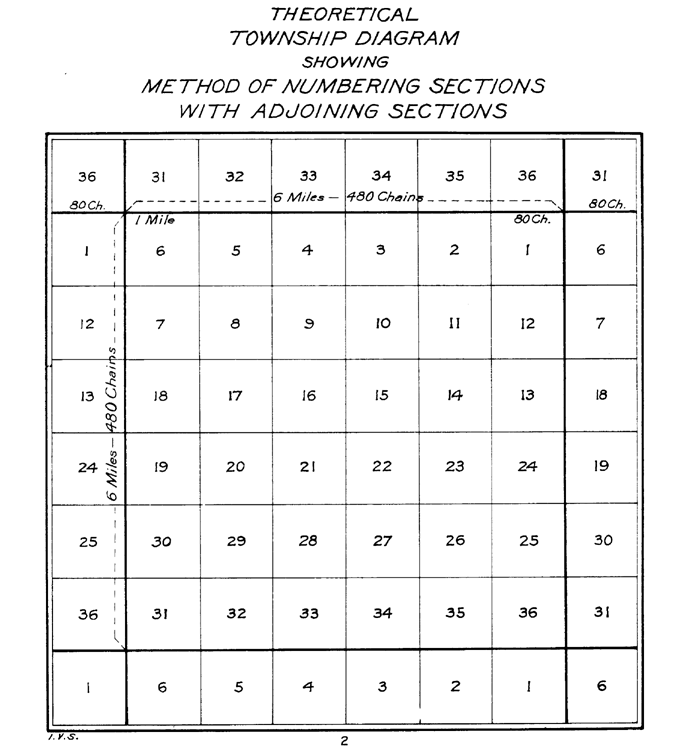
Every township is divided into 36 sections, each usually 1 mile (1.6 km) square. Sections are numbered boustrophedonically within townships[3] as follows (north at top):
| 6 | 5 | 4 | 3 | 2 | 1 |
| 7 | 8 | 9 | 10 | 11 | 12 |
| 18 | 17 | 16 | 15 | 14 | 13 |
| 19 | 20 | 21 | 22 | 23 | 24 |
| 30 | 29 | 28 | 27 | 26 | 25 |
| 31 | 32 | 33 | 34 | 35 | 36 |
Section subdivisions
[edit]Sections can be divided into quarter sections of 160 acres (65 ha), named by intercardinal direction (northwest, northeast, etc.). For instance, the southwest quarter of a section is named SW 1/4.[7]
| NW | NE |
| SW | SE |
Sections can be further broken up into 40-acre (16 ha) blocks, or quarter-quarter sections. These add a second intercardinal direction label. For instance, the southeast quarter of the southwest quarter section mentioned above is labeled SE 1/4, SW 1/4:[7][8]
| NWNW | NENW | NWNE | NENE |
| SWNW | SENW | SWNE | SENE |
| NWSW | NESW | NWSE | NESE |
| SWSW | SESW | SWSE | SESE |
Measurement anomalies
[edit]The curvature of the Earth makes it impossible to superimpose a regular grid on its surface, as the meridians converge toward the North Pole. As the U.S. is in the Northern Hemisphere, if a section's or township's east and west sides lie along meridians, its north side is shorter than its south side. As sections were surveyed from south and east to north and west, accumulated errors and distortions resulted in the north and west lines, and north and west sections diverged the most from the ideal shape and size.
The entire township grid shifts to account for the Earth's curvature. Where the grid is corrected, or where two grids based on different principal meridians meet, section shapes are irregular.
Sections also differ from the PLSS ideal of one square mile for other reasons, including errors and sloppy work by surveyors, poor instrumentation, and difficult terrain. In addition, the primary survey tool was the magnetic compass, which is influenced by local irregularities.
Once established, even an imperfect grid remains in force, mainly because the monuments of the original survey, when recovered, hold legal precedent over subsequent resurveys.[3]
Alternatives and legacy systems
[edit]The Public Land Survey System was not the first to define and implement a survey grid. A number of similar systems were established, often using terms like section and township but not necessarily in the same way. For example, the lands of the Holland Purchase in western New York were surveyed into a township grid before the PLSS was established. In colonial New England land was often divided into squares called towns or townships and further subdivided into parcels called lots or sections.[2]
Sections are also used in land descriptions in the portion of northwestern Georgia that was formerly part of the territory of the Cherokee Nation. They are not, however, part of the PLSS and are irregular in shape and size. See Cherokee County, Georgia for more information on the historical reasons for this.
Another exception to the usual use of sections and section numbering occurs when most of a parcel, or lot, falls under a body of water. The term "government lot" is used for such parcels and they are usually described separately from the rest of the section using single numbers (such as "Government Lot 5 of Section 15"). Also, parcels within a platted subdivision are often specified by lot number rather than using PLSS descriptions.[3]
Where Spanish land grants in Florida have descriptions that predate PLSS or even the U.S. itself, deviation from typical section numbering and size and shape often takes place. In an effort to honor these land grants after the U.S. took control of Florida, surveyors would use descriptions from confirmed land grants to establish their initial boundaries and created PLSS sections that extrapolated from those lines. Often, the amount of land left over in areas immediately surrounding the grants was grossly undersized or awkwardly shaped. Those tracts are referred to as "fractional sections" and often are not subject to township or range definitions. An example of such a legal description's beginning would read "Being a portion of Fractional Sec. 59, Township 0 South, Range 0 West".
Also, land north of the Watson Line near the Georgia border was not subject to the standard U.S. section, township and range designations, since the State of Georgia had claimed and laid out counties and surveyed its public lands south of that line into what eventually became part of the State of Florida. The exact location of the Georgia–Florida state line was ultimately confirmed by an Act of Congress, approved April 9, 1872.
See also
[edit]- Canadian Dominion Land Survey
References
[edit]- ^ White, C. Albert (1983). A History of the Rectangular Survey System (PDF). Washington, D.C.: United States Bureau of Land Management.
- ^ a b c Linklater, Andro (2002). Measuring America: How the United States Was Shaped By the Greatest Land Sale in History. Plume. pp. 72, 166, 234. ISBN 0-452-28459-7.
- ^ a b c d Muehrcke, Phillip C.; Muehrcke, Juliana O.; Kimerling, A. Jon (2001). Map Use: Reading, Analysis, and Interpretation (4th ed.). JP Publications. pp. 234–239. ISBN 0-9602978-5-5.
- ^ "ASLD History". 2012-06-05. Archived from the original on 5 June 2012. Retrieved 2025-02-06.
- ^ United States; King, Rufus; Johnson, William Samuel; Continental Congress Broadside Collection (Library of Congress), eds. (1785). An ordinance for ascertaining the mode of disposing of lands in the Western Territory: Be it ordained by the United States in Congress assembled, that the territory ceded by individual states to the United States, which has been purchased of the Indian inhabitants, shall be disposed of in the following manner. [New York: s.n.
- ^ "Homestead Act (1862)". 29 July 2021.
- ^ a b "Tutorial on the Public Land Survey System Descriptions" (PDF). Wisconsin Department of Natural Resources. Retrieved 2020-01-14.
- ^ Murray, William Gordon (1969). Farm Appraisal and Valuation (5th ed.). Ames: Iowa State University Press. p. 53. ISBN 9780813805702. OCLC 246381719.
Further reading
[edit]- Raymond, William Galt (1914). Plane Surveying for Use in the Classroom and Field. New York: American Book Company.
- Johnson, Hildegard Binder. Order Upon the Land: The U. S. Rectangular Land Survey and the Upper Mississippi Country. Oxford University Press, 1976.
Section (United States land surveying)
View on GrokipediaIntroduction
Definition and Basic Structure
The Public Land Survey System (PLSS) is the rectangular coordinate system established by the United States federal government to subdivide, describe, and manage public domain lands, primarily west of the original thirteen colonies. It divides land into a grid based on geographic coordinates rather than metes and bounds, facilitating equitable distribution and legal description of parcels.[7] The system originated from the Land Ordinance of 1785 and has been administered by agencies such as the General Land Office and its successor, the Bureau of Land Management (BLM).[8] At its core, the PLSS is anchored by principal meridians—north-south reference lines—and baselines, which are east-west reference lines intersecting at initial points selected for their geographic and astronomical significance. From these intersections, township lines (parallel to the baseline, spaced 6 miles apart) and range lines (parallel to the meridian, also 6 miles apart) form the primary grid. This creates survey townships, each a 6-by-6-mile square encompassing approximately 23,040 acres.[9] Townships are identified by their position relative to the initial point: numbered north or south of the baseline (tier) and east or west of the meridian (range), such as "Township 2 North, Range 3 West."[10] Each survey township is further divided into 36 sections, arranged in a standard boustrophedon numbering pattern from 1 to 36, with each section nominally 1 square mile or 640 acres. Sections along the township's perimeter may be fractional due to convergence of meridians or survey adjustments, but interior sections adhere closely to the standard dimensions. This hierarchical structure enables precise legal descriptions, such as "the northeast quarter of Section 15, Township 2 North, Range 3 West," supporting land transactions, taxation, and resource management across over 30 states.[9][11]Historical Purpose and Geographic Scope
The Public Land Survey System (PLSS), established by the Land Ordinance of 1785 enacted on May 20, 1785, by the Congress of the Confederation, served primarily to create a standardized rectangular grid for surveying, subdividing, and auctioning federal public domain lands acquired through cessions from states and the Treaty of Paris of 1783.[12] This framework addressed the inefficiencies of irregular colonial metes-and-bounds surveys, which had fostered overlapping claims and litigation, by enabling rapid, uniform division into townships of 6 by 6 miles, each containing 36 sections of 640 acres, to facilitate orderly westward expansion, settlement by smallholders, and revenue generation for the cash-strapped federal government at a minimum sale price of $1 per acre.[13] [4] The ordinance also mandated reservations, such as one section per township for public schools, reflecting an intent to support education amid settlement.[13] Initially applied to the Northwest Territory—encompassing modern Ohio, Indiana, Illinois, Michigan, Wisconsin, and parts of Minnesota—the PLSS's purpose evolved with territorial acquisitions, extending surveys before settlement to preempt disputes and ensure equitable distribution under laws like the Northwest Ordinance of 1787, which prohibited slavery and promoted governance in surveyed areas.[4] By mandating pre-settlement surveys, the system prioritized causal efficiency in land administration, reducing the frontier anarchy seen in unsurveyed regions and enabling the transfer of over 1.8 billion acres of public land by the early 20th century through sales, grants, and homesteading.[14] Geographically, the PLSS covers the bulk of federal lands outside the original 13 colonies, where proprietary grants and metes-and-bounds prevailed, spanning principal meridians and base lines across 30 primarily Midwestern, Southern, and Western states including Ohio, Indiana, Illinois, Michigan, Wisconsin, Minnesota, Iowa, Missouri, Arkansas, Louisiana, Alabama, Mississippi, Florida, and much of the trans-Mississippi West up to the Pacific, but excluding Texas (which adopted Spanish and state-specific systems), Kentucky, Tennessee (partially surveyed under separate ordinances), Hawaii, and Alaska's non-PLSS areas.[14] [4] This scope delimits about three-quarters of the contiguous U.S. landmass, with surveys adapting to topography via meanders and fractional sections, though non-federal or early-state lands often retained irregular patterns.[14] The system's boundaries reflect the public domain's extent, shaped by purchases like the Louisiana Territory (1803) and Mexican Cession (1848), which necessitated over 300 initial points of origin for grids aligned to true north.[13]Historical Development
Establishment via the Land Ordinance of 1785
The Land Ordinance of 1785, passed by the Congress of the Confederation on May 20, 1785, established the initial framework for the rectangular survey system applied to public lands in the western territories ceded by the original states following the Revolutionary War.[8] This legislation addressed the chaotic land claims and irregular boundaries from colonial metes-and-bounds practices by mandating a grid-based division of land into uniform parcels prior to sale, enabling efficient federal revenue through auctions and promoting orderly westward expansion while reducing future disputes.[15][4] Under the ordinance, surveys divided territory into townships six miles square, each containing 36 sections of one square mile (approximately 640 acres), with further potential subdivision into quarter sections of 160 acres.[8][4] Principal meridians ran north-south along true meridians, intersected by east-west base lines, forming right angles; initial work commenced at the Ohio River's intersection with Pennsylvania's western boundary.[8] Corners were marked with notched posts, stones, or earth mounds, and meander lines delineated boundaries along navigable waters greater than 25 acres.[8] The 16th section of each township was reserved for public schools, marking an early provision for education funding from land resources.[8][4] Implementation began with the survey of the Seven Ranges in northeastern Ohio, directed by Thomas Hutchins as Geographer of the United States, covering about 1 million acres east of the Cuyahoga River and north of the Ohio River starting in 1786.[8][4] Lands were sold at minimum one dollar per acre in public auctions, payable in cash or military warrants, with surveys required before settlement to ensure legal title transfer.[4] This system formed the basis of the Public Land Survey System, eventually encompassing over three-quarters of the continental United States excluding the original colonies and Texas.[8]Survey Expansion and Key Surveys
Following the Land Ordinance of 1785, the initial expansion of the rectangular survey system occurred in the Northwest Territory, beginning with the survey of the Seven Ranges in eastern Ohio. This pioneering effort, directed by Thomas Hutchins as Geographer of the United States, commenced on September 30, 1785, north of the Ohio River and west of Pennsylvania's western boundary. The surveys, conducted by 13 deputy surveyors, divided the land into townships and sections as prescribed, with completion of the Seven Ranges by July 1788, marking the first application of the system to federal public lands.[8] Subsequent surveys in the Northwest Territory included the Ohio Company Purchase, contracted on October 27, 1787, and surveyed starting April 7, 1788, under Rufus Putnam, covering 1.5 million acres around Marietta. The Symmes Purchase between the Great and Little Miami Rivers followed, surveyed from 1788 by Israel Ludlow and completed by 1802, though with noted distortions due to early techniques. Additional key surveys encompassed the Greenville Treaty Line (1797-1800) and U.S. Military Reserve townships (1797-1799), both under Putnam, which facilitated land distribution post-Indian treaties and supported settlement.[8] The Louisiana Purchase in 1803 prompted significant westward expansion, necessitating new principal meridians and base lines to accommodate vast territories. Surveys began in 1805, with the establishment of meridians such as the Second Principal Meridian near Vincennes, Indiana, and the Third Principal Meridian at the Ohio River's mouth, extending into Illinois and parts of Indiana. By 1815, the Fourth Principal Meridian was set at the confluence of the Illinois and Mississippi Rivers, governing surveys in Illinois, Wisconsin, and northeastern Minnesota, while the Fifth Principal Meridian at the Arkansas River's mouth covered Missouri, Arkansas, Iowa, and portions of surrounding states.[8] Further key surveys in the early 19th century included military bounty lands between the St. Francis and Arkansas Rivers (1815, under William Rector) and extensions into the Orleans Territory (1811 instructions by Thomas Freeman). The creation of the General Land Office in 1812 centralized surveying administration, enabling accelerated campaigns amid territorial acquisitions like Florida (1819 onward) and Michigan (1835 subdivisions). Challenges arose from terrain variations, inaccurate early chains, and conflicts with Native American lands, yet the system adapted, with over 37 principal meridians eventually established to minimize cumulative errors.[8][16]| Principal Meridian | Establishment Year | Initial Point | Primary Areas Surveyed |
|---|---|---|---|
| Second | 1805 | Little Blue River confluence with Wabash | Indiana, eastern Illinois |
| Third | 1805 | Mouth of Ohio River | Southern Illinois, western Kentucky |
| Fourth | 1815 | Confluence of Illinois and Mississippi Rivers | Illinois, Wisconsin |
| Fifth | 1815 | Old mouth of Arkansas River | Missouri, Arkansas, Iowa |
| Sixth | 1855 | Thirty-eighth parallel, near Great Bend, Kansas | Kansas, Nebraska |
Integration with Roads, Urban Planning, and Settlement
The Public Land Survey System (PLSS) facilitated orderly settlement by requiring surveys to precede land sales, dividing unsold public domain into townships and sections for systematic disposal and private ownership, as mandated by the Land Ordinance of 1785.[8] This approach, starting with the "Seven Ranges" in Ohio post-1785, enabled the federal government to auction parcels like the Ohio Company Purchase of 964,000 acres in 1787, reducing boundary disputes and promoting stable communities through precise monumentation of corners.[8] By 1862, the Homestead Act further integrated the system, allowing settlers to claim up to 160-acre quarter-sections after improvements, tying expansion to the grid's legal subdivisions.[6] Road development aligned closely with PLSS lines, as section boundaries—spaced one mile apart—provided a ready framework for transportation networks, with field notes from surveys in regions like Michigan (1840s) and Montana (1890) documenting existing trails and new roads following these lines.[8] The Act of July 26, 1866, explicitly granted rights-of-way for highways along section lines, typically 66 feet wide in areas like Dakota Territory (1871), fostering a rectilinear rural road grid across the Midwest and Great Plains that enhanced access to surveyed lands.[8] [17] Later, the Act of May 2, 1890, reserved 4-rod-wide roadways in Oklahoma, embedding the grid into infrastructure planning to support agricultural settlement.[8] In urban planning, the PLSS influenced town platting through dedicated townsites, where sections were subdivided into blocks, lots, and streets aligned with township grids, as per protocols in the Manual of Surveying Instructions.[6] Early examples include Marietta, Ohio (founded April 7, 1788), and Shawneetown, Illinois (surveyed 1810), which used the rectangular system for lot divisions and reserved spaces like Lot 16 for public use such as schools.[8] Cities like Chicago adopted this grid, with surveyor James Thompson's 1830 plan overlaying streets on section lines from the 1785 ordinance, creating a uniform urban layout that extended the rural survey into commercial development.[18] This integration minimized irregularities, enabling efficient expansion, though adaptations for natural features like rivers required meander lines to maintain the system's regularity.[6]Core Technical Framework
Township Organization and Numbering
In the Public Land Survey System (PLSS), townships form the primary grid units, each nominally measuring 6 miles by 6 miles and subdivided into 36 sections of 1 square mile.[6] These townships are organized into a rectangular coordinate framework originating from an initial point where a principal meridian (a north-south reference line) intersects a baseline (an east-west reference line).[9] Township exteriors are established by running lines parallel to the baseline (east-west township lines) at 6-mile intervals north and south, and lines parallel to the principal meridian (north-south range lines) at 6-mile intervals east and west.[8] Tiers of townships, which represent east-west rows, are numbered consecutively north or south from the baseline, beginning with Tier 1 (T. 1 N. or T. 1 S.).[9] For instance, T. 2 N. denotes the second tier north of the baseline, located approximately 6 to 12 miles north.[6] Ranges, which form north-south columns, are similarly numbered east or west from the principal meridian, starting at Range 1 (R. 1 E. or R. 1 W.).[9] A specific township is thus identified by combining its tier and range designations, such as T. 5 N., R. 3 W., relative to a named principal meridian like the Fifth Principal Meridian.[8] This system ensures systematic location across surveyed public lands, with multiple principal meridians and baselines established over time to cover regions like the Northwest Territory and beyond.[6] The numbering convention traces to the Land Ordinance of 1785, which directed the division of unsold western lands into townships progressively numbered from designated lines, facilitating orderly sales and settlement.[8] In practice, to mitigate Earth's curvature, standard parallels (additional east-west correction lines) are set approximately every 24 miles north of the baseline, and guide meridians every 24 miles east or west of the principal meridian, forming larger 24-by-24-mile quadrangles subdivided into 16 townships.[6] Fractional or irregular townships, resulting from natural boundaries or prior claims, retain the same tier and range numbering but may contain fewer than 36 full sections, with deficiencies allocated to boundary lots.[9] Official plats and field notes from the Bureau of Land Management document these designations, preserving the grid's integrity for legal descriptions.[6]Section Layout and Standard Dimensions
In the Public Land Survey System (PLSS), townships are subdivided into 36 sections forming a 6-by-6 grid, each section nominally one square mile in area.[8] The sections are numbered from 1 to 36 following a boustrophedon pattern, which alternates direction row by row to mimic traditional plowing practices: starting with section 1 in the northeast corner and proceeding westward to section 6 in the northwest corner of the northern tier, then southward to the second tier and eastward to section 12, continuing alternately until section 36 in the southeast corner.[8][9] Standard section dimensions are one statute mile (5,280 feet) along each side, measured using Gunter's chain where 80 chains equal one mile, with each chain comprising 66 feet or 100 links.[9][19] This configuration yields an area of 640 acres per section, subdivided further into quarter sections of 160 acres at 40-chain intervals.[9] Section lines are established true north-south and east-west, with corners marked by posts, stones, or mounds accompanied by bearing trees or pits for reference.[8] While nominal, these dimensions incorporate tolerances for surveying errors and terrain variations; for instance, north-south section lines measure exactly 80 chains except along northern township boundaries, and east-west lines approximate the southern boundary length within specified limits.[8] Deviations arise from cumulative measurement discrepancies, meridian convergence, and natural features, leading to fractional sections along township edges where excess or deficiency is allocated to lots rather than altering standard interiors.[8][9] Official protocols, as outlined in the Manual of Surveying Instructions, mandate precise field notes recording chainage, bearings, and monuments to ensure retraceability.[6]Subdivisions and Parceling
Aliquot Parts and Quartering
Aliquot parts in the United States Public Land Survey System (PLSS) denote the fractional subdivisions of a standard section, achieved through successive halving and quartering to create equal legal parcels. These parts enable concise land descriptions, such as the northeast quarter (NE¼) of a section, avoiding the need for detailed angular or linear measurements typical in metes and bounds systems.[6] The system prioritizes aliquot divisions for their simplicity and equity in apportioning public lands, with the section—nominally 640 acres—serving as the primary unit.[11] Quartering establishes the foundational subdivisions by running a north-south meridian and an east-west parallel through the section's center, yielding four quadrants: the northwest quarter (NW¼), northeast quarter (NE¼), southwest quarter (SW¼), and southeast quarter (SE¼), each encompassing 160 acres in a regular section.[6] Further quartering of these 160-acre quarters produces 40-acre quarter-quarters (e.g., NE¼NE¼), continuing hierarchically for smaller parcels as required by land patents or sales.[20] This methodical process ensures uniformity, with descriptions written from the whole to the part, such as "the south half of the northwest quarter" (S½NW¼), and commas separating non-contiguous aliquots (e.g., NE¼, SW¼).[9] The use of aliquot parts assumes proportional division based on cardinal directions, promoting unambiguous property identification in legal conveyances and titles.[11] While aliases like "northeast quarter-section" are interchangeable with fractional notation in descriptions, the latter predominates in official records for precision.[6] In practice, aliquot parts apply primarily to regular sections; fractional or irregular sections often employ numbered government lots instead, preserving the system's adaptability to terrain variations.[21] This framework, codified in federal surveying manuals, underpins much of rural land parceling across the PLSS-covered states.[6]Handling Irregular or Fractional Sections
Fractional sections in the Public Land Survey System (PLSS) are those containing less than 640 acres, typically resulting from disruptions such as meanderable water bodies, prior land grants, reservations, or irregular township boundaries that prevent full rectangular subdivision.[6] These sections arise primarily along the north and west edges of townships or where natural features encroach, leading to incomplete exterior lines or missing quarter corners.[22] Irregular sections, often overlapping in description with fractionals, refer to those with distorted shapes or protracted outlying areas due to survey limitations or environmental factors, requiring non-standard subdivision to approximate aliquot parts.[6] Subdivision of fractional sections prioritizes creating as many regular aliquot parts—such as quarter-sections (160 acres) or quarter-quarter-sections (40 acres)—as feasible, with residual areas designated as numbered lots.[6] Lines are run north-south for quarter-sections and east-west for smaller divisions, terminating at irregular boundaries like meander lines, with excess or deficiency in measurements proportionately distributed against the irregular perimeter rather than interior lines.[6] For sections lacking opposing boundaries, parallel lines are employed per early statutes like the Act of 1805, or weighted mean bearings are used for centerlines to align with official plats.[22] Lots are formed for areas under 40 acres or highly irregular remnants, aiming for equitable shapes typically between 10 and 50 acres to avoid impractical parcels.[6] Numbering of lots in fractional sections begins sequentially with Lot 1 in the northeast portion, progressing east-to-west or north-to-south, using the next available number beyond any from the original survey (e.g., starting at 37 for protracted tracts).[6] Areas are computed to the nearest 0.01 acre based on field notes and plats, with descriptions specifying lot numbers alongside township, range, and section for legal identification.[6] In resurveys, existing rights are protected by retracing original monuments and notes, applying single proportionate measurement between known corners to fix lost ones without altering established subdivisions.[6] For meandered fractional sections, remeandering may update boundaries to the current ordinary high water mark, creating new lots on relicted or avulsed lands if federally owned, while supplemental plats document changes without renumbering established lots.[6] These protocols, governed by the Bureau of Land Management's Manual of Surveying Instructions (last major update 2009), ensure consistency in property descriptions and boundary determinations, minimizing disputes by adhering to original survey intent over theoretical ideals.[6]Surveying Practices and Standards
Original Measurement Techniques and Tools
The primary instruments for original measurements in the United States Public Land Survey System (PLSS) were the Gunter's chain for linear distances and the magnetic compass for directional bearings. The Gunter's chain, standardized at 66 feet in length with 100 iron links each measuring 7.92 inches, enabled consistent measurement of distances in chains and links, where one chain equaled 4 rods or 100 links, facilitating calculations for sections (80 chains per side) and quarter-sections (40 chains).[23] [8] Surveyors often employed a two-pole variant (33 feet, 50 links) for practicality, with chainmen stretching the chain horizontally—leveled on uneven terrain and tensioned uniformly—while using tally pins inserted every 10 chains (or 5 for half-chains) to track progress and minimize errors.[8] Double chaining, involving two independent measurements and averaging results, was standard on principal lines to enhance precision, with discrepancies exceeding 8 links on level ground necessitating re-measurement.[8] Directional measurements relied on the magnetic compass, typically a vernier or plain compass mounted on a Jacob's staff, to determine bearings relative to the true meridian adjusted for local magnetic declination, which varied regionally (e.g., 7°45' east to 18°09' east in early surveys).[8] [24] Bearings were recorded in degrees and minutes, with north-south lines aligned to the true meridian via occasional astronomical observations (e.g., Polaris sightings) on baselines and principal meridians, while east-west lines were run at right angles using offsets or calculated corrections.[8] For initial township exteriors, surveyors ran "random" lines with the compass and chain, then offset back to true cardinal directions; interiors followed "true" lines blazed along trees or marked in open terrain.[8] Corners were established at intervals of 80 chains (sections), 40 chains (quarter-sections), and 6 miles (township exteriors) using durable monuments such as wooden posts (3-5 inches diameter, set 1-2 feet deep), quarried stones (minimum 504 cubic inches, notched for identification), or earthen mounds (e.g., 2.5 feet high in prairies, often with charcoal for visibility).[8] [25] Bearing trees (typically two to four per corner) were selected, blazed, and scribed with species, diameter, bearing, and distance to the corner (e.g., "White Oak, 20 in. dia., N. 74° W. 26 links").[8] Field notes meticulously documented courses, distances in chains and links, monument details, topography, and soil types, with plats drawn at 2 inches per mile scale; closure errors were limited to 1 chain for section lines and 5 chains for townships, with excesses proportioned to the final segments.[8] These techniques, mandated under the Land Ordinance of 1785 and refined by acts like those of 1796 and 1805, prioritized permanence over absolute precision given terrain challenges, with daily chain calibrations against standards and surveyor oaths ensuring fidelity.[8] Meanders along streams were traced at high-water marks using similar chaining and compass readings, recording offsets for obstacles like rivers via triangulation.[8] Though magnetic variation and chaining inconsistencies introduced discrepancies (e.g., cumulative errors up to 3 chains per township), the system's grid endured as the basis for land titles.[8]Units, Precision, and Official Protocols
In the Public Land Survey System (PLSS), linear measurements traditionally employ Gunter's chain as the primary unit, defined as 66 feet or 100 links, with 80 chains equaling one mile (5,280 feet using the U.S. Survey Foot).[6] This system facilitates the division of townships into 36 sections of one square mile each (640 acres), where one acre equals 10 square chains.[6] Modern surveys supplement chains with feet for finer detail, particularly in mineral surveys or geodetic tie-ins, while adhering to the U.S. Survey Foot (1 foot = 0.3048006 meters) for consistency with historical records.[6] Precision in PLSS measurements requires bearings recorded to the nearest minute or 15 seconds and distances to the nearest 0.01 chain (approximately 0.66 feet) or tenths of links in field notes, with plat data rounded accordingly.[6] Original 19th-century surveys, reliant on compass and chain methods, achieved variable precision, often with closure errors accumulating to 3 links (19.8 feet) per mile on township exteriors due to terrain, instrument limitations, and human error, though systematic discrepancies were minimized through double measurements and proportional adjustments.[6] Contemporary resurveys demand higher accuracy, such as GPS positions with less than 0.10 meters at 95% confidence for geodetic control, ensuring compatibility with the National Spatial Reference System while preserving original corner evidence.[26] Official protocols for PLSS surveys are codified in the Bureau of Land Management's (BLM) Manual of Surveying Instructions (2009 edition), which mandates error closures of no more than 1 in 4,000 for general surveys and 3 links per mile for township boundaries, with discrepancies exceeding 2 links per 80 chains triggering corrective measures.[6] The BLM authorizes and oversees all federal cadastral surveys under statutes like the Act of May 18, 1796, requiring field notes on archival paper, permanent monumentation (e.g., 2.5-inch diameter posts or brass caps), and plats approved by the BLM Director before filing as legal records.[6] Resurveys prioritize existent monuments and proportionate restoration over redefinition unless independently authorized, distributing minor errors proportionally to protect vested property rights.[6] For meander lines along water bodies, protocols specify running at the ordinary high-water mark for acreage computation, not boundary establishment, with modern tools like real-time kinematic GPS ensuring alignment within specified tolerances.[6]Anomalies, Errors, and Remediation
Sources of Measurement Discrepancies
Measurement discrepancies in the Public Land Survey System (PLSS) arise primarily from the inherent limitations of early surveying methods, geometric distortions due to Earth's sphericity, environmental factors, and human fallibility during original surveys conducted between 1785 and the early 20th century. Original surveys relied on Gunter's chains for distance measurement—each 66 feet long, equivalent to 100 links or 4 rods—and magnetic compasses for bearings, which introduced cumulative errors over long lines. Allowable error tolerances were strict, such as no more than 2 links (1.32 feet) per 80 chains (5,280 feet) for standard township boundaries, yet practical deviations often exceeded these due to chain sagging on uneven terrain, improper tension, or intentional lengthening to compensate for anticipated shortenings from slopes. [6] Compass-based bearings were further distorted by local magnetic declination variations, which could shift by several degrees over time or distance, and by the use of rhumb lines (constant compass direction) rather than true geodesics, preventing mathematical closure of townships. [6] Geometric discrepancies stem from meridian convergence, as principal meridians converge toward the poles at approximately 1 minute of arc per geographic mile of latitude, resulting in northern township boundaries being shorter than southern ones—for instance, a 1-mile north-south line at 40° north latitude measures about 1.69 links (1.12 feet) less at its northern end than at the south. [6] This convergence accumulates across tiers of townships, with corrections applied via guide meridians and standard parallels every 24 miles (4 townships north-south), but residual errors are systematically allocated to the north and west tiers of sections (typically sections 6, 7, 18, 19, 30, and 31), creating fractional or irregular parcels rather than uniform 640-acre sections. [6] Terrain-induced irregularities compound this, as surveys followed ground distances rather than horizontal equivalents until later refinements; steep slopes, rivers, and lakes necessitated meander lines that often crossed land-water boundaries imprecisely, yielding fractional sections or omitted islands, with errors from misjudging ordinary high water marks or flooding. [6] Inaccessible areas like cliffs or swamps led to approximated witness corners or protractions, further deviating from ideal grids. [6] Human and procedural errors contributed significantly, including gross blunders such as reversed meander courses, transposed distances, or fraudulent field notes, which fixed inaccurate corners as legal precedents despite evident flaws. [6] Sloppy execution in rough terrain—exemplified by surveys in areas like the Snake River canyons or Missouri River floodplains—resulted in obliterated monuments, inconsistent quarter-section placements, or unfaithful representations of topography, with field notes sometimes relying on approximations rather than precise ties. [6] Poor instrumentation, such as uncalibrated chains or compasses affected by nearby iron deposits, amplified these issues, while clerical transcription errors in plats and notes propagated discrepancies into official records. [6] These sources collectively mean that many original sections vary from the nominal 640 acres, with some as small as 200-300 acres in western states due to cumulative effects, necessitating resurveys under Bureau of Land Management protocols that prioritize original corner evidence over modern geodesy. [6]Resurvey Procedures and Legal Adjustments
In the Public Land Survey System (PLSS), resurveys address discrepancies arising from lost or obliterated corners, eroded monuments, or measurement errors in original surveys, aiming to reestablish boundaries while preserving legal stability. These procedures are primarily managed by the Bureau of Land Management (BLM) for federal interest lands under the authority of the General Resurvey Act of 1909 (43 U.S.C. § 772), which permits resurveys to mark boundaries but prohibits impairment of bona fide rights acquired under prior surveys.[6] Resurveys must adhere to the BLM's Manual of Surveying Instructions (2009), incorporating modern tools like GPS and total stations while subordinating measurements to historical evidence such as field notes, plats, and collateral indicators.[6] Accuracy standards require closures within 1:500 to 1:5000 of perimeter distances, with maximum lineal errors limited to 2 links per 80 chains.[6] Dependent resurveys, the most common type, involve retracing original lines using recoverable evidence to restore lost corners through proportionate measurement between identified control points, ensuring alignment with the original surveyor's intent.[6][27] Surveyors first verify existent monuments and lines via direct evidence (e.g., original stakes) or collateral evidence (e.g., bearing trees, fences), then apply double proportionate methods for quadrilateral adjustments or single methods for linear segments, distributing excesses or deficiencies evenly.[6] Monuments are remonumented with durable materials like stainless steel posts and brass caps, tied to the National Spatial Reference System, and documented in detailed field notes including prior survey history.[6] For non-federal lands, private licensed surveyors perform retracements—preliminary verifications of original positions—without altering established boundaries, focusing on rehabilitation of found corners rather than wholesale restoration.[27] Independent resurveys are employed when original evidence proves insufficient or unreliable, establishing new lines independent of prior records to supersede the original survey solely for remaining public lands, while treating alienated tracts as fixed.[6][27] This approach selects an initial control point (e.g., a verified section corner) and computes positions without incorporating historical errors, often using protracted blocks as buffers against adjacent surveys.[6] Such resurveys require special BLM instructions and approval, with plats reflecting updated subdivisions but excluding patented lands from boundary shifts.[6] Legal adjustments prioritize the original survey's marked lines and corners as controlling evidence, rendering post-patent resurveys subordinate unless gross errors (e.g., closure failures exceeding 50 chains per township) justify court intervention.[6] Under principles established in cases like Cragin v. Powell (128 U.S. 691, 1888), surveyors must follow the original General Land Office lines, even if theoretically flawed, to avoid arbitrary displacements of settled titles; resurveys cannot retroactively invade bona fide claims without due process.[28] Approved BLM resurveys become official records upon Director certification, appealable to the Interior Board of Land Appeals (43 CFR § 4.410), while state courts resolve private disputes by weighing original monuments over calls to course or distance.[6] Adjustments for natural changes, such as accretion or avulsion along water boundaries, fix lines at pre-event positions per riparian rules, with evidence like aerial photography required for verification.[6]Legal and Boundary Implications
Role in Property Titles and Descriptions
Land surveying establishes the precise boundaries and descriptions integral to property titles in the United States, with original cadastral surveys forming the basis for most public and private land titles to ensure legal security of ownership.[11] In regions governed by the Public Land Survey System (PLSS), adopted starting in 1785 under the Land Ordinance, surveyors divide land into townships of 36 square-mile sections, further subdivided into aliquot parts such as quarter-sections (160 acres) or smaller fractions like the NE¼ of a section, which are directly referenced in deeds and titles for unambiguous identification.[11] These descriptions, such as "Lot 2, Section 14, Township 3 South, Range 4 East, Principal Meridian," enable efficient recording in county registries and federal databases, supporting transfers, mortgages, and taxation without reliance on physical monuments alone.[29] Title surveys, conducted by licensed professionals, reconcile legal descriptions with on-site measurements to detect encroachments, easements, or boundary shifts from erosion or prior errors, which are critical for title insurance and lender approval in real estate transactions. Without such verification, discrepancies between recorded titles and actual possession can invalidate conveyances or trigger litigation, as courts prioritize original survey monuments and calls over later assumptions. In PLSS areas, federal standards from the Bureau of Land Management mandate adherence to these aliquot-based descriptions for any land disposal or exchange, preserving chain-of-title integrity across generations.[11] In non-PLSS jurisdictions, primarily east of the Ohio River, metes-and-bounds descriptions derived from surveyor chains, bearings, and natural landmarks supplement or replace grid references, but still require fieldwork to monument corners and certify plats for recording.[29] Professional surveys thus underpin title abstracting, where historical plats and field notes are examined to confirm unclouded ownership, often resolving ambiguities through supplemental evidence like adjacent deeds or GLO (General Land Office) records dating to the 19th century.[30] This process mitigates risks in high-value transfers, with surveys revealing up to 20-30% of properties with boundary issues in urbanizing areas, per industry estimates from title professionals.[31]Common Disputes and Resolution Mechanisms
Common disputes in United States land surveying, particularly under the Public Land Survey System (PLSS), often stem from historical inaccuracies in original General Land Office (GLO) surveys, such as measurement errors or unrecorded variations in terrain, leading to overlaps or gaps between adjacent parcels.[32] These issues manifest in conflicts over aliquot part divisions, where fractional sections fail to align precisely due to closing errors or ambiguous protraction methods, or in junior-senior rights disputes where later patents overlap earlier ones because of faulty senior survey measurements.[32] Encroachments, such as fences or structures crossing section lines, and riparian boundary shifts from meander line discrepancies further exacerbate tensions, especially in areas with evolving watercourses or unmonumented quarter corners. Resolution mechanisms prioritize retracing original GLO monuments and field notes as controlling evidence, with licensed surveyors adhering to the Bureau of Land Management's Manual of Surveying Instructions to proportion discrepancies and reestablish lost corners using collateral evidence like proportionate measurement or double proportion methods.[33] In cases of persistent ambiguity, parties may commission independent boundary surveys to produce plats that reconcile record descriptions with on-ground evidence, often serving as prima facie proof in administrative or judicial proceedings.[34] For escalated conflicts, mediation or arbitration facilitates mutual agreements, such as boundary line adjustments via quitclaim deeds, while litigation invokes quiet title actions where courts appoint expert surveyors for testimony and may apply doctrines like acquiescence—recognizing long-established occupation as binding—or adverse possession after statutory periods, typically 7 to 20 years depending on state law.- Administrative remedies: Federal lands under BLM jurisdiction may undergo dependent resurveys to resolve hiatuses or conflicts, updating plats while preserving original intent.[33]
- State-level protocols: Many states mandate surveyor certification and require disputes to reference original surveys before accepting modern GPS data, preventing further divergence.[34]
- Preventive measures: Title insurance policies often exclude survey-related risks unless a current ALTA/NSPS survey is obtained, underscoring the role of pre-dispute verification in averting litigation.
