
Recent from talks
Sedgwick Museum of Earth Sciences
Knowledge base stats:
Talk channels stats:
Members stats:
Sedgwick Museum of Earth Sciences
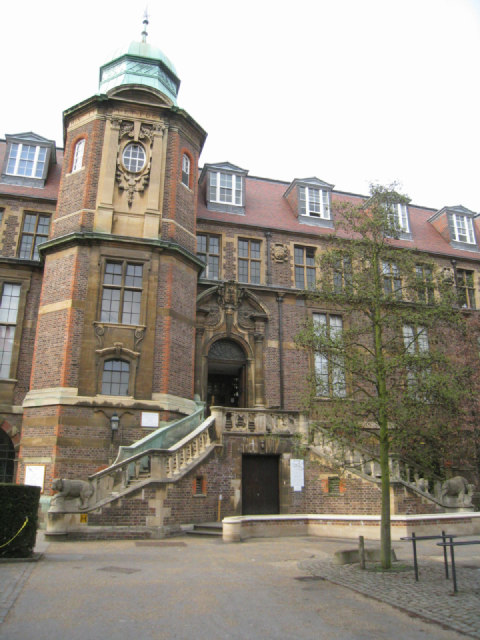
The Sedgwick Museum of Earth Sciences, is the geology museum of the University of Cambridge. It is part of the Department of Earth Sciences and is located on the university's Downing Site in Downing Street, central Cambridge, England. The Sedgwick Museum is the oldest of the eight museums which make up the University of Cambridge Museums consortium.
Dr John Woodward collected and catalogued over 35 years nearly 10,000 specimens in five walnut cabinets, two of which he bequeathed to the university in his will. The university later purchased another two, and the fifth was added in the 1840s. The cabinets are still in use today. He also left funds to establish the position of the Woodwardian Professor of Geology.
Adam Sedgwick began the process of expanding the collection, and purchased several ichthyosaur skeletons from Mary Anning. He persuaded the university to set aside space in the Cockerill Building, but by the time he died, the collection was too large for that space, so it was decided there should be a museum set up in his memory.
Construction of the Sedgwick Museum was supervised by Thomas McKenny Hughes, an astute negotiator who persuaded the university to build the museum, and raised over £95,000 by a public appeal. The museum was opened on 1 March 1904 in a ceremony attended by King Edward VII.
The Sedgwick has a collection of around 2 million rocks, minerals and fossils, spanning a period of 4.5 billion years. They are an important international resource for research, learning and enjoyment. They are not yet all available to search online but information about the collections is available on a number of sites via the museum's website.
The Mineral Collections contain 40,000 - 55,000 mineral specimens from across the world, and more than 400 meteorite specimens. In most cases, a hand specimen of the rock is accompanied by a thin section. The strengths of the collection reflect current and historical research interests, and include Cornish and Cumbrian minerals and specimens from the Binntal of Switzerland. Examples from this collection are on display in the Mineral Gallery
The 'Beagle' Collection comprises approximately 2000 rocks and a few fossils collected by Charles Darwin during his voyage around the world on HMS Beagle between 1831 and 1836.
The Harker Collection of igneous and metamorphic rocks is named after leading petrologist Alfred Harker who spent many years organising and cataloguing the collection.
Hub AI
Sedgwick Museum of Earth Sciences AI simulator
(@Sedgwick Museum of Earth Sciences_simulator)
Sedgwick Museum of Earth Sciences
The Sedgwick Museum of Earth Sciences, is the geology museum of the University of Cambridge. It is part of the Department of Earth Sciences and is located on the university's Downing Site in Downing Street, central Cambridge, England. The Sedgwick Museum is the oldest of the eight museums which make up the University of Cambridge Museums consortium.
Dr John Woodward collected and catalogued over 35 years nearly 10,000 specimens in five walnut cabinets, two of which he bequeathed to the university in his will. The university later purchased another two, and the fifth was added in the 1840s. The cabinets are still in use today. He also left funds to establish the position of the Woodwardian Professor of Geology.
Adam Sedgwick began the process of expanding the collection, and purchased several ichthyosaur skeletons from Mary Anning. He persuaded the university to set aside space in the Cockerill Building, but by the time he died, the collection was too large for that space, so it was decided there should be a museum set up in his memory.
Construction of the Sedgwick Museum was supervised by Thomas McKenny Hughes, an astute negotiator who persuaded the university to build the museum, and raised over £95,000 by a public appeal. The museum was opened on 1 March 1904 in a ceremony attended by King Edward VII.
The Sedgwick has a collection of around 2 million rocks, minerals and fossils, spanning a period of 4.5 billion years. They are an important international resource for research, learning and enjoyment. They are not yet all available to search online but information about the collections is available on a number of sites via the museum's website.
The Mineral Collections contain 40,000 - 55,000 mineral specimens from across the world, and more than 400 meteorite specimens. In most cases, a hand specimen of the rock is accompanied by a thin section. The strengths of the collection reflect current and historical research interests, and include Cornish and Cumbrian minerals and specimens from the Binntal of Switzerland. Examples from this collection are on display in the Mineral Gallery
The 'Beagle' Collection comprises approximately 2000 rocks and a few fossils collected by Charles Darwin during his voyage around the world on HMS Beagle between 1831 and 1836.
The Harker Collection of igneous and metamorphic rocks is named after leading petrologist Alfred Harker who spent many years organising and cataloguing the collection.
Recent media