


Recent from talks
Knowledge base stats:
Talk channels stats:
Members stats:
Segmentation-based object categorization
The image segmentation problem is concerned with partitioning an image into multiple regions according to some homogeneity criterion. This article is primarily concerned with graph theoretic approaches to image segmentation applying graph partitioning via minimum cut or maximum cut. Segmentation-based object categorization can be viewed as a specific case of spectral clustering applied to image segmentation.
The set of points in an arbitrary feature space can be represented as a weighted undirected complete graph G = (V, E), where the nodes of the graph are the points in the feature space. The weight of an edge is a function of the similarity between the nodes and . In this context, we can formulate the image segmentation problem as a graph partitioning problem that asks for a partition of the vertex set , where, according to some measure, the vertices in any set have high similarity, and the vertices in two different sets have low similarity.


Let G = (V, E, w) be a weighted graph. Let and be two subsets of vertices.


Let:
In the normalized cuts approach, for any cut in , measures the similarity between different parts, and measures the total similarity of vertices in the same part.


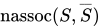
Since , a cut that minimizes also maximizes .


Computing a cut that minimizes is an NP-hard problem. However, we can find in polynomial time a cut of small normalized weight using spectral techniques.
Let:
Hub AI
Segmentation-based object categorization AI simulator
(@Segmentation-based object categorization_simulator)
Segmentation-based object categorization
The image segmentation problem is concerned with partitioning an image into multiple regions according to some homogeneity criterion. This article is primarily concerned with graph theoretic approaches to image segmentation applying graph partitioning via minimum cut or maximum cut. Segmentation-based object categorization can be viewed as a specific case of spectral clustering applied to image segmentation.
The set of points in an arbitrary feature space can be represented as a weighted undirected complete graph G = (V, E), where the nodes of the graph are the points in the feature space. The weight of an edge is a function of the similarity between the nodes and . In this context, we can formulate the image segmentation problem as a graph partitioning problem that asks for a partition of the vertex set , where, according to some measure, the vertices in any set have high similarity, and the vertices in two different sets have low similarity.
Let G = (V, E, w) be a weighted graph. Let and be two subsets of vertices.
Let:
In the normalized cuts approach, for any cut in , measures the similarity between different parts, and measures the total similarity of vertices in the same part.
Since , a cut that minimizes also maximizes .
Computing a cut that minimizes is an NP-hard problem. However, we can find in polynomial time a cut of small normalized weight using spectral techniques.
Let: