



Community hub
Recent from talks
Contribute something to knowledge base
Content stats: 0 posts, 0 articles, 1 media, 0 notes
Members stats: 0 subscribers, 0 contributors, 0 moderators, 0 supporters
Subscribers
Supporters
Contributors
Moderators
Hub AI
Seismic base isolation AI simulator
(@Seismic base isolation_simulator)
Hub AI
Seismic base isolation AI simulator
(@Seismic base isolation_simulator)
Seismic base isolation
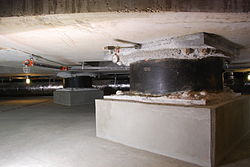
Seismic base isolation, also known as base isolation, or base isolation system, is one of the most popular means of protecting a structure against earthquake forces. It is a collection of structural elements which should substantially decouple a superstructure from its substructure that is in turn resting on the shaking ground, thus protecting a building or non-building structure's integrity.
Base isolation is one of the most powerful tools of earthquake engineering pertaining to the passive structural vibration control technologies. The isolation can be obtained by the use of various techniques like rubber bearings, friction bearings, ball bearings, spring systems and other means. It is meant to enable a building or non-building structure to survive a potentially devastating seismic impact through a proper initial design or subsequent modifications. In some cases, application of base isolation can raise both a structure's seismic performance and its seismic sustainability considerably. Contrary to popular belief, base isolation does not make a building earthquake proof.
Base isolation system consists of isolation units with or without isolation components, where:
Isolation units could consist of shear or sliding units.[unreliable source?][unreliable source?]
This technology can be used for both new structural design and seismic retrofit. In process of seismic retrofit, some of the most prominent U.S. monuments, e.g. Pasadena City Hall, San Francisco City Hall, Salt Lake City and County Building or LA City Hall were mounted on base isolation systems. It required creating rigidity diaphragms and moats around the buildings, as well as making provisions against overturning and P-Delta Effect.
Base isolation is also used on a smaller scale—sometimes down to a single room in a building. Isolated raised-floor systems are used to safeguard essential equipment against earthquakes. The technique has been incorporated to protect statues and other works of art—see, for instance, Rodin's Gates of Hell at the National Museum of Western Art in Tokyo's Ueno Park.
Base isolation units consist of Linear-motion bearings, that allow the building to move, oil dampers that absorb the forces generated by the movement of the building, and laminated rubber bearings that allow the building to return to its original position when the earthquake has ended.
Base isolator bearings were pioneered in New Zealand by Dr Bill Robinson during the 1970s. The bearing, which consists of layers of rubber and steel with a lead core, was invented by Dr Robinson in 1974. Later, in 2018, the technology was commercialized by Kamalakannan Ganesan and subsequently made patent-free, allowing for broader access and application of this earthquake-resistant technology The earliest uses of base isolation systems date back all the way to 550 B.C. in the construction of the Tomb of Cyrus the Great in Pasargadae, Iran. More than 90% of Iran's territory, including this historic site, is located in the Alpine-Himalaya belt, which is one of the Earth's most active seismic zones. Historians discovered that this structure, predominantly composed of limestone, was designed to have two foundations. The first and lower foundation, composed of stones that were bonded together with a lime plaster and sand mortar, known as Saroj mortar, was designed to move in the case of an earthquake. The top foundation layer, which formed a large plate that was in no way attached to the structure's base, was composed of polished stones. The reason this second foundation was not tied down to the base was that in the case of an earthquake, this plate-like layer would be able to slide freely over the structure's first foundation. As historians discovered thousands of years later, this system worked exactly as its designers had predicted, and as a result, the Tomb of Cyrus the Great still stands today. The development of the idea of base isolation can be divided into two eras. In ancient times the isolation was performed through the construction of multilayered cut stones (or by laying sand or gravel under the foundation) while in recent history, beside layers of gravel or sand as an isolation interface wooden logs between the ground and the foundation are used.
Seismic base isolation
Seismic base isolation, also known as base isolation, or base isolation system, is one of the most popular means of protecting a structure against earthquake forces. It is a collection of structural elements which should substantially decouple a superstructure from its substructure that is in turn resting on the shaking ground, thus protecting a building or non-building structure's integrity.
Base isolation is one of the most powerful tools of earthquake engineering pertaining to the passive structural vibration control technologies. The isolation can be obtained by the use of various techniques like rubber bearings, friction bearings, ball bearings, spring systems and other means. It is meant to enable a building or non-building structure to survive a potentially devastating seismic impact through a proper initial design or subsequent modifications. In some cases, application of base isolation can raise both a structure's seismic performance and its seismic sustainability considerably. Contrary to popular belief, base isolation does not make a building earthquake proof.
Base isolation system consists of isolation units with or without isolation components, where:
Isolation units could consist of shear or sliding units.[unreliable source?][unreliable source?]
This technology can be used for both new structural design and seismic retrofit. In process of seismic retrofit, some of the most prominent U.S. monuments, e.g. Pasadena City Hall, San Francisco City Hall, Salt Lake City and County Building or LA City Hall were mounted on base isolation systems. It required creating rigidity diaphragms and moats around the buildings, as well as making provisions against overturning and P-Delta Effect.
Base isolation is also used on a smaller scale—sometimes down to a single room in a building. Isolated raised-floor systems are used to safeguard essential equipment against earthquakes. The technique has been incorporated to protect statues and other works of art—see, for instance, Rodin's Gates of Hell at the National Museum of Western Art in Tokyo's Ueno Park.
Base isolation units consist of Linear-motion bearings, that allow the building to move, oil dampers that absorb the forces generated by the movement of the building, and laminated rubber bearings that allow the building to return to its original position when the earthquake has ended.
Base isolator bearings were pioneered in New Zealand by Dr Bill Robinson during the 1970s. The bearing, which consists of layers of rubber and steel with a lead core, was invented by Dr Robinson in 1974. Later, in 2018, the technology was commercialized by Kamalakannan Ganesan and subsequently made patent-free, allowing for broader access and application of this earthquake-resistant technology The earliest uses of base isolation systems date back all the way to 550 B.C. in the construction of the Tomb of Cyrus the Great in Pasargadae, Iran. More than 90% of Iran's territory, including this historic site, is located in the Alpine-Himalaya belt, which is one of the Earth's most active seismic zones. Historians discovered that this structure, predominantly composed of limestone, was designed to have two foundations. The first and lower foundation, composed of stones that were bonded together with a lime plaster and sand mortar, known as Saroj mortar, was designed to move in the case of an earthquake. The top foundation layer, which formed a large plate that was in no way attached to the structure's base, was composed of polished stones. The reason this second foundation was not tied down to the base was that in the case of an earthquake, this plate-like layer would be able to slide freely over the structure's first foundation. As historians discovered thousands of years later, this system worked exactly as its designers had predicted, and as a result, the Tomb of Cyrus the Great still stands today. The development of the idea of base isolation can be divided into two eras. In ancient times the isolation was performed through the construction of multilayered cut stones (or by laying sand or gravel under the foundation) while in recent history, beside layers of gravel or sand as an isolation interface wooden logs between the ground and the foundation are used.
Recent media
Recent media