


Community hub
Recent from talks
Contribute something to knowledge base
Content stats: 0 posts, 0 articles, 1 media, 0 notes
Members stats: 0 subscribers, 0 contributors, 0 moderators, 0 supporters
Subscribers
Supporters
Contributors
Moderators
Hub AI
Excitation (magnetic) AI simulator
(@Excitation (magnetic)_simulator)
Hub AI
Excitation (magnetic) AI simulator
(@Excitation (magnetic)_simulator)
Excitation (magnetic)
In electromagnetism, excitation is the process of generating a magnetic field by means of an electric current.
An electric generator or electric motor consists of a rotor spinning in a magnetic field. The magnetic field may be produced by permanent magnets or by field coils. In the case of a machine with field coils, a current must flow in the coils to generate (excite) the field, otherwise no power is transferred to or from the rotor. Field coils yield the most flexible form of magnetic flux regulation and de-regulation, but at the expense of a flow of electric current. Hybrid topologies exist, which incorporate both permanent magnets and field coils in the same configuration. The flexible excitation of a rotating electrical machine is employed by either brushless excitation techniques or by the injection of current by carbon brushes (static excitation).
For a machine using field coils, as is the case in most large generators, the field must be established by a current in order for the generator to produce electricity. Although some of the generator's own output can be used to maintain the field once it starts up, an external source of current is needed for starting the generator. In any case, it is important to be able to control the field since this will maintain the system voltage.
Except for permanent magnet generators, a generator produces output voltage proportional to the magnetic flux, which is the sum of flux from the magnetization of the structure and the flux proportional to the field produced by the excitation current. If there is no excitation current the flux is tiny and the armature voltage is almost nil.
The field current controls the generated voltage allowing a power system’s voltage to be regulated to remove the effect of increasing armature current causing increased voltage drop in the armature winding conductors. In a system with multiple generators and a constant system voltage the current and power delivered by an individual generator is regulated by the field current. A generator is a current to voltage, or transimpedance amplifier. To avoid damage from progressively larger over-corrections, the field current must be adjusted more slowly than the effect of the adjustment propagates through the power system.
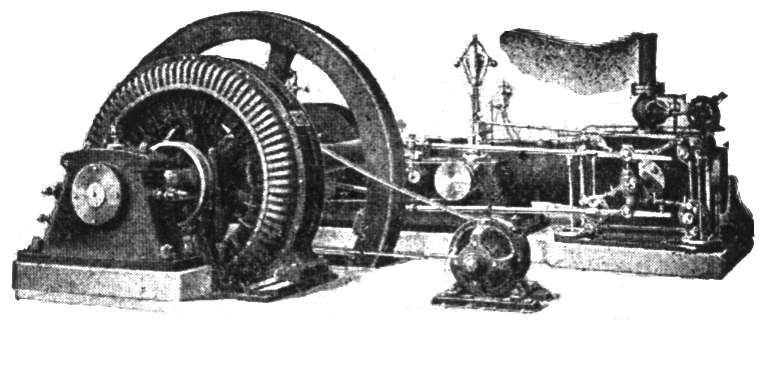
For large, or older, generators, it is usual for a separate exciter dynamo to be powered in parallel with the main power generator. This is a small permanent-magnet or battery-excited dynamo that produces the field current for the larger generator.
Modern generators with field coils are usually self-excited; i.e., some of the power output from the rotor is used to power the field coils. The rotor iron retains a degree of residual magnetism when the generator is turned off. The generator is started with no load connected; the initial weak field induces a weak current in the rotor coils, which in turn creates an initial field current, increasing the field strength, thus increasing the induced current in the rotor, and so on in a feedback process until the machine "builds up" to full voltage.
Self-excited generators must be started without any external load attached. Any external load will sink the electrical power from the generator before the capacity to generate electrical power can increase.
Excitation (magnetic)
In electromagnetism, excitation is the process of generating a magnetic field by means of an electric current.
An electric generator or electric motor consists of a rotor spinning in a magnetic field. The magnetic field may be produced by permanent magnets or by field coils. In the case of a machine with field coils, a current must flow in the coils to generate (excite) the field, otherwise no power is transferred to or from the rotor. Field coils yield the most flexible form of magnetic flux regulation and de-regulation, but at the expense of a flow of electric current. Hybrid topologies exist, which incorporate both permanent magnets and field coils in the same configuration. The flexible excitation of a rotating electrical machine is employed by either brushless excitation techniques or by the injection of current by carbon brushes (static excitation).
For a machine using field coils, as is the case in most large generators, the field must be established by a current in order for the generator to produce electricity. Although some of the generator's own output can be used to maintain the field once it starts up, an external source of current is needed for starting the generator. In any case, it is important to be able to control the field since this will maintain the system voltage.
Except for permanent magnet generators, a generator produces output voltage proportional to the magnetic flux, which is the sum of flux from the magnetization of the structure and the flux proportional to the field produced by the excitation current. If there is no excitation current the flux is tiny and the armature voltage is almost nil.
The field current controls the generated voltage allowing a power system’s voltage to be regulated to remove the effect of increasing armature current causing increased voltage drop in the armature winding conductors. In a system with multiple generators and a constant system voltage the current and power delivered by an individual generator is regulated by the field current. A generator is a current to voltage, or transimpedance amplifier. To avoid damage from progressively larger over-corrections, the field current must be adjusted more slowly than the effect of the adjustment propagates through the power system.
For large, or older, generators, it is usual for a separate exciter dynamo to be powered in parallel with the main power generator. This is a small permanent-magnet or battery-excited dynamo that produces the field current for the larger generator.
Modern generators with field coils are usually self-excited; i.e., some of the power output from the rotor is used to power the field coils. The rotor iron retains a degree of residual magnetism when the generator is turned off. The generator is started with no load connected; the initial weak field induces a weak current in the rotor coils, which in turn creates an initial field current, increasing the field strength, thus increasing the induced current in the rotor, and so on in a feedback process until the machine "builds up" to full voltage.
Self-excited generators must be started without any external load attached. Any external load will sink the electrical power from the generator before the capacity to generate electrical power can increase.
Recent media
Recent media