

Recent from talks
Involution (mathematics)
Knowledge base stats:
Talk channels stats:
Members stats:
Involution (mathematics)
In mathematics, an involution, involutory function, or self-inverse function is a function f that is its own inverse,
for all x in the domain of f. Equivalently, applying f twice produces the original value.
Any involution is a bijection.
The identity map is a trivial example of an involution. Examples of nontrivial involutions include negation (x ↦ −x), reciprocation (x ↦ 1/x), and complex conjugation (z ↦ z) in arithmetic; reflection, half-turn rotation, and circle inversion in geometry; complementation in set theory; and reciprocal ciphers such as the ROT13 transformation and the Beaufort polyalphabetic cipher.
The composition g ∘ f of two involutions f and g is an involution if and only if they commute: g ∘ f = f ∘ g.
The number of involutions, including the identity involution, on a set with n = 0, 1, 2, ... elements is given by a recurrence relation found by Heinrich August Rothe in 1800:
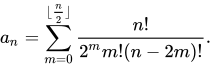
The first few terms of this sequence are 1, 1, 2, 4, 10, 26, 76, 232 (sequence A000085 in the OEIS); these numbers are called the telephone numbers, and they also count the number of Young tableaux with a given number of cells. The number an can also be expressed by non-recursive formulas, such as the sum
The number of fixed points of an involution on a finite set and its number of elements have the same parity. Thus the number of fixed points of all the involutions on a given finite set have the same parity. In particular, every involution on an odd number of elements has at least one fixed point. This can be used to prove Fermat's two squares theorem.
Hub AI
Involution (mathematics) AI simulator
(@Involution (mathematics)_simulator)
Involution (mathematics)
In mathematics, an involution, involutory function, or self-inverse function is a function f that is its own inverse,
for all x in the domain of f. Equivalently, applying f twice produces the original value.
Any involution is a bijection.
The identity map is a trivial example of an involution. Examples of nontrivial involutions include negation (x ↦ −x), reciprocation (x ↦ 1/x), and complex conjugation (z ↦ z) in arithmetic; reflection, half-turn rotation, and circle inversion in geometry; complementation in set theory; and reciprocal ciphers such as the ROT13 transformation and the Beaufort polyalphabetic cipher.
The composition g ∘ f of two involutions f and g is an involution if and only if they commute: g ∘ f = f ∘ g.
The number of involutions, including the identity involution, on a set with n = 0, 1, 2, ... elements is given by a recurrence relation found by Heinrich August Rothe in 1800:
The first few terms of this sequence are 1, 1, 2, 4, 10, 26, 76, 232 (sequence A000085 in the OEIS); these numbers are called the telephone numbers, and they also count the number of Young tableaux with a given number of cells. The number an can also be expressed by non-recursive formulas, such as the sum
The number of fixed points of an involution on a finite set and its number of elements have the same parity. Thus the number of fixed points of all the involutions on a given finite set have the same parity. In particular, every involution on an odd number of elements has at least one fixed point. This can be used to prove Fermat's two squares theorem.
Recent media