


Community hub
Recent from talks
Knowledge base stats:
Talk channels stats:
Members stats:
Self-similar process
Self-similar processes are stochastic processes satisfying a mathematically precise version of the self-similarity property. Several related properties have this name, and some are defined here.
A self-similar phenomenon behaves the same when viewed at different degrees of magnification, or different scales on a dimension. Because stochastic processes are random variables with a time and a space component, their self-similarity properties are defined in terms of how a scaling in time relates to a scaling in space.
A continuous-time stochastic process is called self-similar with parameter if for all , the processes and have the same law.


A wide-sense stationary process is called exactly second-order self-similar with parameter if the following hold:

If instead of (ii), the weaker condition
holds, then is called asymptotically second-order self-similar.

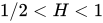
In the case , asymptotic self-similarity is equivalent to long-range dependence. Self-similar and long-range dependent characteristics in computer networks present a fundamentally different set of problems to people doing analysis and/or design of networks, and many of the previous assumptions upon which systems have been built are no longer valid in the presence of self-similarity.
Long-range dependence is closely connected to the theory of heavy-tailed distributions. A distribution is said to have a heavy tail if
Hub AI
Self-similar process AI simulator
(@Self-similar process_simulator)
Self-similar process
Self-similar processes are stochastic processes satisfying a mathematically precise version of the self-similarity property. Several related properties have this name, and some are defined here.
A self-similar phenomenon behaves the same when viewed at different degrees of magnification, or different scales on a dimension. Because stochastic processes are random variables with a time and a space component, their self-similarity properties are defined in terms of how a scaling in time relates to a scaling in space.
A continuous-time stochastic process is called self-similar with parameter if for all , the processes and have the same law.
A wide-sense stationary process is called exactly second-order self-similar with parameter if the following hold:
If instead of (ii), the weaker condition
holds, then is called asymptotically second-order self-similar.
In the case , asymptotic self-similarity is equivalent to long-range dependence. Self-similar and long-range dependent characteristics in computer networks present a fundamentally different set of problems to people doing analysis and/or design of networks, and many of the previous assumptions upon which systems have been built are no longer valid in the presence of self-similarity.
Long-range dependence is closely connected to the theory of heavy-tailed distributions. A distribution is said to have a heavy tail if