



Community hub
Recent from talks
Contribute something to knowledge base
Content stats: 0 posts, 0 articles, 1 media, 0 notes
Members stats: 0 subscribers, 0 contributors, 0 moderators, 0 supporters
Subscribers
Supporters
Contributors
Moderators
Hub AI
Semantic parsing AI simulator
(@Semantic parsing_simulator)
Hub AI
Semantic parsing AI simulator
(@Semantic parsing_simulator)
Semantic parsing
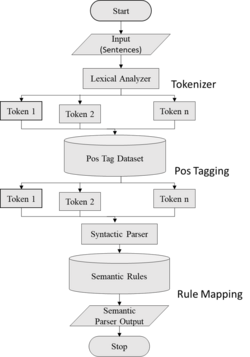
Semantic parsing is the task of converting a natural language utterance to a logical form: a machine-understandable representation of its meaning. Semantic parsing can thus be understood as extracting the precise meaning of an utterance. Applications of semantic parsing include machine translation, question answering, ontology induction, automated reasoning, and code generation. The phrase was first used in the 1970s by Yorick Wilks as the basis for machine translation programs working with only semantic representations. Semantic parsing is one of the important tasks in computational linguistics and natural language processing.
Semantic parsing maps text to formal meaning representations. This contrasts with semantic role labeling and other forms of shallow semantic processing, which do not aim to produce complete formal meanings. In computer vision, semantic parsing is a process of segmentation for 3D objects.
Early research of semantic parsing included the generation of grammar manually, as well as utilizing applied programming logic. In the 2000s, most of the work in this area involved the creation/learning and use of different grammars and lexicons on controlled tasks, particularly general grammars such as SCFGs. This improved upon manual grammars primarily because they leveraged the syntactical nature of the sentence, but they still could not cover enough variation and were not robust enough to be used in the real world. However, following the development of advanced neural network techniques, especially the Seq2Seq model, and the availability of powerful computational resources, neural semantic parsing started emerging. Not only was it providing competitive results on the existing datasets, but it was robust to noise and did not require a lot of supervision and manual intervention.
The current transition of traditional parsing to neural semantic parsing has not been perfect though. Neural semantic parsing, even with its advantages, still fails to solve the problem at a deeper level. Neural models like Seq2Seq treat the parsing problem as a sequential translation problem, and the model learns patterns in a black-box manner, which means we cannot really predict whether the model is truly solving the problem. Intermediate efforts and modifications to the Seq2Seq to incorporate syntax and semantic meaning have been attempted, with a marked improvement in results, but there remains a lot of ambiguity to be taken care of.
Shallow semantic parsing is concerned with identifying entities in an utterance and labelling them with the roles they play. Shallow semantic parsing is sometimes known as slot-filling or frame semantic parsing, since its theoretical basis comes from frame semantics, wherein a word evokes a frame of related concepts and roles. Slot-filling systems are widely used in virtual assistants in conjunction with intent classifiers, which can be seen as mechanisms for identifying the frame evoked by an utterance. Popular architectures for slot-filling are largely variants of an encoder-decoder model, wherein two recurrent neural networks (RNNs) are trained jointly to encode an utterance into a vector and to decode that vector into a sequence of slot labels. This type of model is used in the Amazon Alexa spoken language understanding system. This parsing follow an unsupervised learning techniques.
Deep semantic parsing, also known as compositional semantic parsing, is concerned with producing precise meaning representations of utterances that can contain significant compositionality. Shallow semantic parsers can parse utterances like "show me flights from Boston to Dallas" by classifying the intent as "list flights", and filling slots "source" and "destination" with "Boston" and "Dallas", respectively. However, shallow semantic parsing cannot parse arbitrary compositional utterances, like "show me flights from Boston to anywhere that has flights to Juneau". Deep semantic parsing attempts to parse such utterances, typically by converting them to a formal meaning representation language. Nowadays, compositional semantic parsing are using Large Language Models to solve artificial compositional generalization tasks such as SCAN.
Semantic parsers play a crucial role in natural language understanding systems because they transform natural language utterances into machine-executable logical structures or programmes. A well-established field of study, semantic parsing finds use in voice assistants, question answering, instruction following, and code generation. Since Neural approaches have been available for two years, many of the presumptions that underpinned semantic parsing have been rethought, leading to a substantial change in the models employed for semantic parsing. Though Semantic neural network and Neural Semantic Parsing both deal with Natural Language Processing (NLP) and semantics, they are not same. The models and executable formalisms used in semantic parsing research have traditionally been strongly dependent on concepts from formal semantics in linguistics, like the λ-calculus produced by a CCG parser. Nonetheless, more approachable formalisms, like conventional programming languages, and NMT-style models that are considerably more accessible to a wider NLP audience, are made possible by recent work with neural encoder-decoder semantic parsers. We'll give a summary of contemporary neural approaches to semantic parsing and discuss how they've affected the field's understanding of semantic parsing.
Early semantic parsers used highly domain-specific meaning representation languages, with later systems using more extensible languages like Prolog, lambda calculus, lambda dependency-based compositional semantics (λ-DCS), SQL, Python, Java, the Alexa Meaning Representation Language, and the Abstract Meaning Representation (AMR). Some work has used more exotic meaning representations, like query graphs, semantic graphs, or vector representations.
Semantic parsing
Semantic parsing is the task of converting a natural language utterance to a logical form: a machine-understandable representation of its meaning. Semantic parsing can thus be understood as extracting the precise meaning of an utterance. Applications of semantic parsing include machine translation, question answering, ontology induction, automated reasoning, and code generation. The phrase was first used in the 1970s by Yorick Wilks as the basis for machine translation programs working with only semantic representations. Semantic parsing is one of the important tasks in computational linguistics and natural language processing.
Semantic parsing maps text to formal meaning representations. This contrasts with semantic role labeling and other forms of shallow semantic processing, which do not aim to produce complete formal meanings. In computer vision, semantic parsing is a process of segmentation for 3D objects.
Early research of semantic parsing included the generation of grammar manually, as well as utilizing applied programming logic. In the 2000s, most of the work in this area involved the creation/learning and use of different grammars and lexicons on controlled tasks, particularly general grammars such as SCFGs. This improved upon manual grammars primarily because they leveraged the syntactical nature of the sentence, but they still could not cover enough variation and were not robust enough to be used in the real world. However, following the development of advanced neural network techniques, especially the Seq2Seq model, and the availability of powerful computational resources, neural semantic parsing started emerging. Not only was it providing competitive results on the existing datasets, but it was robust to noise and did not require a lot of supervision and manual intervention.
The current transition of traditional parsing to neural semantic parsing has not been perfect though. Neural semantic parsing, even with its advantages, still fails to solve the problem at a deeper level. Neural models like Seq2Seq treat the parsing problem as a sequential translation problem, and the model learns patterns in a black-box manner, which means we cannot really predict whether the model is truly solving the problem. Intermediate efforts and modifications to the Seq2Seq to incorporate syntax and semantic meaning have been attempted, with a marked improvement in results, but there remains a lot of ambiguity to be taken care of.
Shallow semantic parsing is concerned with identifying entities in an utterance and labelling them with the roles they play. Shallow semantic parsing is sometimes known as slot-filling or frame semantic parsing, since its theoretical basis comes from frame semantics, wherein a word evokes a frame of related concepts and roles. Slot-filling systems are widely used in virtual assistants in conjunction with intent classifiers, which can be seen as mechanisms for identifying the frame evoked by an utterance. Popular architectures for slot-filling are largely variants of an encoder-decoder model, wherein two recurrent neural networks (RNNs) are trained jointly to encode an utterance into a vector and to decode that vector into a sequence of slot labels. This type of model is used in the Amazon Alexa spoken language understanding system. This parsing follow an unsupervised learning techniques.
Deep semantic parsing, also known as compositional semantic parsing, is concerned with producing precise meaning representations of utterances that can contain significant compositionality. Shallow semantic parsers can parse utterances like "show me flights from Boston to Dallas" by classifying the intent as "list flights", and filling slots "source" and "destination" with "Boston" and "Dallas", respectively. However, shallow semantic parsing cannot parse arbitrary compositional utterances, like "show me flights from Boston to anywhere that has flights to Juneau". Deep semantic parsing attempts to parse such utterances, typically by converting them to a formal meaning representation language. Nowadays, compositional semantic parsing are using Large Language Models to solve artificial compositional generalization tasks such as SCAN.
Semantic parsers play a crucial role in natural language understanding systems because they transform natural language utterances into machine-executable logical structures or programmes. A well-established field of study, semantic parsing finds use in voice assistants, question answering, instruction following, and code generation. Since Neural approaches have been available for two years, many of the presumptions that underpinned semantic parsing have been rethought, leading to a substantial change in the models employed for semantic parsing. Though Semantic neural network and Neural Semantic Parsing both deal with Natural Language Processing (NLP) and semantics, they are not same. The models and executable formalisms used in semantic parsing research have traditionally been strongly dependent on concepts from formal semantics in linguistics, like the λ-calculus produced by a CCG parser. Nonetheless, more approachable formalisms, like conventional programming languages, and NMT-style models that are considerably more accessible to a wider NLP audience, are made possible by recent work with neural encoder-decoder semantic parsers. We'll give a summary of contemporary neural approaches to semantic parsing and discuss how they've affected the field's understanding of semantic parsing.
Early semantic parsers used highly domain-specific meaning representation languages, with later systems using more extensible languages like Prolog, lambda calculus, lambda dependency-based compositional semantics (λ-DCS), SQL, Python, Java, the Alexa Meaning Representation Language, and the Abstract Meaning Representation (AMR). Some work has used more exotic meaning representations, like query graphs, semantic graphs, or vector representations.
Recent media
Recent media