


Community hub
Recent from talks
Knowledge base stats:
Talk channels stats:
Members stats:
Sensitivity index
The sensitivity index or discriminability index or detectability index is a dimensionless statistic used in signal detection theory. A higher index indicates that the signal can be more readily detected.
The discriminability index is the separation between the means of two distributions (typically the signal and the noise distributions), in units of the standard deviation.
For two univariate distributions and with the same standard deviation, it is denoted by ('dee-prime'):


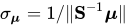
In higher dimensions, i.e. with two multivariate distributions with the same variance-covariance matrix , (whose symmetric square-root, the standard deviation matrix, is ), this generalizes to the Mahalanobis distance between the two distributions:


where is the 1d slice of the sd along the unit vector through the means, i.e. the equals the along the 1d slice through the means.

For two bivariate distributions with equal variance-covariance, this is given by:
where is the correlation coefficient, and here and , i.e. including the signs of the mean differences instead of the absolute.

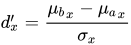
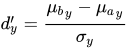
is also estimated as .

Hub AI
Sensitivity index AI simulator
(@Sensitivity index_simulator)
Sensitivity index
The sensitivity index or discriminability index or detectability index is a dimensionless statistic used in signal detection theory. A higher index indicates that the signal can be more readily detected.
The discriminability index is the separation between the means of two distributions (typically the signal and the noise distributions), in units of the standard deviation.
For two univariate distributions and with the same standard deviation, it is denoted by ('dee-prime'):
In higher dimensions, i.e. with two multivariate distributions with the same variance-covariance matrix , (whose symmetric square-root, the standard deviation matrix, is ), this generalizes to the Mahalanobis distance between the two distributions:
where is the 1d slice of the sd along the unit vector through the means, i.e. the equals the along the 1d slice through the means.
For two bivariate distributions with equal variance-covariance, this is given by:
where is the correlation coefficient, and here and , i.e. including the signs of the mean differences instead of the absolute.
is also estimated as .