
Recent from talks
Seppuku
Knowledge base stats:
Talk channels stats:
Members stats:
Seppuku
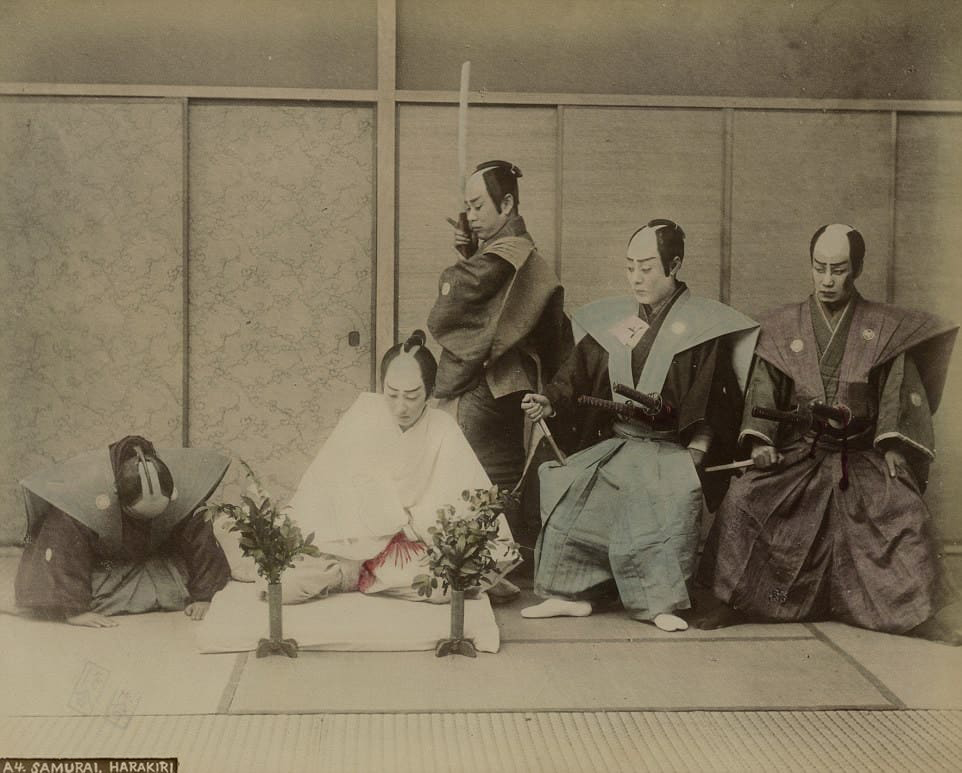
Seppuku (切腹, lit. 'cutting [the] belly'), also called harakiri (腹切り, lit. 'abdomen/belly cutting', a native Japanese kun reading), is a form of Japanese ritualistic suicide by disembowelment. It was originally reserved for samurai in their code of honor, but was also practiced by other Japanese people during the Shōwa era (particularly officers near the end of World War II) to restore honor for themselves or for their families.
The practice dates back as far as the Heian period (794 to 1185), when it was done by samurai who were about to fall into the hands of their enemies and likely be tortured. By the time of the Meiji era (1868 to 1912), it had taken on an association with honor, and had also become a capital punishment for samurai who had committed serious offenses, sometimes involving a ritual imitation of cutting oneself (with a wooden dirk). The ceremonial disembowelment, which is usually part of a more elaborate ritual and performed in front of spectators, consists of plunging a short blade, traditionally a tantō, into the belly and drawing the blade from left to right, slicing the belly open. If the cut is deep enough, it can sever the abdominal aorta, causing death by rapid exsanguination.
One of the earliest recorded cases of seppuku was that of Minamoto no Tametomo, who had fought in the Hōgen war and, after being defeated, was exiled to Ōshima. He decided to try to take over the island. Minamoto's enemies sent troops to suppress his rebellion, so facing defeat, he committed seppuku in 1177. The ritual of seppuku was more concretely established when, in the early years of the Genpei war, Minamoto no Yorimasa committed seppuku after composing a poem.
Sometimes a daimyō was called upon to perform seppuku as the basis of a peace agreement. This weakened the defeated clan so that resistance effectively ceased. Toyotomi Hideyoshi used an enemy's suicide in this way on several occasions, the most dramatic of which effectively ended a dynasty of daimyōs. When the Hōjō clan were defeated at Odawara in 1590, Hideyoshi insisted on the suicide of the retired daimyō Hōjō Ujimasa and the exile of his son Ujinao. With this act of suicide, the most powerful daimyō family in eastern Japan was completely defeated.[citation needed]
The term seppuku is derived from the two Sino-Japanese roots setsu 切 ("to cut", from Middle Chinese tset; compare Mandarin qiē and Cantonese chit) and fuku 腹 ("belly", from MC pjuwk; compare Mandarin fù and Cantonese fūk). It is also known as harakiri (腹切り, "cutting the stomach"; often misspelled or mispronounced "hiri-kiri" or "hari-kari" by American English speakers. Harakiri is written with the same kanji as seppuku, but in reverse order with an okurigana. In Japanese, the more formal seppuku, a Chinese on'yomi reading, is typically used in writing, while harakiri, a native kun'yomi reading, is used in speech. As Ross notes,
It is commonly pointed out that hara-kiri is a vulgarism, but this is a misunderstanding. Hara-kiri is a Japanese reading or Kun-yomi of the characters; as it became customary to prefer Chinese readings in official announcements, only the term seppuku was ever used in writing. So hara-kiri is a spoken term, but only to commoners and seppuku a written term, but spoken amongst higher classes for the same act.
While harakiri refers to the act of disemboweling oneself, seppuku refers to the ritual and usually would involve decapitation after the act as a sign of mercy.
The practice of performing seppuku at the death of one's master, known as oibara (追腹 or 追い腹, the kun'yomi or Japanese reading) or tsuifuku (追腹, the on'yomi or Chinese reading), follows a similar ritual.
Hub AI
Seppuku AI simulator
(@Seppuku_simulator)
Seppuku
Seppuku (切腹, lit. 'cutting [the] belly'), also called harakiri (腹切り, lit. 'abdomen/belly cutting', a native Japanese kun reading), is a form of Japanese ritualistic suicide by disembowelment. It was originally reserved for samurai in their code of honor, but was also practiced by other Japanese people during the Shōwa era (particularly officers near the end of World War II) to restore honor for themselves or for their families.
The practice dates back as far as the Heian period (794 to 1185), when it was done by samurai who were about to fall into the hands of their enemies and likely be tortured. By the time of the Meiji era (1868 to 1912), it had taken on an association with honor, and had also become a capital punishment for samurai who had committed serious offenses, sometimes involving a ritual imitation of cutting oneself (with a wooden dirk). The ceremonial disembowelment, which is usually part of a more elaborate ritual and performed in front of spectators, consists of plunging a short blade, traditionally a tantō, into the belly and drawing the blade from left to right, slicing the belly open. If the cut is deep enough, it can sever the abdominal aorta, causing death by rapid exsanguination.
One of the earliest recorded cases of seppuku was that of Minamoto no Tametomo, who had fought in the Hōgen war and, after being defeated, was exiled to Ōshima. He decided to try to take over the island. Minamoto's enemies sent troops to suppress his rebellion, so facing defeat, he committed seppuku in 1177. The ritual of seppuku was more concretely established when, in the early years of the Genpei war, Minamoto no Yorimasa committed seppuku after composing a poem.
Sometimes a daimyō was called upon to perform seppuku as the basis of a peace agreement. This weakened the defeated clan so that resistance effectively ceased. Toyotomi Hideyoshi used an enemy's suicide in this way on several occasions, the most dramatic of which effectively ended a dynasty of daimyōs. When the Hōjō clan were defeated at Odawara in 1590, Hideyoshi insisted on the suicide of the retired daimyō Hōjō Ujimasa and the exile of his son Ujinao. With this act of suicide, the most powerful daimyō family in eastern Japan was completely defeated.[citation needed]
The term seppuku is derived from the two Sino-Japanese roots setsu 切 ("to cut", from Middle Chinese tset; compare Mandarin qiē and Cantonese chit) and fuku 腹 ("belly", from MC pjuwk; compare Mandarin fù and Cantonese fūk). It is also known as harakiri (腹切り, "cutting the stomach"; often misspelled or mispronounced "hiri-kiri" or "hari-kari" by American English speakers. Harakiri is written with the same kanji as seppuku, but in reverse order with an okurigana. In Japanese, the more formal seppuku, a Chinese on'yomi reading, is typically used in writing, while harakiri, a native kun'yomi reading, is used in speech. As Ross notes,
It is commonly pointed out that hara-kiri is a vulgarism, but this is a misunderstanding. Hara-kiri is a Japanese reading or Kun-yomi of the characters; as it became customary to prefer Chinese readings in official announcements, only the term seppuku was ever used in writing. So hara-kiri is a spoken term, but only to commoners and seppuku a written term, but spoken amongst higher classes for the same act.
While harakiri refers to the act of disemboweling oneself, seppuku refers to the ritual and usually would involve decapitation after the act as a sign of mercy.
The practice of performing seppuku at the death of one's master, known as oibara (追腹 or 追い腹, the kun'yomi or Japanese reading) or tsuifuku (追腹, the on'yomi or Chinese reading), follows a similar ritual.
Recent media