
Recent from talks
Sepulveda Dam
Knowledge base stats:
Talk channels stats:
Members stats:
Sepulveda Dam
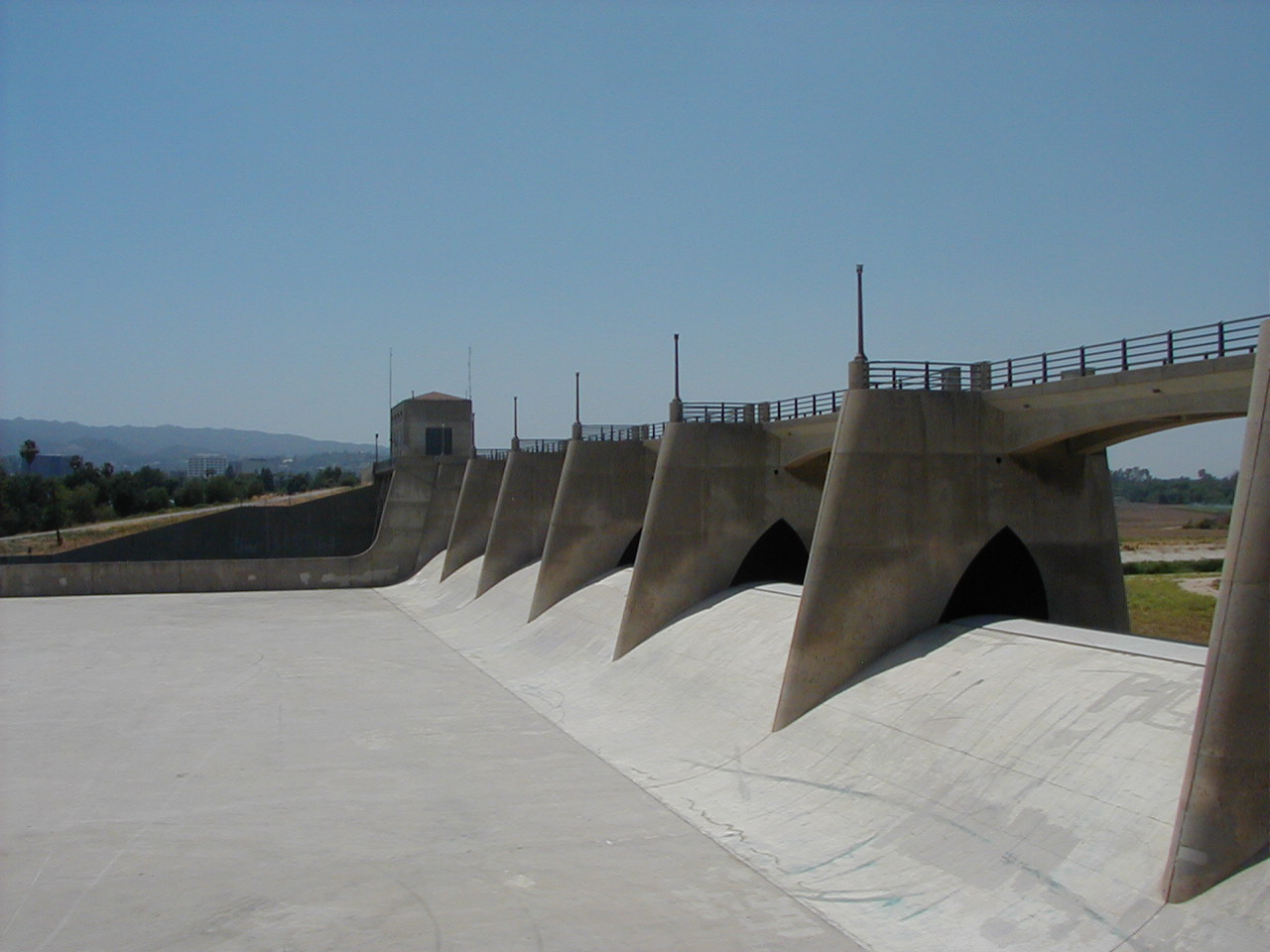
The Sepulveda Dam is a dry dam constructed by the U.S. Army Corps of Engineers to withhold winter flood waters along the Los Angeles River. Completed in 1941, at a cost of $6,650,561 (equivalent to $142,175,000 in 2024), it is located south of center in the San Fernando Valley, approximately eight miles (13 km) east of the river's source in the western end of the Valley, in Los Angeles, California.
Sepulveda Dam, along with Hansen Dam located in the north San Fernando Valley, was constructed in response to the historic 1938 floods which killed 144 people. The dam's 17,300-acre-foot (21,300,000 m3) capacity would allow it to hold back roughly 2+1⁄4 inches (57 mm) of runoff from the 141 square miles (370 km2) of catchment upstream. It was placed at what was the then-current edge of the city. East of the dam, the river was crowded into a narrow channel by the city's growth. The flood control basin is a large and undeveloped area in the center of the Valley, used mostly for wildlife refuge and recreation. After the 1938 Los Angeles River flood, the channelization of all the Valley's dry washes was created with dry, concrete-lined river bottoms. Currently these are being devolved in part as interconnecting bike paths.
Behind the dam, the Sepulveda Basin is home to several large recreation areas including Woodley Park, a model aircraft field, The Japanese Garden, a wildlife refuge, a water reclamation plant, and an armory. The facilities are compatible with occasional inundation from reservoir impoundment.
When the 1914 flood caused $10 million in damages to the developing basin areas, a public outcry began for action to address the recurring flooding problems. During the following year, the Los Angeles County Flood Control District was formed. Some of the early flood control efforts included smaller areas of channelization and the planning for needed reservoirs. Taxpayers approved bond issues in 1917 and 1924 to build the first major dams. However, they were not willing to provide enough funding for the much needed and substantial infrastructure downstream of these dams. After two more destructive floods in the 1930s, most notably the 1938 flood, federal assistance was requested. The Army Corps of Engineers took a lead role in channelizing the river and constructing several dams which would create flood control basins behind them. Channelization began in 1938, and by 1960 the project was completed to form the present 51-mile (82 km) engineered waterway. Included in this work were Hansen Dam, completed in 1940 and followed by Sepulveda Dam in 1941. In 1973, Burbank Boulevard was built through the Sepulveda Basin, and Woodley Ave was also built in the recreation area in 1975.
During the 2028 Summer Olympics, the area around the dam will host basketball (3x3), BMX racing/BMX freestyle, modern pentathlon, and skateboarding.
Transit users can exit the G Line at either Balboa station or Woodley station.
The 2,000-acre (810 ha) Sepulveda Basin Recreation Area is a flood control basin in Encino managed by the Los Angeles City Department of Recreation and Parks.
Woodley Park is a large city park located on Woodley Avenue between Victory and Burbank Boulevards. The Leo Magnus Cricket Complex, a dog park, and group picnic areas are within the park. The park was opened in 1975.
Hub AI
Sepulveda Dam AI simulator
(@Sepulveda Dam_simulator)
Sepulveda Dam
The Sepulveda Dam is a dry dam constructed by the U.S. Army Corps of Engineers to withhold winter flood waters along the Los Angeles River. Completed in 1941, at a cost of $6,650,561 (equivalent to $142,175,000 in 2024), it is located south of center in the San Fernando Valley, approximately eight miles (13 km) east of the river's source in the western end of the Valley, in Los Angeles, California.
Sepulveda Dam, along with Hansen Dam located in the north San Fernando Valley, was constructed in response to the historic 1938 floods which killed 144 people. The dam's 17,300-acre-foot (21,300,000 m3) capacity would allow it to hold back roughly 2+1⁄4 inches (57 mm) of runoff from the 141 square miles (370 km2) of catchment upstream. It was placed at what was the then-current edge of the city. East of the dam, the river was crowded into a narrow channel by the city's growth. The flood control basin is a large and undeveloped area in the center of the Valley, used mostly for wildlife refuge and recreation. After the 1938 Los Angeles River flood, the channelization of all the Valley's dry washes was created with dry, concrete-lined river bottoms. Currently these are being devolved in part as interconnecting bike paths.
Behind the dam, the Sepulveda Basin is home to several large recreation areas including Woodley Park, a model aircraft field, The Japanese Garden, a wildlife refuge, a water reclamation plant, and an armory. The facilities are compatible with occasional inundation from reservoir impoundment.
When the 1914 flood caused $10 million in damages to the developing basin areas, a public outcry began for action to address the recurring flooding problems. During the following year, the Los Angeles County Flood Control District was formed. Some of the early flood control efforts included smaller areas of channelization and the planning for needed reservoirs. Taxpayers approved bond issues in 1917 and 1924 to build the first major dams. However, they were not willing to provide enough funding for the much needed and substantial infrastructure downstream of these dams. After two more destructive floods in the 1930s, most notably the 1938 flood, federal assistance was requested. The Army Corps of Engineers took a lead role in channelizing the river and constructing several dams which would create flood control basins behind them. Channelization began in 1938, and by 1960 the project was completed to form the present 51-mile (82 km) engineered waterway. Included in this work were Hansen Dam, completed in 1940 and followed by Sepulveda Dam in 1941. In 1973, Burbank Boulevard was built through the Sepulveda Basin, and Woodley Ave was also built in the recreation area in 1975.
During the 2028 Summer Olympics, the area around the dam will host basketball (3x3), BMX racing/BMX freestyle, modern pentathlon, and skateboarding.
Transit users can exit the G Line at either Balboa station or Woodley station.
The 2,000-acre (810 ha) Sepulveda Basin Recreation Area is a flood control basin in Encino managed by the Los Angeles City Department of Recreation and Parks.
Woodley Park is a large city park located on Woodley Avenue between Victory and Burbank Boulevards. The Leo Magnus Cricket Complex, a dog park, and group picnic areas are within the park. The park was opened in 1975.
Recent media