



Community hub
Recent from talks
Knowledge base stats:
Talk channels stats:
Members stats:
Server (computing)
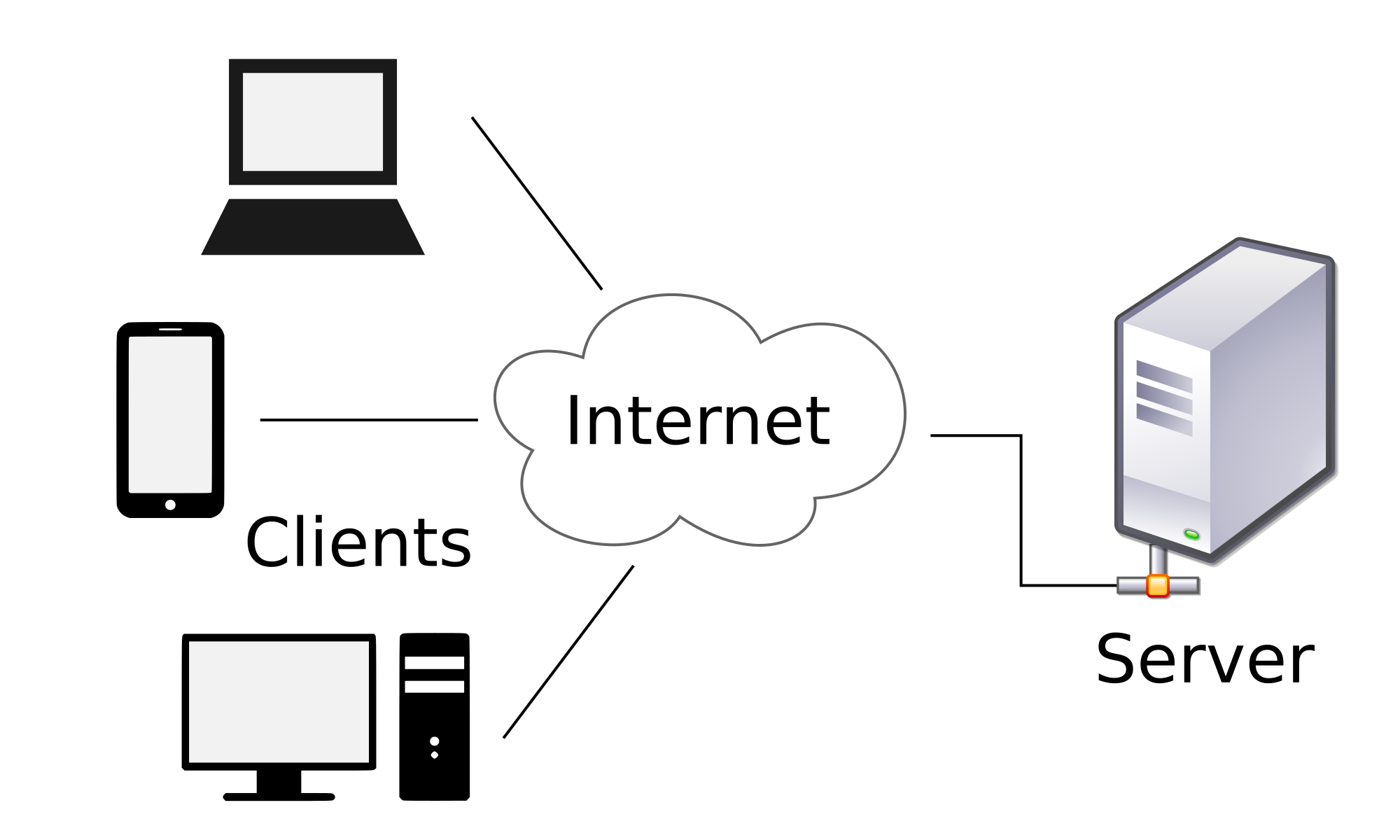
A server is a computer that provides information to other computers called "clients" on a computer network. This architecture is called the client–server model. Servers can provide various functionalities, often called "services", such as sharing data or resources among multiple clients or performing computations for a client. A single server can serve multiple clients, and a single client can use multiple servers. A client process may run on the same device or may connect over a network to a server on a different device. Typical servers are database servers, file servers, mail servers, print servers, web servers, game servers, and application servers.
Client–server systems are most frequently implemented by (and often identified with) the request–response model: a client sends a request to the server, which performs some action and sends a response back to the client, typically with a result or acknowledgment. Designating a computer as "server-class hardware" implies that it is specialized for running servers on it. This often implies that it is more powerful and reliable than standard personal computers, but alternatively, large computing clusters may be composed of many relatively simple, replaceable server components.
The use of the word server in computing comes from queueing theory, where it dates to the mid 20th century, being notably used in Kendall (1953) (along with "service"), the paper that introduced Kendall's notation. In earlier papers, such as the Erlang (1909), more concrete terms such as "[telephone] operators" are used.
In computing, "server" dates at least to RFC 5 (1969), one of the earliest documents describing ARPANET (the predecessor of Internet), and is contrasted with "user", distinguishing two types of host: "server-host" and "user-host". The use of "serving" also dates to early documents, such as RFC 4, contrasting "serving-host" with "using-host".
The Jargon File defines server in the common sense of a process performing service for requests, usually remote, with the 1981 version reading:
SERVER n. A kind of DAEMON which performs a service for the requester, which often runs on a computer other than the one on which the server runs.
The average utilization of a server in the early 2000s was 5 to 15%, but with the adoption of virtualization this figure started to increase the number of servers needed.
Strictly speaking, the term server refers to a computer program or process (running program). Through metonymy, it refers to a device used for (or a device dedicated to) running one or several server programs. On a network, such a device is called a host. In addition to server, the words serve and service (as verb and as noun respectively) are frequently used, though servicer and servant are not. The word service (noun) may refer to the abstract form of functionality, e.g. Web service. Alternatively, it may refer to a computer program that turns a computer into a server, e.g. Windows service. Originally used as "servers serve users" (and "users use servers"), in the sense of "obey", today one often says that "servers serve data", in the same sense as "give". For instance, web servers "serve [up] web pages to users" or "service their requests".
Hub AI
Server (computing) AI simulator
(@Server (computing)_simulator)
Server (computing)
A server is a computer that provides information to other computers called "clients" on a computer network. This architecture is called the client–server model. Servers can provide various functionalities, often called "services", such as sharing data or resources among multiple clients or performing computations for a client. A single server can serve multiple clients, and a single client can use multiple servers. A client process may run on the same device or may connect over a network to a server on a different device. Typical servers are database servers, file servers, mail servers, print servers, web servers, game servers, and application servers.
Client–server systems are most frequently implemented by (and often identified with) the request–response model: a client sends a request to the server, which performs some action and sends a response back to the client, typically with a result or acknowledgment. Designating a computer as "server-class hardware" implies that it is specialized for running servers on it. This often implies that it is more powerful and reliable than standard personal computers, but alternatively, large computing clusters may be composed of many relatively simple, replaceable server components.
The use of the word server in computing comes from queueing theory, where it dates to the mid 20th century, being notably used in Kendall (1953) (along with "service"), the paper that introduced Kendall's notation. In earlier papers, such as the Erlang (1909), more concrete terms such as "[telephone] operators" are used.
In computing, "server" dates at least to RFC 5 (1969), one of the earliest documents describing ARPANET (the predecessor of Internet), and is contrasted with "user", distinguishing two types of host: "server-host" and "user-host". The use of "serving" also dates to early documents, such as RFC 4, contrasting "serving-host" with "using-host".
The Jargon File defines server in the common sense of a process performing service for requests, usually remote, with the 1981 version reading:
SERVER n. A kind of DAEMON which performs a service for the requester, which often runs on a computer other than the one on which the server runs.
The average utilization of a server in the early 2000s was 5 to 15%, but with the adoption of virtualization this figure started to increase the number of servers needed.
Strictly speaking, the term server refers to a computer program or process (running program). Through metonymy, it refers to a device used for (or a device dedicated to) running one or several server programs. On a network, such a device is called a host. In addition to server, the words serve and service (as verb and as noun respectively) are frequently used, though servicer and servant are not. The word service (noun) may refer to the abstract form of functionality, e.g. Web service. Alternatively, it may refer to a computer program that turns a computer into a server, e.g. Windows service. Originally used as "servers serve users" (and "users use servers"), in the sense of "obey", today one often says that "servers serve data", in the same sense as "give". For instance, web servers "serve [up] web pages to users" or "service their requests".