



Community hub
Recent from talks
Knowledge base stats:
Talk channels stats:
Members stats:
Severn Tunnel
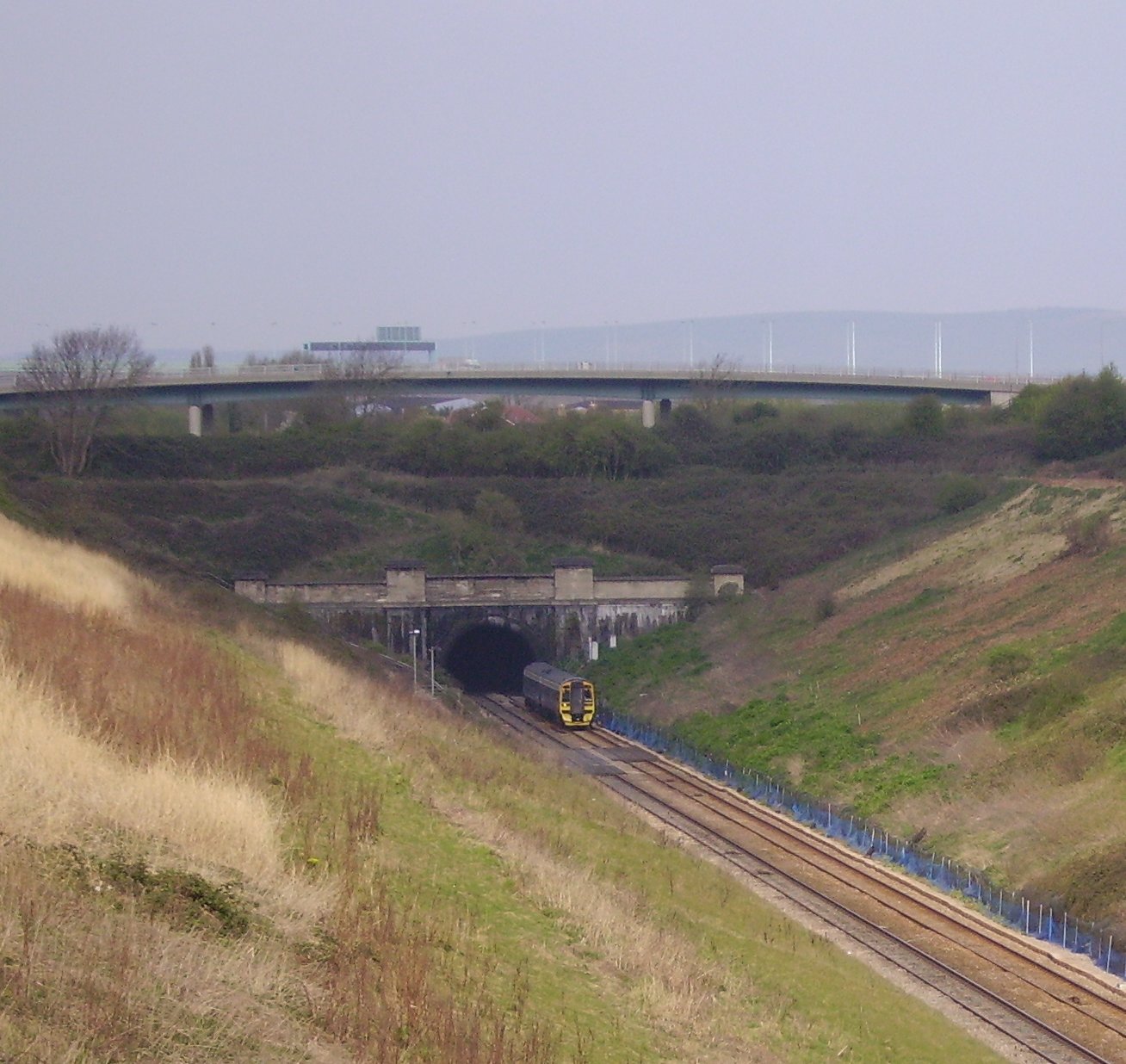
The Severn Tunnel (Welsh: Twnnel Hafren) is a railway tunnel in the United Kingdom, linking South Gloucestershire in the west of England to Monmouthshire in south Wales under the estuary of the River Severn. It was constructed by the Great Western Railway (GWR) between 1873 and 1886 for the purpose of dramatically shortening the journey times of their trains, passenger and goods alike, between South Wales and Western England. It has often been regarded as the crowning achievement of GWR's chief engineer Sir John Hawkshaw.
Prior to the tunnel's construction, lengthy detours were necessary for all traffic between South Wales and Western England, which either used ship or a lengthy diversion upriver via Gloucester. Recognising the value of such a tunnel, the GWR sought its development, tasking Hawkshaw with its design and later contracting the civil engineer Thomas A. Walker to undertake its construction, which commenced in March 1873. Work proceeded smoothly until October 1879, at which point significant flooding of the tunnel occurred from what is now known as "The Great Spring". Through strenuous and innovative efforts, the flooding was contained and work was able to continue, albeit with a great emphasis on drainage. Structurally completed during 1885, the first passenger train was run through the tunnel on 1 December 1886, nearly 14 years after the commencement of work.
Following its opening, the tunnel quickly formed a key element of the main trunk railway line between southern England and South Wales. Amongst other services, the GWR operated a car shuttle train service through the tunnel for many decades. However, the tunnel has also presented especially difficult conditions, both operationally and in terms of infrastructure and structural maintenance. On average, around 50 million litres of water per day infiltrates the tunnel, necessitating the permanent operation of several large pumping engines. Originally, during much of the steam era, a large number of pilot and banking locomotives were required to assist heavy trains traverse the challenging gradients of the tunnel, which were deployed from nearby marshalling yards.
The tunnel is 7,008 m (4.355 mi) long, of which 3,621 m (2.250 mi) is under the river. It was the longest underwater tunnel in the world until 1987—when Japan's Seikan Tunnel linking the islands of Honshu and Hokkaido took the title—and, for more than 100 years, it was the longest mainline railway tunnel within the UK. It was finally exceeded in this capacity during 2007 with the opening of the two major tunnels of High Speed 1, forming a part of the Channel Tunnel Rail Link. In 2016, overhead line equipment (OHLE) was installed in the tunnel to allow the passage of electric traction; this work was undertaken as one element of the wider 21st-century modernisation of the Great Western main line.
The Severn Tunnel forms a critical part of the trunk railway line between southern England and South Wales, and carries an intensive passenger train service as well as significant levels of goods traffic. As of 2012, an average of 200 trains per day use the tunnel. The whole length of the tunnel is controlled as a single signal section, which has the consequence of limiting the headway of successive trains.
There is a continuous drainage culvert between the tracks to lead ground water away to the lowest point of the tunnel, under Sudbrook Pumping Station, where it is pumped to the surface. The hazard of ignited petroleum running into the culvert in the event of derailment of a tank wagon means special arrangements have to be made to prevent occupation of the tunnel by passenger trains while hazardous liquid loads are being worked through. Evacuation arrangements are in place to enable the escape of passengers and staff in the event of serious accident in the tunnel.
There is restricted personnel access to the tunnel at Sudbrook Pumping Station, where an iron ladder descends in the shaft of the water pumping main; the ventilation air is pumped in at this point also. The GWR original ventilation arrangement was to extract air at Sudbrook, but the exhaust gases from steam train operation led to premature corrosion of the fan mechanism. When the Cornish pumping engines were replaced in the 1960s, the draughting was reversed so that atmospheric air is pumped into the tunnel exhausting at the tunnel mouths.[citation needed]
On average, it has been determined that around 50 million litres (11 million imp gal) per day[citation needed] of fresh (spring) water are typically being pumped from the tunnel; this is normally released directly into the adjacent River Severn. Attempts have also been made to try to determine the sources of the water which feeds the "Great Spring".
Hub AI
Severn Tunnel AI simulator
(@Severn Tunnel_simulator)
Severn Tunnel
The Severn Tunnel (Welsh: Twnnel Hafren) is a railway tunnel in the United Kingdom, linking South Gloucestershire in the west of England to Monmouthshire in south Wales under the estuary of the River Severn. It was constructed by the Great Western Railway (GWR) between 1873 and 1886 for the purpose of dramatically shortening the journey times of their trains, passenger and goods alike, between South Wales and Western England. It has often been regarded as the crowning achievement of GWR's chief engineer Sir John Hawkshaw.
Prior to the tunnel's construction, lengthy detours were necessary for all traffic between South Wales and Western England, which either used ship or a lengthy diversion upriver via Gloucester. Recognising the value of such a tunnel, the GWR sought its development, tasking Hawkshaw with its design and later contracting the civil engineer Thomas A. Walker to undertake its construction, which commenced in March 1873. Work proceeded smoothly until October 1879, at which point significant flooding of the tunnel occurred from what is now known as "The Great Spring". Through strenuous and innovative efforts, the flooding was contained and work was able to continue, albeit with a great emphasis on drainage. Structurally completed during 1885, the first passenger train was run through the tunnel on 1 December 1886, nearly 14 years after the commencement of work.
Following its opening, the tunnel quickly formed a key element of the main trunk railway line between southern England and South Wales. Amongst other services, the GWR operated a car shuttle train service through the tunnel for many decades. However, the tunnel has also presented especially difficult conditions, both operationally and in terms of infrastructure and structural maintenance. On average, around 50 million litres of water per day infiltrates the tunnel, necessitating the permanent operation of several large pumping engines. Originally, during much of the steam era, a large number of pilot and banking locomotives were required to assist heavy trains traverse the challenging gradients of the tunnel, which were deployed from nearby marshalling yards.
The tunnel is 7,008 m (4.355 mi) long, of which 3,621 m (2.250 mi) is under the river. It was the longest underwater tunnel in the world until 1987—when Japan's Seikan Tunnel linking the islands of Honshu and Hokkaido took the title—and, for more than 100 years, it was the longest mainline railway tunnel within the UK. It was finally exceeded in this capacity during 2007 with the opening of the two major tunnels of High Speed 1, forming a part of the Channel Tunnel Rail Link. In 2016, overhead line equipment (OHLE) was installed in the tunnel to allow the passage of electric traction; this work was undertaken as one element of the wider 21st-century modernisation of the Great Western main line.
The Severn Tunnel forms a critical part of the trunk railway line between southern England and South Wales, and carries an intensive passenger train service as well as significant levels of goods traffic. As of 2012, an average of 200 trains per day use the tunnel. The whole length of the tunnel is controlled as a single signal section, which has the consequence of limiting the headway of successive trains.
There is a continuous drainage culvert between the tracks to lead ground water away to the lowest point of the tunnel, under Sudbrook Pumping Station, where it is pumped to the surface. The hazard of ignited petroleum running into the culvert in the event of derailment of a tank wagon means special arrangements have to be made to prevent occupation of the tunnel by passenger trains while hazardous liquid loads are being worked through. Evacuation arrangements are in place to enable the escape of passengers and staff in the event of serious accident in the tunnel.
There is restricted personnel access to the tunnel at Sudbrook Pumping Station, where an iron ladder descends in the shaft of the water pumping main; the ventilation air is pumped in at this point also. The GWR original ventilation arrangement was to extract air at Sudbrook, but the exhaust gases from steam train operation led to premature corrosion of the fan mechanism. When the Cornish pumping engines were replaced in the 1960s, the draughting was reversed so that atmospheric air is pumped into the tunnel exhausting at the tunnel mouths.[citation needed]
On average, it has been determined that around 50 million litres (11 million imp gal) per day[citation needed] of fresh (spring) water are typically being pumped from the tunnel; this is normally released directly into the adjacent River Severn. Attempts have also been made to try to determine the sources of the water which feeds the "Great Spring".