Hubbry Logo
Sewing gaugeSewing gaugeMain
Open search
Sewing gauge
Community hub
Sewing gauge
logo
8 pages, 0 posts
0 subscribers
Be the first to start a discussion here.
Sewing gauge
Sewing gauge
from Wikipedia
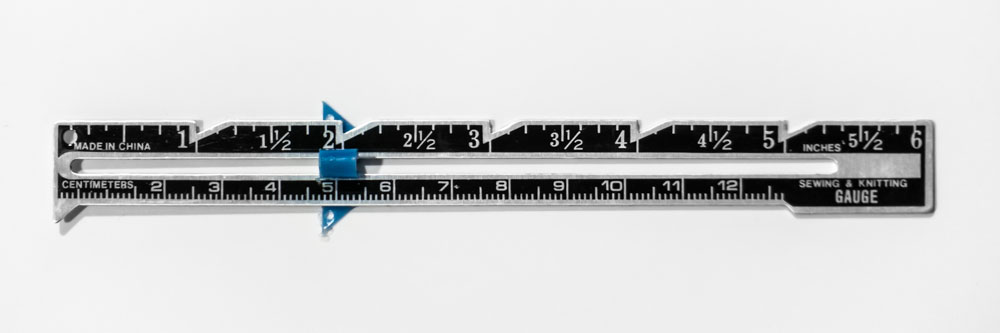
A 6" long sewing gauge with a plastic slider

A sewing gauge is a ruler, typically 6 inches long, used for measuring short spaces. It is typically a metal scale, marked in both inches and centimeters with a sliding pointer, similar in use to a caliper. It is used to mark hems for alterations as well as intervals between pleats and buttonholes and buttonhole lengths. It can be also used as a compass to draw arcs and circles by anchoring the slider with a pin and placing the tip of a marking pencil in the hole located at the end of the scale. Some models also incorporate a button shank and a blunt point for turning corners right side out.[1][2]

References

[edit]
Revisions and contributorsEdit on WikipediaRead on Wikipedia
from Grokipedia
A sewing gauge, also known as a seam gauge, is a compact measuring tool used in and related crafts to ensure precise, repeatable measurements for elements such as hems, seams, and button placements. Typically 6 inches long and constructed from rigid metal or plastic with markings in both inches and centimeters, it features a sliding marker that acts like a caliper to lock in specific distances, allowing for accurate marking without the need for constant remeasuring. This tool's primary value lies in its versatility for tasks requiring consistency, such as determining seam allowances (often ¼ inch or ⅝ inch), measuring sizes and spacing, checking depths, and gauging or strap widths. In , it helps maintain symmetrical blocks and uniform seam allowances, while in pattern drafting, it supports even hems and waistbands. Metal versions are preferred for durability and heat resistance near irons, though plastic alternatives exist for lighter use. Variations include basic models for general measuring, as well as multifunctional designs like the 7-inch Dritz gauge with an integrated point turner for inverting seams and corners, or the 5-in-1 gauge (available in 6-inch and 11-inch lengths) that incorporates a for circles, for right angles, and button measurer. An expanding sewing gauge variant allows for setting equal intervals, making it ideal for spacing buttons or tucks. Overall, the sewing gauge enhances efficiency and accuracy in sewing projects by simplifying short, frequent measurements that a flexible cannot reliably provide.

Design and Features

Components

A standard sewing gauge consists of a rigid, ruler-like body typically measuring 6 inches (15 cm) in length, constructed from durable metal such as aluminum or sturdy to ensure precision and longevity during frequent use. The key adjustable component is the sliding marker, often a pointer or clip that moves along the ruler's edge and locks into position via a grip or thumbscrew, enabling consistent and repeatable positioning for measurements. Along the edges, small notches and slots are incorporated at regular intervals, such as at inch and half-inch divisions, to facilitate hooking into fabric edges or aligning markings for curves and spacing. Basic models may also feature a pointed end serving as a point turner for manipulating seams and a small for use as a pivot in creating circular patterns. These core components provide the foundational structure shared across various sewing gauge variants.

Markings and Scale

The scale on a sewing gauge typically features dual-sided markings in both inches and centimeters to accommodate users working in different measurement systems, with one side dedicated to and the other to metric for versatility in global sewing practices. Increments are marked as finely as 1/8 inch (approximately 3 ) to support the precision required in sewing tasks, allowing for accurate small-scale adjustments. These markings are often laser-etched or engraved directly onto the gauge body, ensuring durability and resistance to wear from repeated use. Key indicators on the scale include bold, prominent lines at common seam widths such as 1/4 inch, 1/2 inch, and 1 inch, which facilitate quick identification and consistent application in garment construction. Specialized notches or slots are incorporated for practical measurements, including lengths ranging from 1/2 to 1 inch, enabling precise marking of button placements and corresponding openings without additional tools. Readability is enhanced through clear, high-contrast black engravings on metal or light-colored bodies, which remain legible even after extensive handling and prevent fading or smudging. Precision considerations focus on the gauge's incremental design and the sliding marker's alignment mechanism, which locks securely to maintain consistent positioning across multiple measurements. The markings integrate seamlessly with the gauge's components, such as the etched ruler body guiding the adjustable slider for repeatable results.

Common Uses

Marking Seams and Hems

Sewing gauges facilitate precise marking of seam allowances by allowing users to adjust the sliding marker to standard widths, such as 5/8 inch, which is commonly used in commercial patterns for garment assembly. The tool's edge is positioned along the fabric's raw edge, and markings are made with tailor's chalk, a marking , or pins to guide subsequent stitching, ensuring uniformity across seams like those in bodices or side panels. This method maintains consistent seam widths, preventing distortions in fit or alignment during construction. In hem creation, the gauge measures and establishes uniform depths for professional finishes on items such as skirts, pants, or curtains, often employing double-fold techniques with depths of 1 inch or more to enclose raw edges securely. Users set the slider to the desired hem width, fold the fabric to align the raw edge with the marker, and press with an iron to set the crease, repeating for the second fold if needed; this approach is particularly effective for straight hems where evenness is critical. Key techniques include using the gauge's straight edge as a guide against the fabric for linear tracing, which simplifies repetitive measurements and integrates with pressing to create crisp folds. The adjustable marker enables quick repositioning for multiple passes, such as marking hem depths around a full garment . These applications provide significant benefits by promoting evenness in edge and fold definitions, which reduces errors in or bias-cut fabrics where slight variations can lead to puckering or misalignment. Overall, the gauge's precision minimizes rework, supporting efficient and high-quality garment assembly.

Spacing and Measurements

Sewing gauges enable sewists to achieve uniform spacing across fabric surfaces, ensuring and professional finishes in . By utilizing the adjustable or expanding mechanism, these tools allow for repeatable measurements at consistent intervals, such as 1-inch gaps, without relying on freehand . This precision is particularly valuable for distributed elements that require alignment over larger areas, on the gauge's fine increments marked in inches or millimeters for accuracy. In and placement, the sewing gauge measures equal intervals along garment fronts, cuffs, or plackets to match corresponding buttons precisely. For instance, standard spacing of 2 to 3½ inches apart can be set using the sliding marker, which holds the position firmly while transferring marks to the fabric via or a pin. This method ensures buttons align seamlessly when fastened, preventing gaps or misalignment in fitted pieces like shirts or jackets. For pleat and tuck formation, the gauge sets precise intervals for folds in skirts, blouses, or decorative panels. can be adjusted to mark box s at even depths, such as 1-inch widths, or narrower pin tucks spaced ¼ inch apart, guiding the fabric into uniform creases before stitching. This approach maintains consistent volume and drape, essential for balanced silhouettes in structured designs. Beyond fasteners and folds, sewing gauges measure intervals for grommets or eyelets on corsets, typically spaced 1 inch vertically to distribute lacing tension evenly along the back panel. They also determine strap widths on bags, ensuring parallel edges at 1½ inches, and verify in or gathers by marking equidistant points on curves or skirt hems. These applications promote structural integrity and aesthetic harmony in reinforced or gathered elements. Advanced techniques involve pairing the sewing gauge with fabric markers, such as tailor's chalk or water-soluble pens, to create temporary guide lines for complex spacing after initial measurements. Additionally, the gauge's point turner end can refine sharp corners in collars or pockets post-marking, pushing out seams crisply for a polished outcome.

Types

Basic Seam Gauge

The basic seam gauge is the standard, most common iteration of this sewing tool, consisting of a 6-inch typically constructed from metal or durable , equipped with a single sliding marker that locks into position for precise, repeatable measurements. This simple design includes etched markings in both inches and centimeters along its length, along with basic notches at key intervals to facilitate hooking and securing fabric edges during marking. The tool's straightforward configuration prioritizes functionality without additional attachments, making it ideal as a baseline for everyday tasks. Typical specifications for the basic seam gauge include a lightweight build weighing around 0.3 ounces for metal models, with options in silver-toned metal for a finish or vibrant colorful for visibility in a kit. These gauges are affordably priced, generally ranging from $2 to $7, allowing accessibility for hobbyists and professionals alike. Branded examples, such as the Dritz 620 model, exemplify this economical yet reliable format. Key advantages of the basic seam gauge lie in its exceptional portability due to its compact dimensions, fitting easily into sewing bags or drawers, and its robust durability that withstands frequent handling without deformation. This makes it particularly essential for beginners assembling home sewing kits, where simplicity aids in building foundational skills for accurate measurements. It is widely available at craft stores like Joann and major online retailers such as Amazon, with established brands including Dritz and offering consistent quality. In practice, the basic seam gauge supports standard marking and spacing tasks, such as hems and buttonholes, providing reliable consistency in routine projects.

Specialized Variants

Specialized variants of the sewing gauge extend the functionality of the basic sliding model by incorporating adjustable or multi-purpose features tailored to specific sewing tasks. The expanding gauge, for instance, features adjustable arms that allow for precise and marking of equal intervals across larger distances, typically expanding to 24 inches with multiple points to divide spaces into equal sections. This design is particularly useful for tasks requiring consistent spacing, such as button placement, pleats, shirring, , and creating even divisions in blocks or . Another prominent variant is the 5-in-1 , often made of durable and available in 6-inch and 11-inch lengths, which integrates the core sliding mechanism with additional specialized components into a compact body for enhanced versatility. This tool combines a seam gauge for measurements, a for right angles, a point turner for shaping seams, a pivot hole for circles and arcs, and a measurer for spacing placements. It supports a range of activities in and , enabling users to mark, measure, and create shapes without switching tools. Hem-specific gauges address the challenges of folding and pressing curved or irregular edges, differing from standard models by incorporating curved edges and right angles for accurate shaping. The Dritz Ezy-Hem Gauge, for example, facilitates pressing straight hems from 1/4 to 4 inches and curved hems from 1/4 to 2.5 inches, making it ideal for cuffs, pant legs, waistbands, belts, and pockets. Its markings are designed for use during pressing to allow precise folding and without creating unwanted ridges in the fabric. Quilting-focused variants emphasize markings for quarter-inch seams, a critical standard in and piecing to ensure blocks fit together accurately. These gauges often build on the sliding design with prominent 1/4-inch indicators, sometimes integrated into multi-tools like the 5-in-1, to facilitate consistent seam allowances and spacing in construction. While traditional mechanical designs dominate, specialized variants are selected based on project demands; multi-tools suit versatile crafters handling diverse tasks, whereas expanding or hem-specific gauges benefit garment sewers focused on spacing or finishing details.

History

Origins in Sewing Tools

The practice of measuring in sewing dates back to prehistoric eras, with communities employing bone awls and early needles to pierce and join animal hides for and , circa 25,000 BCE. These rudimentary bone tools, often fashioned from animal splinters and sharpened for precision, served dual purposes in marking and stitching, as evidenced by archaeological finds across indicating the emergence of tailored garments. In medieval , wooden measuring sticks—such as 36-inch rulers marked in inches—and knotted ropes facilitated consistent seam allowances, particularly in armor production where metal-reinforced required exact fittings to ensure mobility and protection. Tailors' workshops depicted in 14th-century manuscripts highlight these sticks as essential for aligning seams in padded garments like gambesons. By the , tailors' kits incorporated simple wooden picket measures and paper strips inscribed with custom body dimensions, replacing purely ad-hoc methods like hand spans or measurements amid the early Industrial Revolution's push for efficiency. These precursors allowed for repeatable seam depths and hem lines in bespoke clothing, though standardization remained limited until flexible tapes appeared in the 1790s. In the , sewing boxes commonly included ivory-handled or brass seam markers for pinpointing allowances, reflecting the period's emphasis on domestic and intricate garment construction. Sewing measurement tools held cultural significance in pre-1900 home crafts, as illustrated by the Victoria and Albert Museum's collections of implements from 1600 to 1900, which underscore their role in everyday production across social classes. In coastal towns like , , the textile trade from the 1840s to 1914 integrated such tools into local commerce, with carved wooden tape measures featuring inlays—often adorned with motifs like flowers or pastoral scenes—used by seamstresses and embroiderers in shops supplying wool work and ready-made fabrics. This era's tools, preserved in museum holdings, highlight women's contributions to the industry amid global trade influences. The progression from improvised bone implements and knotted cords to brass-fitted markers during the marked a transition toward precision, driven by mass garment production needs and enabling the development of more advanced 20th-century designs.

Modern Developments

The modern gauge, characterized by its sliding marker for precise measurements, emerged in the mid-20th century as home gained popularity. An early design was patented in by Roy O. Rundquist, featuring an elongated slotted body made from materials like aluminum or plastic and a resilient marker that slid smoothly without damaging the slot edges, enabling accurate hem marking and adjustments. This innovation built on earlier marking tools but introduced reliable adjustability for home users. A key refinement came in 1967 with Benjamin L. Snyder's for a sewing gauge assigned to Pentapco, Inc., which incorporated a locking slider with openings and projections to secure the marker at exact positions, enhancing accuracy for seams, hems, and buttonholes. Post-World War II advancements in plastics facilitated affordable , shifting from metal-only construction to durable, lightweight composites that reduced costs and increased accessibility for amateur sewers. Commercialization accelerated in the amid a surge in home , driven by Singer's targeted to teenage girls and homemakers through educational classes like the Teen-Age Sewing Course (starting in 1946), which ran for 20 years and popularized bundled notions kits often including gauges. Established notions companies like Dritz, founded in 1921 for hooks and eyes, expanded into comprehensive tools by this era, producing standardized gauges integrated into Singer kits and retail sets. In the , the resurgence of crafting has spurred eco-friendly variants using for , as seen in models like the Arrow Mountain gauge, which avoids synthetic finishes for iron-safe use. designs, such as Dritz's 14-in-1 gauge for spacing buttons, pleats, and seams, reflect demands for versatility in modern hobbies. The tool's straightforward has limited major patents since the , focusing instead on material innovations and kit integration.

References

Add your contribution
Related Hubs
User Avatar
No comments yet.