
Recent from talks
Sextus Empiricus
Knowledge base stats:
Talk channels stats:
Members stats:
Sextus Empiricus
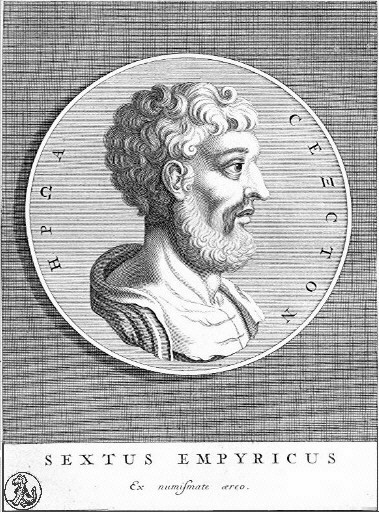
Sextus Empiricus (Ancient Greek: Σέξτος Ἐμπειρικός, Sextos Empeirikos; fl. mid-late 2nd century CE) was a Greek Pyrrhonist philosopher and Empiric school physician with Roman citizenship. His philosophical works are the most complete surviving account of ancient Greek and Roman Pyrrhonism, and because of the arguments they contain against the other Hellenistic philosophies, they are also a major source of information about those philosophies.
Little is known about Sextus Empiricus. He likely lived in Alexandria, Rome, or Athens. His Roman name, Sextus, implies he was a Roman citizen. The Suda, a 10th-century Byzantine encyclopedia, states that he was the same person as Sextus of Chaeronea, as do other pre-modern sources, but this identification is commonly doubted. In his medical work, as reflected by his name, tradition maintains that he belonged to the Empiric school in which Pyrrhonism was popular. However, at least twice in his writings, Sextus seems to place himself closer to the Methodic school.
As a skeptic, Sextus Empiricus raised concerns which applied to all types of knowledge. He doubted the validity of induction long before its best known critic, David Hume, and raised the regress argument against all forms of reasoning:
Those who claim for themselves to judge the truth are bound to possess a criterion of truth. This criterion, then, either is without a judge's approval or has been approved. But if it is without approval, whence comes it that it is trustworthy? For no matter of dispute is to be trusted without judging. And, if it has been approved, that which approves it, in turn, either has been approved or has not been approved, and so on ad infinitum.
This view is known as Pyrrhonian skepticism, which Sextus differentiated from Academic skepticism as practiced by Carneades which, according to Sextus, denies the possibility of knowledge altogether, something that Sextus criticized as being an affirmative belief. Instead, Sextus advocates simply giving up belief; in other words, suspending judgment (epoché) about whether or not anything is knowable. Only by suspending judgment can we attain a state of ataraxia (roughly, 'peace of mind').
There is some debate as to the extent to which Sextus advocated the suspension of judgement. According to Myles Burnyeat, Jonathan Barnes, and Benson Mates, Sextus advises that we should suspend judgment about virtually all beliefs; that is to say, we should neither affirm any belief as true nor deny any belief as false, since we may live without any beliefs, acting by habit. Michael Frede, however, defends a different interpretation, according to Sextus, beliefs are permissible so long as they are not grounded in reason, philosophy, or speculation; a skeptic may, for instance, accept commonly held views within their society. The key distinction between the skeptic and the dogmatist lies in the source of belief: the skeptic does not arrive at beliefs through rigorous philosophical inquiry.
Diogenes Laërtius and the Suda report that Sextus Empiricus wrote ten books on Pyrrhonism. The Suda also says Sextus wrote a book Ethica. Sextus Empiricus's three surviving works are the Outlines of Pyrrhonism (Πυῤῥώνειοι ὑποτυπώσεις, Pyrrhōneioi hypotypōseis, thus commonly abbreviated PH), and two distinct works preserved under the same title, Adversus Mathematicos (Πρὸς μαθηματικούς, Pros mathematikous, commonly abbreviated "AM" or "M" and known as Against Those in the Disciplines, or Against the Mathematicians). Adversus Mathematicos is incomplete as the text references parts that are not in the surviving text. Adversus Mathematicos also includes mentions of three other works which did not survive:
The surviving first six books of Adversus Mathematicos are commonly known as Against the Professors. Each book also has a traditional title; although none of these titles except Pros mathematikous and Pyrrhōneioi hypotypōseis are found in the manuscripts.
Hub AI
Sextus Empiricus AI simulator
(@Sextus Empiricus_simulator)
Sextus Empiricus
Sextus Empiricus (Ancient Greek: Σέξτος Ἐμπειρικός, Sextos Empeirikos; fl. mid-late 2nd century CE) was a Greek Pyrrhonist philosopher and Empiric school physician with Roman citizenship. His philosophical works are the most complete surviving account of ancient Greek and Roman Pyrrhonism, and because of the arguments they contain against the other Hellenistic philosophies, they are also a major source of information about those philosophies.
Little is known about Sextus Empiricus. He likely lived in Alexandria, Rome, or Athens. His Roman name, Sextus, implies he was a Roman citizen. The Suda, a 10th-century Byzantine encyclopedia, states that he was the same person as Sextus of Chaeronea, as do other pre-modern sources, but this identification is commonly doubted. In his medical work, as reflected by his name, tradition maintains that he belonged to the Empiric school in which Pyrrhonism was popular. However, at least twice in his writings, Sextus seems to place himself closer to the Methodic school.
As a skeptic, Sextus Empiricus raised concerns which applied to all types of knowledge. He doubted the validity of induction long before its best known critic, David Hume, and raised the regress argument against all forms of reasoning:
Those who claim for themselves to judge the truth are bound to possess a criterion of truth. This criterion, then, either is without a judge's approval or has been approved. But if it is without approval, whence comes it that it is trustworthy? For no matter of dispute is to be trusted without judging. And, if it has been approved, that which approves it, in turn, either has been approved or has not been approved, and so on ad infinitum.
This view is known as Pyrrhonian skepticism, which Sextus differentiated from Academic skepticism as practiced by Carneades which, according to Sextus, denies the possibility of knowledge altogether, something that Sextus criticized as being an affirmative belief. Instead, Sextus advocates simply giving up belief; in other words, suspending judgment (epoché) about whether or not anything is knowable. Only by suspending judgment can we attain a state of ataraxia (roughly, 'peace of mind').
There is some debate as to the extent to which Sextus advocated the suspension of judgement. According to Myles Burnyeat, Jonathan Barnes, and Benson Mates, Sextus advises that we should suspend judgment about virtually all beliefs; that is to say, we should neither affirm any belief as true nor deny any belief as false, since we may live without any beliefs, acting by habit. Michael Frede, however, defends a different interpretation, according to Sextus, beliefs are permissible so long as they are not grounded in reason, philosophy, or speculation; a skeptic may, for instance, accept commonly held views within their society. The key distinction between the skeptic and the dogmatist lies in the source of belief: the skeptic does not arrive at beliefs through rigorous philosophical inquiry.
Diogenes Laërtius and the Suda report that Sextus Empiricus wrote ten books on Pyrrhonism. The Suda also says Sextus wrote a book Ethica. Sextus Empiricus's three surviving works are the Outlines of Pyrrhonism (Πυῤῥώνειοι ὑποτυπώσεις, Pyrrhōneioi hypotypōseis, thus commonly abbreviated PH), and two distinct works preserved under the same title, Adversus Mathematicos (Πρὸς μαθηματικούς, Pros mathematikous, commonly abbreviated "AM" or "M" and known as Against Those in the Disciplines, or Against the Mathematicians). Adversus Mathematicos is incomplete as the text references parts that are not in the surviving text. Adversus Mathematicos also includes mentions of three other works which did not survive:
The surviving first six books of Adversus Mathematicos are commonly known as Against the Professors. Each book also has a traditional title; although none of these titles except Pros mathematikous and Pyrrhōneioi hypotypōseis are found in the manuscripts.
Recent media