
Recent from talks
Seyfert galaxy
Knowledge base stats:
Talk channels stats:
Members stats:
Seyfert galaxy
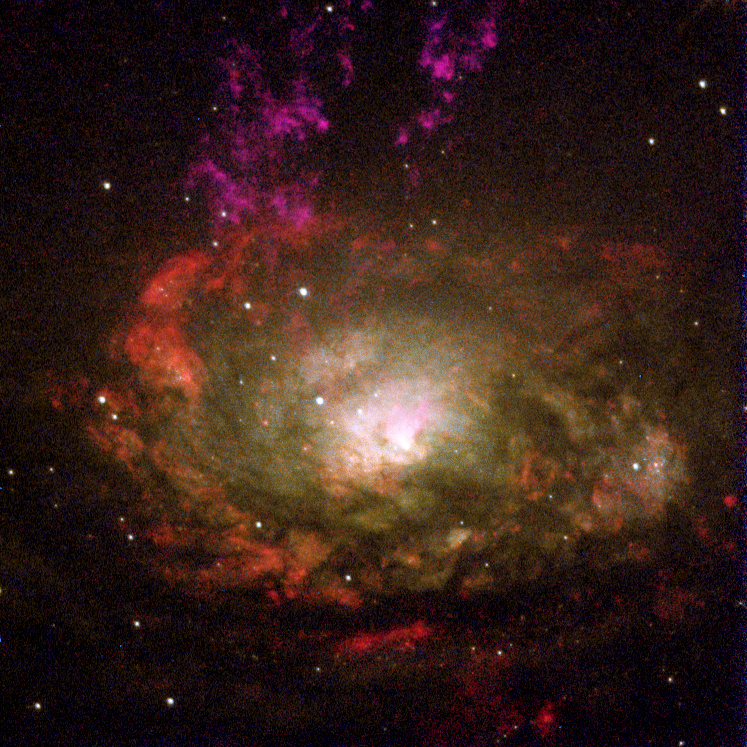
Seyfert galaxies are one of the two largest groups of active galaxies, along with quasar host galaxies. They have quasar-like nuclei (very luminous sources of electromagnetic radiation that are outside of our own galaxy) with very high surface brightnesses whose spectra reveal strong, high-ionisation emission lines, but unlike quasars, their host galaxies are clearly detectable.
Seyfert galaxies account for about 10% of all galaxies and are some of the most intensely studied objects in astronomy, as they are thought to be powered by the same phenomena that occur in quasars, although they are closer and less luminous than quasars. These galaxies have supermassive black holes at their centers which are surrounded by accretion discs of in-falling material. The accretion discs are believed to be the source of the observed ultraviolet radiation. Ultraviolet emission and absorption lines provide the best diagnostics for the composition of the surrounding material.
Seen in visible light, most Seyfert galaxies look like normal spiral galaxies, but when studied under other wavelengths, it becomes clear that the luminosity of their cores is of comparable intensity to the luminosity of whole galaxies the size of the Milky Way.
Seyfert galaxies are named after Carl Seyfert, who first described this class in 1943.
Seyfert galaxies were first detected in 1908 by Edward A. Fath and Vesto Slipher, who were using the Lick Observatory to look at the spectra of astronomical objects that were thought to be "spiral nebulae". They noticed that NGC 1068 showed six bright emission lines, which was considered unusual as most objects observed showed an absorption spectrum corresponding to stars.
In 1926, Edwin Hubble looked at the emission lines of NGC 1068 and two other such "nebulae" and classified them as extragalactic objects. In 1943, Carl Keenan Seyfert discovered more galaxies similar to NGC 1068 and reported that these galaxies have very bright stellar-like nuclei that produce broad emission lines. In 1944 Cygnus A was detected at 160 MHz, and detection was confirmed in 1948 when it was established that it was a discrete source. Its double radio structure became apparent with the use of interferometry. In the next few years, other radio sources such as supernova remnants were discovered. By the end of the 1950s, more important characteristics of Seyfert galaxies were discovered, including the fact that their nuclei are extremely compact (< 100 pc, i.e. "unresolved"), have high mass (≈109±1 solar masses), and the duration of peak nuclear emissions is relatively short (> 108 years).
In the 1960s and 1970s, research to further understand the properties of Seyfert galaxies was carried out. A few direct measurements of the actual sizes of Seyfert nuclei were taken, and it was established that the emission lines in NGC 1068 were produced in a region over a thousand light years in diameter. Controversy existed over whether Seyfert redshifts were of cosmological origin. Confirming estimates of the distance to Seyfert galaxies and their age were limited since their nuclei vary in brightness over a time scale of a few years; therefore arguments involving distance to such galaxies and the constant speed of light cannot always be used to determine their age. In the same time period, research had been undertaken to survey, identify and catalogue galaxies, including Seyferts. Beginning in 1967, Benjamin Markarian published lists containing a few hundred galaxies distinguished by their very strong ultraviolet emission, with measurements on the position of some of them being improved in 1973 by other researchers. At the time, it was believed that 1% of spiral galaxies are Seyferts. By 1977, it was found that very few Seyfert galaxies are ellipticals, most of them being spiral or barred spiral galaxies. During the same time period, efforts have been made to gather spectrophotometric data for Seyfert galaxies. It became obvious that not all spectra from Seyfert galaxies look the same, so they have been subclassified according to the characteristics of their emission spectra. A simple division into types I and II has been devised, with the classes depending on the relative width of their emission lines. It has been later noticed that some Seyfert nuclei show intermediate properties, resulting in their being further subclassified into types 1.2, 1.5, 1.8 and 1.9 (see #Classification). Early surveys for Seyfert galaxies were biased in counting only the brightest representatives of this group. More recent surveys that count galaxies with low-luminosity and obscured Seyfert nuclei suggest that the Seyfert phenomenon is actually quite common, occurring in 16% ± 5% of galaxies; indeed, several dozen galaxies exhibiting the Seyfert phenomenon exist in the close vicinity (≈27 Mpc) of our own galaxy. Seyfert galaxies form a substantial fraction of the galaxies appearing in the Markarian Catalogue, a list of galaxies displaying an ultraviolet excess in their nuclei.
An active galactic nucleus (AGN) is a compact region at the center of a galaxy that has a higher than normal luminosity over portions of the electromagnetic spectrum. A galaxy having an active nucleus is called an active galaxy. Active galactic nuclei are the most luminous sources of electromagnetic radiation in the Universe, and their evolution puts constraints on cosmological models. Depending on the type, their luminosity varies over a timescale from a few hours to a few years. The two largest subclasses of active galaxies are quasars and Seyfert galaxies, the main difference between the two being the amount of radiation they emit. In a typical Seyfert galaxy, the nuclear source emits at visible wavelengths an amount of radiation comparable to that of the whole galaxy's constituent stars, while in a quasar, the nuclear source is brighter than the constituent stars by at least a factor of 100. Seyfert galaxies have extremely bright nuclei, with luminosities ranging between 108 and 1011 solar luminosities. Only about 5% of them are radio bright; their emissions are moderate in gamma rays and bright in X-rays. Their visible and infrared spectra show very bright emission lines of hydrogen, helium, nitrogen, and oxygen. These emission lines exhibit strong Doppler broadening, which implies velocities from 500 to 4,000 km/s (310 to 2,490 mi/s), and are believed to originate near an accretion disc surrounding the central black hole.
Hub AI
Seyfert galaxy AI simulator
(@Seyfert galaxy_simulator)
Seyfert galaxy
Seyfert galaxies are one of the two largest groups of active galaxies, along with quasar host galaxies. They have quasar-like nuclei (very luminous sources of electromagnetic radiation that are outside of our own galaxy) with very high surface brightnesses whose spectra reveal strong, high-ionisation emission lines, but unlike quasars, their host galaxies are clearly detectable.
Seyfert galaxies account for about 10% of all galaxies and are some of the most intensely studied objects in astronomy, as they are thought to be powered by the same phenomena that occur in quasars, although they are closer and less luminous than quasars. These galaxies have supermassive black holes at their centers which are surrounded by accretion discs of in-falling material. The accretion discs are believed to be the source of the observed ultraviolet radiation. Ultraviolet emission and absorption lines provide the best diagnostics for the composition of the surrounding material.
Seen in visible light, most Seyfert galaxies look like normal spiral galaxies, but when studied under other wavelengths, it becomes clear that the luminosity of their cores is of comparable intensity to the luminosity of whole galaxies the size of the Milky Way.
Seyfert galaxies are named after Carl Seyfert, who first described this class in 1943.
Seyfert galaxies were first detected in 1908 by Edward A. Fath and Vesto Slipher, who were using the Lick Observatory to look at the spectra of astronomical objects that were thought to be "spiral nebulae". They noticed that NGC 1068 showed six bright emission lines, which was considered unusual as most objects observed showed an absorption spectrum corresponding to stars.
In 1926, Edwin Hubble looked at the emission lines of NGC 1068 and two other such "nebulae" and classified them as extragalactic objects. In 1943, Carl Keenan Seyfert discovered more galaxies similar to NGC 1068 and reported that these galaxies have very bright stellar-like nuclei that produce broad emission lines. In 1944 Cygnus A was detected at 160 MHz, and detection was confirmed in 1948 when it was established that it was a discrete source. Its double radio structure became apparent with the use of interferometry. In the next few years, other radio sources such as supernova remnants were discovered. By the end of the 1950s, more important characteristics of Seyfert galaxies were discovered, including the fact that their nuclei are extremely compact (< 100 pc, i.e. "unresolved"), have high mass (≈109±1 solar masses), and the duration of peak nuclear emissions is relatively short (> 108 years).
In the 1960s and 1970s, research to further understand the properties of Seyfert galaxies was carried out. A few direct measurements of the actual sizes of Seyfert nuclei were taken, and it was established that the emission lines in NGC 1068 were produced in a region over a thousand light years in diameter. Controversy existed over whether Seyfert redshifts were of cosmological origin. Confirming estimates of the distance to Seyfert galaxies and their age were limited since their nuclei vary in brightness over a time scale of a few years; therefore arguments involving distance to such galaxies and the constant speed of light cannot always be used to determine their age. In the same time period, research had been undertaken to survey, identify and catalogue galaxies, including Seyferts. Beginning in 1967, Benjamin Markarian published lists containing a few hundred galaxies distinguished by their very strong ultraviolet emission, with measurements on the position of some of them being improved in 1973 by other researchers. At the time, it was believed that 1% of spiral galaxies are Seyferts. By 1977, it was found that very few Seyfert galaxies are ellipticals, most of them being spiral or barred spiral galaxies. During the same time period, efforts have been made to gather spectrophotometric data for Seyfert galaxies. It became obvious that not all spectra from Seyfert galaxies look the same, so they have been subclassified according to the characteristics of their emission spectra. A simple division into types I and II has been devised, with the classes depending on the relative width of their emission lines. It has been later noticed that some Seyfert nuclei show intermediate properties, resulting in their being further subclassified into types 1.2, 1.5, 1.8 and 1.9 (see #Classification). Early surveys for Seyfert galaxies were biased in counting only the brightest representatives of this group. More recent surveys that count galaxies with low-luminosity and obscured Seyfert nuclei suggest that the Seyfert phenomenon is actually quite common, occurring in 16% ± 5% of galaxies; indeed, several dozen galaxies exhibiting the Seyfert phenomenon exist in the close vicinity (≈27 Mpc) of our own galaxy. Seyfert galaxies form a substantial fraction of the galaxies appearing in the Markarian Catalogue, a list of galaxies displaying an ultraviolet excess in their nuclei.
An active galactic nucleus (AGN) is a compact region at the center of a galaxy that has a higher than normal luminosity over portions of the electromagnetic spectrum. A galaxy having an active nucleus is called an active galaxy. Active galactic nuclei are the most luminous sources of electromagnetic radiation in the Universe, and their evolution puts constraints on cosmological models. Depending on the type, their luminosity varies over a timescale from a few hours to a few years. The two largest subclasses of active galaxies are quasars and Seyfert galaxies, the main difference between the two being the amount of radiation they emit. In a typical Seyfert galaxy, the nuclear source emits at visible wavelengths an amount of radiation comparable to that of the whole galaxy's constituent stars, while in a quasar, the nuclear source is brighter than the constituent stars by at least a factor of 100. Seyfert galaxies have extremely bright nuclei, with luminosities ranging between 108 and 1011 solar luminosities. Only about 5% of them are radio bright; their emissions are moderate in gamma rays and bright in X-rays. Their visible and infrared spectra show very bright emission lines of hydrogen, helium, nitrogen, and oxygen. These emission lines exhibit strong Doppler broadening, which implies velocities from 500 to 4,000 km/s (310 to 2,490 mi/s), and are believed to originate near an accretion disc surrounding the central black hole.
Recent media