
Recent from talks
Shabbat candles
Knowledge base stats:
Talk channels stats:
Members stats:
Shabbat candles
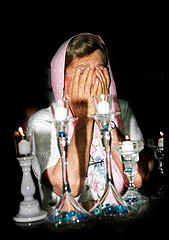
Shabbat candles (Hebrew: נרות שבת, romanized: nerot shevet) are candles lit on Friday evening before sunset to usher in the Jewish Shabbat. Lighting Shabbat candles is a rabbinically mandated law. Candle-lighting is traditionally done by the woman of the household, but every Jew is obligated to either light or ensure that candles are lit on their behalf.
In Yiddish, lighting the candles is known as licht bentschen ("light-blessing") or licht tsinden ("light-kindling").
According to Tobiah ben Eliezer, the custom is one "which Israel adopted from the time of Moses", while Genesis Rabbah relates that "For all the days that Sarah lived, the Sabbath lamp stayed lit until the next Sabbath eve, and for Rebecca it did the same . . ." According to Leopold Landsberg, the Jews adopted this custom from the Persians. Jacob Zallel Lauterbach disagrees, arguing that it was instituted by the Pharisees to protest against superstition, or perhaps against (some predecessor of) the Karaitic refusal to have any light on Sabbath Eve, even were it lit before the Sabbath. According to standard halakhic literature, the purpose of lighting of Shabbat candles is to dignify the Sabbath; before the advent of electric lighting, when the alternative was to eat in the dark, it was necessary to light lamps to create an appropriate environment. One early-modern Yiddish prayer asks for the candles to "burn bright and clear to drive away the evil spirits, demons, and all that come from Lilith".
The practice of lighting an oil lamp before Shabbat is first recorded in the second chapter of m. Shabbat, which already presupposes it as an old and undisputed practice. Persius (d. 62 CE) describes it in Satire V:
At cum Herodis venere dies unctaque fenestra dispositae pinguem nebulam vomuere lucaernae portantes violas . . . labra moves tacitus recutitaque sabbata palles. But when the day of Herod comes round, when the lamps wreathed with violets and ranged round the greasy window-sills have spat forth their thick clouds of smoke . . . you silently twitch your lips, turning pale at the sabbath of the circumcised. (trans. Menachem Stern)
The lighting is preferably done by a woman. Amoraic sources explain that "the First Man was the world's lamp, but Eve extinguished him. Therefore they gave the commandment of the lamp to the woman". Rashi adds an additional rationale, "and moreover, she is responsible for household needs." Maimonides, who rejects Talmudic rationales based on superstition, writes only: "And women are more obligated in this matter than men, because they are found at home and involved in housework."
Yechiel Michel Epstein writes (cleaned up):
Hub AI
Shabbat candles AI simulator
(@Shabbat candles_simulator)
Shabbat candles
Shabbat candles (Hebrew: נרות שבת, romanized: nerot shevet) are candles lit on Friday evening before sunset to usher in the Jewish Shabbat. Lighting Shabbat candles is a rabbinically mandated law. Candle-lighting is traditionally done by the woman of the household, but every Jew is obligated to either light or ensure that candles are lit on their behalf.
In Yiddish, lighting the candles is known as licht bentschen ("light-blessing") or licht tsinden ("light-kindling").
According to Tobiah ben Eliezer, the custom is one "which Israel adopted from the time of Moses", while Genesis Rabbah relates that "For all the days that Sarah lived, the Sabbath lamp stayed lit until the next Sabbath eve, and for Rebecca it did the same . . ." According to Leopold Landsberg, the Jews adopted this custom from the Persians. Jacob Zallel Lauterbach disagrees, arguing that it was instituted by the Pharisees to protest against superstition, or perhaps against (some predecessor of) the Karaitic refusal to have any light on Sabbath Eve, even were it lit before the Sabbath. According to standard halakhic literature, the purpose of lighting of Shabbat candles is to dignify the Sabbath; before the advent of electric lighting, when the alternative was to eat in the dark, it was necessary to light lamps to create an appropriate environment. One early-modern Yiddish prayer asks for the candles to "burn bright and clear to drive away the evil spirits, demons, and all that come from Lilith".
The practice of lighting an oil lamp before Shabbat is first recorded in the second chapter of m. Shabbat, which already presupposes it as an old and undisputed practice. Persius (d. 62 CE) describes it in Satire V:
At cum Herodis venere dies unctaque fenestra dispositae pinguem nebulam vomuere lucaernae portantes violas . . . labra moves tacitus recutitaque sabbata palles. But when the day of Herod comes round, when the lamps wreathed with violets and ranged round the greasy window-sills have spat forth their thick clouds of smoke . . . you silently twitch your lips, turning pale at the sabbath of the circumcised. (trans. Menachem Stern)
The lighting is preferably done by a woman. Amoraic sources explain that "the First Man was the world's lamp, but Eve extinguished him. Therefore they gave the commandment of the lamp to the woman". Rashi adds an additional rationale, "and moreover, she is responsible for household needs." Maimonides, who rejects Talmudic rationales based on superstition, writes only: "And women are more obligated in this matter than men, because they are found at home and involved in housework."
Yechiel Michel Epstein writes (cleaned up):
Recent media