
Recent from talks
Shallow foundation
Knowledge base stats:
Talk channels stats:
Members stats:
Shallow foundation
A shallow foundation is a type of building foundation that transfers structural load to the earth very near to the surface, rather than to a subsurface layer or a range of depths, as does a deep foundation. Customarily, a shallow foundation is considered as such when the width of the entire foundation is greater than its depth. In comparison to deep foundations, shallow foundations are less technical, thus making them more economical and the most widely used for relatively light structures.
Footings are always wider than the members that they support. Structural loads from a column or wall are usually greater than 1,000 kPa, while the soil's bearing capacity is commonly less than that (typically less than 400 kPa). By possessing a larger bearing area, the foundation distributes the pressure to the soil, decreasing the bearing pressure to within allowable values. A structure is not limited to one footing. Multiple types of footings may be used in a construction project.
A wall footing (or strip footing) is a continuous concrete strip that supports structural and non-structural load-bearing walls. Found directly under a wall, a wall footing's width is commonly 2–3 times wider than the wall above it.
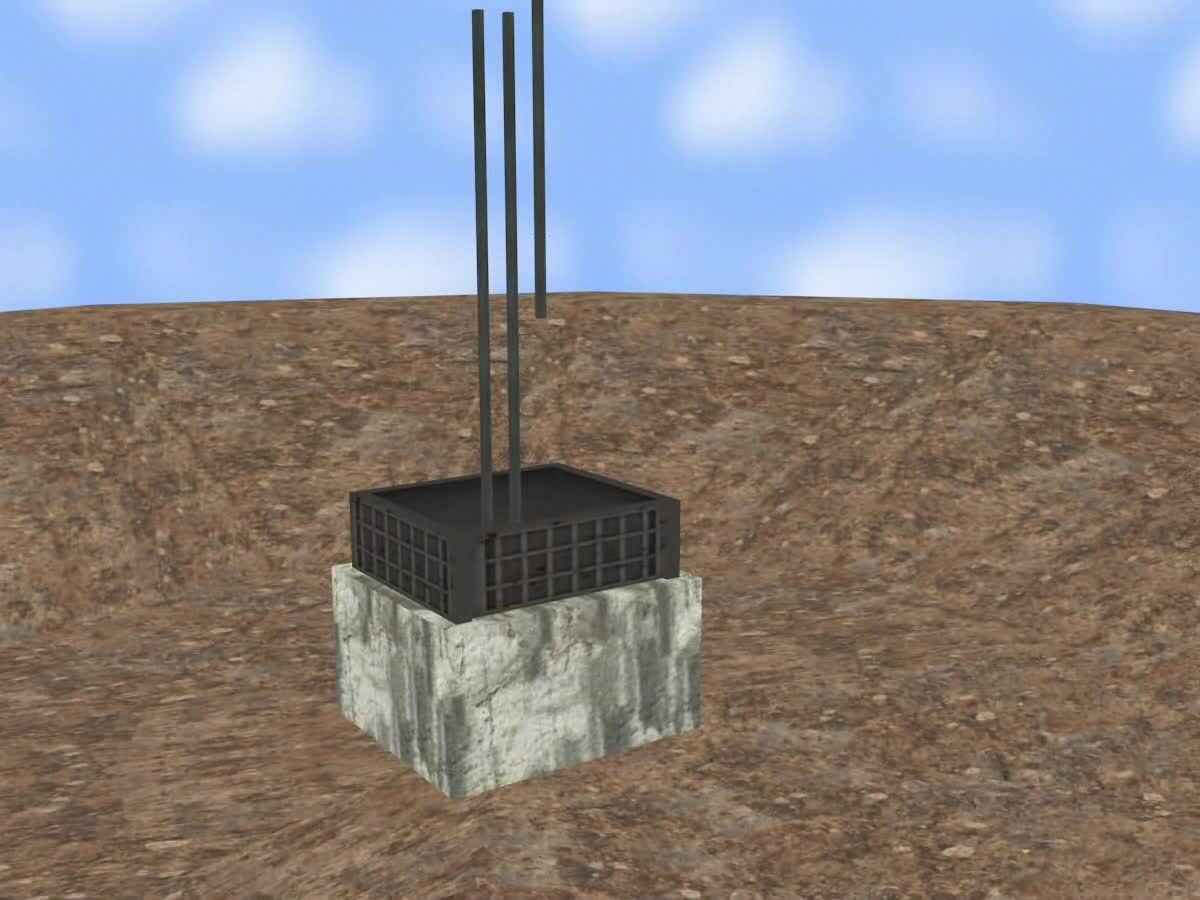
Also called single-column footing, an isolated footing is a square, rectangular, or circular slab that supports the structural members individually. Generally, each column is set on an individual footing to transmit and distribute the load of the structure to the soil underneath. Sometimes, an isolated footing can be sloped or stepped at the base to spread greater loads. This type of footing is used when the structural load is relatively low, columns are widely spaced, and the soil's bearing capacity is adequate at a shallow depth.
When more than one column shares the same footing, it is called a combined footing. A combined footing is typically utilized when the spacing of the columns is too restricted such that if isolated footing were used, they would overlap one another. Also, when property lines make isolated footings eccentrically loaded, combined footings are preferred.
When the load among the columns is equal, the combined footing may be rectangular. Conversely, when the load among the columns is unequal, the combined footing should be trapezoidal.
A strap footing connects individual columns with the use of a strap beam. The general purpose of a strap footing is alike to those of a combined footing, where the spacing is possibly limited and/or the columns are adjacent to the property lines.
Also called raft foundation, a mat foundation is a single continuous slab that covers the entirety of the base of a building. Mat foundations support all the loads of the structure and transmit them to the ground evenly. Soil conditions may prevent other footings from being used. Since this type of foundation distributes the load coming from the building uniformly over a considerably large area, it is favored when individual footings are unfeasible due to the low bearing capacity of the soil.
Hub AI
Shallow foundation AI simulator
(@Shallow foundation_simulator)
Shallow foundation
A shallow foundation is a type of building foundation that transfers structural load to the earth very near to the surface, rather than to a subsurface layer or a range of depths, as does a deep foundation. Customarily, a shallow foundation is considered as such when the width of the entire foundation is greater than its depth. In comparison to deep foundations, shallow foundations are less technical, thus making them more economical and the most widely used for relatively light structures.
Footings are always wider than the members that they support. Structural loads from a column or wall are usually greater than 1,000 kPa, while the soil's bearing capacity is commonly less than that (typically less than 400 kPa). By possessing a larger bearing area, the foundation distributes the pressure to the soil, decreasing the bearing pressure to within allowable values. A structure is not limited to one footing. Multiple types of footings may be used in a construction project.
A wall footing (or strip footing) is a continuous concrete strip that supports structural and non-structural load-bearing walls. Found directly under a wall, a wall footing's width is commonly 2–3 times wider than the wall above it.
Also called single-column footing, an isolated footing is a square, rectangular, or circular slab that supports the structural members individually. Generally, each column is set on an individual footing to transmit and distribute the load of the structure to the soil underneath. Sometimes, an isolated footing can be sloped or stepped at the base to spread greater loads. This type of footing is used when the structural load is relatively low, columns are widely spaced, and the soil's bearing capacity is adequate at a shallow depth.
When more than one column shares the same footing, it is called a combined footing. A combined footing is typically utilized when the spacing of the columns is too restricted such that if isolated footing were used, they would overlap one another. Also, when property lines make isolated footings eccentrically loaded, combined footings are preferred.
When the load among the columns is equal, the combined footing may be rectangular. Conversely, when the load among the columns is unequal, the combined footing should be trapezoidal.
A strap footing connects individual columns with the use of a strap beam. The general purpose of a strap footing is alike to those of a combined footing, where the spacing is possibly limited and/or the columns are adjacent to the property lines.
Also called raft foundation, a mat foundation is a single continuous slab that covers the entirety of the base of a building. Mat foundations support all the loads of the structure and transmit them to the ground evenly. Soil conditions may prevent other footings from being used. Since this type of foundation distributes the load coming from the building uniformly over a considerably large area, it is favored when individual footings are unfeasible due to the low bearing capacity of the soil.
Recent media