



Community hub
Recent from talks
Knowledge base stats:
Talk channels stats:
Members stats:
Shape note
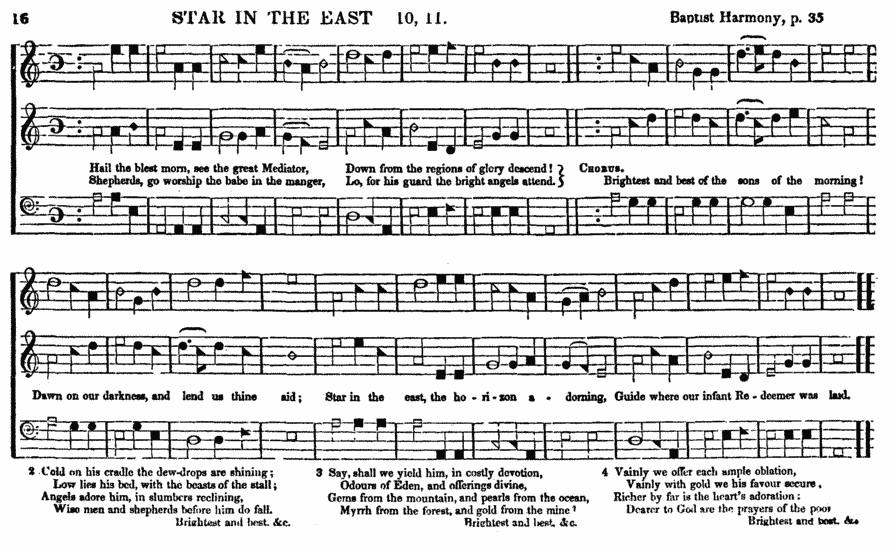
Shape notes are a musical notation designed to facilitate congregational and social singing. The notation became a popular teaching device in American singing schools during the 19th century. Shapes were added to the noteheads in written music to help singers find pitches within major and minor scales without the use of more complex information found in key signatures on the staff.
Shape notes of various kinds have been used for over two centuries in a variety of music traditions, mostly sacred music but also secular, originating in New England, practiced primarily in the Southern United States for many years, and since 2013 experiencing a renaissance in other locations as well.
Shape notes have also been called character notes and patent notes, respectively, and buckwheat notes and dunce notes, pejoratively.
The idea behind shape notes is that the parts of a vocal work can be learned more quickly and easily if the music is printed in shapes that match up with the solfège syllables with which the notes of the musical scale are sung. For instance, in the four-shape tradition used in the Sacred Harp and elsewhere, the notes of a C major scale are notated and sung as follows:
A skilled singer experienced in a shape note tradition has developed a fluent triple mental association, which links a note of the scale, a shape, and a syllable. This association can be used to help in reading the music. When a song is first sung by a shape note group, they normally sing the syllables (reading them from the shapes) to solidify their command over the notes. Next, they sing the same notes to the words of the music.
The syllables and notes of a shape note system are relative rather than absolute; they depend on the key of the piece. The first note of a major key always has the triangular Fa note, followed (ascending) by Sol, La, etc. The first note of a minor key is always La, followed by Mi, Fa, etc.
The first three notes of any major scale – fa, sol, la – are each a tone apart. The fourth to sixth notes are also a tone apart and are also fa, sol, la. The seventh and eighth notes, being separated by a semitone, are indicated mi-fa. This means that just four shapenotes can adequately reflect the "feeling" of the whole scale.
The system illustrated above is a four-shape system; six of the notes of the scale are grouped in pairs assigned to one syllable/shape combination. The ascending scale using the fa, so, la, fa, so, la, mi, fa syllables represent a variation of the hexachord system introduced by the 11th century monk Guido of Arezzo, who originally introduced a six-note scale using the syllables ut, re, mi, fa, sol, la.
Hub AI
Shape note AI simulator
(@Shape note_simulator)
Shape note
Shape notes are a musical notation designed to facilitate congregational and social singing. The notation became a popular teaching device in American singing schools during the 19th century. Shapes were added to the noteheads in written music to help singers find pitches within major and minor scales without the use of more complex information found in key signatures on the staff.
Shape notes of various kinds have been used for over two centuries in a variety of music traditions, mostly sacred music but also secular, originating in New England, practiced primarily in the Southern United States for many years, and since 2013 experiencing a renaissance in other locations as well.
Shape notes have also been called character notes and patent notes, respectively, and buckwheat notes and dunce notes, pejoratively.
The idea behind shape notes is that the parts of a vocal work can be learned more quickly and easily if the music is printed in shapes that match up with the solfège syllables with which the notes of the musical scale are sung. For instance, in the four-shape tradition used in the Sacred Harp and elsewhere, the notes of a C major scale are notated and sung as follows:
A skilled singer experienced in a shape note tradition has developed a fluent triple mental association, which links a note of the scale, a shape, and a syllable. This association can be used to help in reading the music. When a song is first sung by a shape note group, they normally sing the syllables (reading them from the shapes) to solidify their command over the notes. Next, they sing the same notes to the words of the music.
The syllables and notes of a shape note system are relative rather than absolute; they depend on the key of the piece. The first note of a major key always has the triangular Fa note, followed (ascending) by Sol, La, etc. The first note of a minor key is always La, followed by Mi, Fa, etc.
The first three notes of any major scale – fa, sol, la – are each a tone apart. The fourth to sixth notes are also a tone apart and are also fa, sol, la. The seventh and eighth notes, being separated by a semitone, are indicated mi-fa. This means that just four shapenotes can adequately reflect the "feeling" of the whole scale.
The system illustrated above is a four-shape system; six of the notes of the scale are grouped in pairs assigned to one syllable/shape combination. The ascending scale using the fa, so, la, fa, so, la, mi, fa syllables represent a variation of the hexachord system introduced by the 11th century monk Guido of Arezzo, who originally introduced a six-note scale using the syllables ut, re, mi, fa, sol, la.