Hubbry Logo
Sheaf tossSheaf tossMain
Open search
Sheaf toss
Community hub
Sheaf toss
logo
8 pages, 0 posts
0 subscribers
Be the first to start a discussion here.
Sheaf toss
Sheaf toss
from Wikipedia

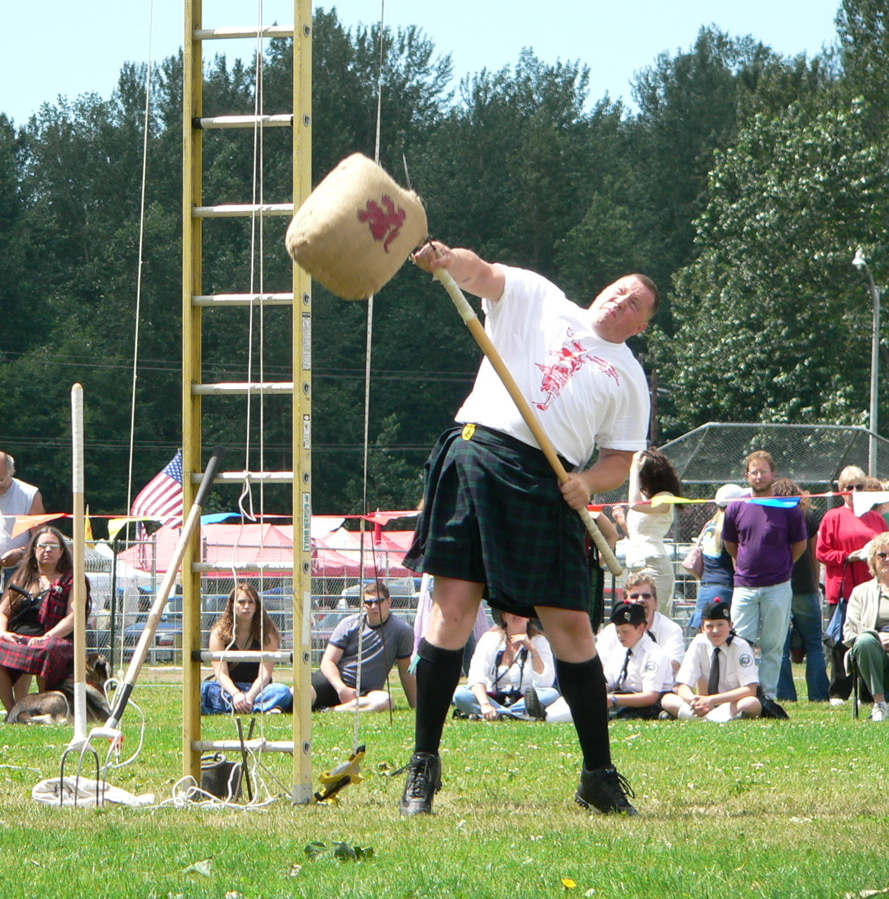
The sheaf toss event at the 2005 Skagit Valley Highland Games, in the state of Washington, United States.

The sheaf toss (Scottish Gaelic: sguab) is a traditional Irish and Scottish agricultural sport event originally contested at country fairs. A pitchfork is used to hurl a hessian bag stuffed with straw over a horizontal bar above the competitor's head.[1] Typical weight for the bag is 16 or 20 lb (7.3 or 9.1 kg).[2] Three chances are given to each competitor to cleanly go over the bar. After all challengers have made their attempts, the bar is raised and all successful competitors move on to the new height. This continues until all but one athlete is eliminated.

The Sheaf toss has been incorporated as an event at many of the Scottish highland games although technically it is not itself a heavy athletics event. The sheaf toss is also a traditional sport in the Basque Country. It is a feature of the annual Sykehouse Show in South Yorkshire, England.

Sheaf tossing is also contested in Ireland and Australia particularly at agricultural shows and at fairs; Irish sheaf tossing differs from sheaf tossing in Scotland and France in that the sheaf is made of rushes which are bound tightly with baling twine and are not placed in a bag. The rules are the same as the Scottish version and a pitchfork is used. The same pitchfork is usually used for all competitors so as not to give anybody an unfair advantage by allowing them use their own customised pitchfork. A variation of this rule is that if one brings a custom pitchfork to the competition, they must allow any other competitor to use that fork.

World records

[edit]
  • 9.1 kg (20 lb) – 11.30 metres (37 ft 1 in) by Spencer Tyler United States (2019 Chicago Highland Games)[3]
  • 7.3 kg (16 lb) – 12.80 metres (42 ft 0 in) by Zach Riley United States (2017 Bartholomew Scottish Festival)[3]

Progression of the world record

[edit]

20 lb sheaf[4]

Distance Holder Year Location
9.50 metres (31 ft 2 in) Canada Harry MacDonald 1997 Alexandria, Virginia, USA
9.61 metres (31 ft 6 in) United States Robert Troupe 1997 Bethlehem, Pennsylvania, USA
9.69 metres (31 ft 9 in) United States Karl Dodge 1998 Huntersville, North Carolina, USA
9.71 metres (31 ft 10 in) United States Art McDermott 1998 Lincoln, New Hampshire, USA
10.06 metres (33 ft 0 in) United States Karl Dodge 1998 Bethlehem, Pennsylvania, USA
10.21 metres (33 ft 6 in) United States Karl Dodge 1999 McAlester, Oklahoma, USA
10.34 metres (33 ft 11 in) United States Karl Dodge 1999 Highlands Ranch, Colorado, USA
10.36 metres (34 ft 0 in) United States Ryan Vierra 2000 Stone Mountain, Georgia, USA
10.67 metres (35 ft 0 in) United States Ryan Vierra 2001 Huntersville, North Carolina, USA
10.75 metres (35 ft 3 in) United States Mike Smith 2004 Huntersville, North Carolina, USA
10.92 metres (35 ft 10 in) United States Eric Frasure 2007 Stone Mountain, Georgia, USA
10.97 metres (36 ft 0 in) United States Eric Frasure 2008 Stone Mountain, Georgia, USA
11.00 metres (36 ft 1 in) United States Eric Frasure 2010 Huntersville, North Carolina, USA
11.03 metres (36 ft 2 in) United States Eric Frasure 2010 Stone Mountain, Georgia, USA
11.12 metres (36 ft 6 in) United States Spencer Tyler 2018 (To be confirmed)
11.15 metres (36 ft 7 in) United States Spencer Tyler 2019 Long Beach, California, USA
11.30 metres (37 ft 1 in) United States Spencer Tyler 2019 Chicago, Illinois, USA

See also

[edit]

References

[edit]
Revisions and contributorsEdit on WikipediaRead on Wikipedia
from Grokipedia
The sheaf toss is a traditional athletic event in Scottish , where competitors use a to hurl a weighted burlap sack filled with or twine—known as a sheaf—over a suspended between uprights, aiming to achieve the maximum height without the sack touching the bar. The sheaf typically weighs 16 to 20 pounds (7.3 to 9.1 kg) for men and 10 to 12 pounds (4.5 to 5.4 kg) for women, depending on the category, with the event testing explosive power, technique, and precision in an overhead throw. Originating from agricultural practices on Scottish and Irish farms, the simulates the chore of pitching bundles of hay or into barn lofts or onto wagons using a , evolving into a competitive discipline at country fairs and later incorporated into , though it is more prominently featured in North American iterations of the games than in . While the broader are first recorded in the during the reign of King Malcolm III in , possibly evolving from earlier Celtic traditions for selecting warriors and clansmen, the sheaf toss emerged as a practical farm-based challenge rather than a core ancient event. In modern competitions, athletes are divided into categories such as , , (under 200 pounds or 90.7 kg), and masters (over 40 years old), with equipment including a two- or three-tined and a bar approximately 10 feet (3 meters) wide between uprights. The rules mirror those of a or weight-for-height event: each competitor receives three attempts to clear the bar at progressively increasing heights, with failure on all three attempts resulting in elimination, and the winner determined by the highest successful clearance or, in ties, by the fewest overall misses. Techniques vary, including the "reach and rip" method where the athlete drives the under the sheaf and explodes upward, often requiring significant core and strength to propel the sack cleanly over the bar without rotation or deflection. The men's is 37 feet 1 inch (11.3 m), set by Spencer Tyler in at the Chicago ; the women's is 26 feet (7.9 m) for the 12 lb sheaf, set in 2018. Today, sheaf toss remains a staple of festivals across and parts of , celebrating Celtic heritage while attracting athletes from and throwing sports.

Overview

Description

Sheaf toss is a traditional Scottish and Irish strength in which competitors use a to hurl a bundled sheaf—a burlap filled with —over a positioned at progressively higher levels. The core objective is to clear the highest bar possible through a format of elimination, where each is allotted three attempts per increment; failure to succeed on all three tries results in elimination from further progression. Basic technique involves positioning the sheaf on the ground, inserting the tines beneath it to lift, and then explosively tossing it overhead to arc over the bar, drawing power primarily from the legs for initial drive, the core for stability, and the arms for the final projection. Standard sheaf weights are 7.3 kg (16 lb) for men's masters and divisions, and 9.1 kg (20 lb) for men's and professional divisions. Women's divisions use 4.5 kg (10 lb) sheaves across masters, , and professional categories.

Cultural Significance

The sheaf toss symbolizes the rural strength and traditions deeply embedded in Scottish and Irish agricultural communities, originating as a competition among farmers to demonstrate prowess in handling heavy bundles of straw or hay during country fairs and shows. This event evokes the physical demands of labor, where tossing sheaves onto wagons or stacks was essential, thereby honoring the endurance and skill required for sustaining rural livelihoods. Integrated into the , the sheaf toss serves as a showcase of athletic prowess within a broader cultural framework that fosters community gatherings, traditional music, and the preservation of Scottish heritage. These games, blending heavy events like the sheaf toss with piping competitions and Highland dancing, emphasize collective identity and historical ties to clan systems, transforming individual feats into communal celebrations. In modern contexts, the sheaf toss attracts participants and spectators to ethnic festivals worldwide, promoting Scottish and Irish heritage on a global scale, with major events such as the Stirling Highland Games drawing over 7,800 visitors annually and the Grandfather Mountain Highland Games exceeding 44,000 attendees. Often paired with clan gatherings and social activities, it prioritizes camaraderie and cultural exchange over mere competition, reinforcing bonds among diaspora communities.

History

Origins in Agriculture

The sheaf toss originated as a practical demonstration of farm labor skills in 18th- and 19th-century Scotland and Ireland, closely tied to the labor-intensive process of sheaf binding during harvest seasons, where workers gathered and bundled cut grain into sheaves for efficient transport and storage. While some accounts suggest roots in medieval agricultural practices, competitive forms emerged at country fairs and agricultural shows in the 19th century, where farmers competed to toss sheaves onto high carts or over obstacles, aiming to showcase efficiency in loading and stacking for quicker harvest completion. These informal competitions rewarded those who could propel the sheaves the greatest height or distance using traditional pitchforks, fostering a sense of community and rivalry among rural workers during annual gatherings. The event evolved directly from everyday rural tasks, such as loading hay bales or straw sheaves into barns or wagons, with informal rules dictated by the farm tools available, like three-tined pitchforks designed for gripping and lifting bundles without scattering the contents. In the , such demonstrations were common at local fairs focused on , while in Ireland, rural gatherings similarly featured sheaf-tossing challenges as part of celebrations, predating the formalized structure of the . This agricultural foundation provided the basis for the sheaf toss's later adoption into competitive sports.

Integration into Highland Games

The sheaf toss transitioned from a folk agricultural practice to a formalized event within organized largely through the efforts of Scottish immigrants in during the mid-19th century. As Scottish communities established gatherings to preserve cultural traditions, the first documented in the United States occurred in 1836 in New York, with subsequent events in the , such as California's inaugural Scottish Games in 1866, incorporating heavy athletics that highlighted immigrant farming skills. The sheaf toss as a specific competitive event was introduced later, with the first dedicated staging occurring at the in starting in 1956. Standardization of the event gained momentum in the 20th century, particularly through organizations like the North American Scottish Games Association (NASGA), founded in 1976, which adopted consistent rules including fixed sheaf weights varying by division (e.g., 20 pounds for men, 16 pounds for masters) and the use of a raised crossbar with a pitchfork. Though the Royal Caledonian Society in primarily focused on traditional events like and without incorporating sheaf toss until much later, if at all, by the early 20th century, the event had become a staple in North American competitions, distinguishing them from Scottish prototypes by emphasizing vertical height over distance. The spread to accelerated with waves of Scottish immigration in the , leading to sheaf toss's establishment as a core heavy event in U.S. and Canadian games by the mid-, often featured alongside and dancing to foster community identity among diaspora populations. In the , post-World War II revival efforts revitalized the sheaf toss through organizations like NASGA, which facilitated professional circuits and ensured the event's growth into a spectator favorite, contributing to the professionalization of Highland athletics in .

Equipment and Rules

The Sheaf

The sheaf serves as the central in the sheaf toss event, constructed from a burlap bag filled with tightly bound , hay, pine needles, or rope to replicate a traditional agricultural bundle. For added durability during repeated tosses, organizers recommend layering two or three burlap bags. Alternative fillings, such as bailing twine, may be used in some competitions to achieve the required weight and density. Standard weights for the sheaf are 7.3 kg (16 lb) in amateur or divisions and 9.1 kg (20 lb) for professional men's events, while women's competitions typically employ 4.5–5.4 kg (10–12 lb) sheaves. Some variation in weight is permitted due to the organic nature of the materials, but totals must align with class specifications to maintain fairness. The burlap bag's dimensions must not exceed 91 cm (36 inches) in length by 61 cm (24 inches) in width when laid flat, though smaller bags are preferred to facilitate tight bundling and optimal handling. Once filled and secured, the sheaf forms a compact, cylindrical shape providing stability for the initial lift while allowing for an aerodynamic spin during the overhead toss. In preparation, the sheaf is assembled on-site by compressing the filling material into the bag and binding it securely with or to ensure uniform density and prevent shifting mid-throw. This process promotes consistency across attempts, as the sheaf must remain intact upon landing to validate the throw. Regional variations exist, particularly in Irish competitions, where the sheaf may consist of bundled rushes rather than straw-filled bags to emphasize cultural and historical authenticity tied to local harvesting practices.

The Pitchfork

The pitchfork serves as the primary implement in sheaf toss, designed to grip and propel the sheaf overhead. It typically features a straight handle measuring approximately 1.5 meters (5 feet) in length, constructed from wood such as for and balance, paired with a metal head of 2 or 3 curved tines that allow secure engagement with the sheaf's base. Configurations with more than 3 tines, such as modified 5-tine forks, are generally prohibited to maintain standardization and safety. Regulations for the emphasize adherence to traditional agricultural designs to preserve the event's heritage, requiring it to resemble a standard tool without excessive modifications. Competitors are permitted to supply their own pitchforks, but all must be approved as safe by event judges prior to use, with identical copies sometimes mandated in competitions to ensure equitable conditions among participants. In professional settings, only pitchforks with 2- or 3-tine heads are allowed, reflecting guidelines from organizations like the Southeastern Highland Athletics Group (SHAG) and Scottish Heavy Athletics. Maintenance of the focuses on functionality and participant safety, with tines routinely sharpened and polished using tools like grinders, files, and emery paper to facilitate smooth release of the sheaf while avoiding overly acute edges that could cause . Before each event, judges inspect the for structural integrity, ensuring no bends, cracks, or hazardous protrusions compromise the toss.

Competition Mechanics

In sheaf toss competitions, the event follows a progressive elimination format akin to the , with the crossbar starting at a low height—typically around 10 feet (3 meters)—and raised in increments of 2 feet (0.61 meters) until five or fewer competitors remain, after which increments decrease to 6 inches (0.15 meters) for precision. The starting height is set to be divisible by 12 inches in consultation with athletes, and record attempts may use even finer 1-inch adjustments. Each competitor receives three consecutive attempts to clear the bar at every height, with the sheaf required to pass entirely over the bar and land between uprights spaced 8 to 12 feet (2.4 to 3.7 meters) apart; failure on all three attempts at any height results in elimination, though passes are allowed without penalty until the final stages. Scoring is based solely on the maximum height cleared, measured from the ground to the top of the bar, determining the winner and placements in descending order of achievement. Ties at the winning height are resolved first by the fewest total misses across the competition, then by performance at the next lower successful height, with additional attempts possible if needed; a two-minute time limit per attempt applies to maintain pace. The sheaf, a burlap filled with or similar material weighing 16 to 20 pounds (7.3 to 9.1 kg) for men or 10 to 12 pounds (4.5 to 5.4 kg) for women, must be tossed using a standard with a 5-foot (1.5-meter) handle and 2 or 3 tines—no modified equipment is permitted. Athletes position themselves stationary behind a marked throwing line or trig, with no running start allowed to ensure and fairness; the feet must remain in place until the release. The standard technique involves inserting the pitchfork tines beneath the sheaf, gripping the handle firmly, and executing an explosive upward coordinated with full-body —often a 180- to 360-degree spin—to impart spin and height to the sheaf, propelling it end-over-end over the bar. Officials judge the toss valid if the sheaf clears without disqualifying factors, and any style is permissible provided it is deemed . Common fouls include stepping over the throwing line or trig during the attempt, which nullifies the toss; using non-approved pitchforks or sheaves; or unsafe conduct leading to disqualification. An incomplete toss occurs if the sheaf fails to clear the bar fully or pulls it down excessively (depending on whether a knock-off or fixed bar is used), resulting in no credit for that attempt. Three consecutive fouls or failures at a height eliminate the competitor, except in tiebreak scenarios.

Competitions

Major Highland Games Events

While the sheaf toss is occasionally featured at some Highland Games in Scotland, such as the Aberfeldy Highland Games, it is more prominently integrated into North American events as a highlight of the heavy athletics competitions. In North America, the event is integrated into numerous annual Highland Games sanctioned by organizations like the North American Scottish Games Athletics (NASGA), which standardizes rules including 20-pound sheaves for professional and open divisions across its member competitions. The Alma Highland Festival and Games, established in 1968 in Alma, Michigan, hosts sheaf toss as part of its professional and amateur athletics over Memorial Day weekend, attracting athletes and families to celebrate Scottish traditions in "Scotland, USA." The Pacific Northwest Scottish Highland Games, organized by the Seattle Scottish Highland Games Association since the 1930s and held annually in late July in Enumclaw, Washington, features the sheaf toss in its heavy events lineup, drawing approximately 20,000 attendees for a weekend of competitions and clan gatherings. Major U.S. events further emphasize the sheaf toss's popularity, such as the in , begun in 1956 and conducted yearly in mid-July, where it is contested in professional, amateur, and masters divisions before 30,000 to 40,000 visitors amid pipe bands and clan tents. These gatherings, often NASGA-sanctioned, highlight the event's role in community festivals with consistent annual scheduling to foster athletic excellence and cultural exchange. On the professional circuit, sheaf toss competitions contribute to broader heavy events series across North American games, where top athletes can earn up to $5,000 in seasonal through cumulative performances, incentivizing participation in sanctioned meets.

International and Regional Variations

Sheaf toss has spread beyond its Scottish and Irish roots, adapting to local agricultural traditions and cultural festivals in various regions, often with modifications to , weights, or formats to suit participants and venues. In , the event is prominently featured at agricultural shows, including the Royal Adelaide Show, where the first official competition took place in 1914. Australian versions typically employ a lighter sheaf weighing 8 pounds (3.6 kg) compared to the heavier bundles in traditional , with bar heights measured in metric units to align with national standards. Competitions emphasize technique and are held at events like the Angaston Show, preserving the sport's rural heritage while attracting family audiences. In Ireland, sheaf tossing remains a staple of agricultural shows and rural festivals, contested at gatherings such as the Agricultural Show, Tinahely Show, and Trim Haymaking Festival, where it highlights historical farming skills. These events often include junior and senior categories, fostering community participation and maintaining the sport's ties to traditions without significant deviations from the core mechanics of tossing a straw bundle over a raised bar. In 2025, the Show featured the event on July 6, drawing large crowds. In the Basque Country, a closely related discipline called lanzamiento de fardo forms part of the herri kirolak, or rural sports, where athletes use a to hurl a straw bale over a , originating from practical farm tasks like loading hay. Integrated into local festivals and championships organized by federations, the event underscores strength and precision, with competitions held across the region to celebrate Basque agrarian culture. England hosts sheaf tossing at select agricultural shows, notably the annual Sykehouse Show in , which claims to be one of the few venues south of the Scottish border offering the competition. This adaptation draws on the sport's agricultural origins, providing a platform for local competitors to demonstrate skill in tossing the sheaf for height amid broader rural exhibitions. In the United States, sheaf toss features in numerous Scottish and Irish festivals as well as , with modern variants incorporating dedicated women's divisions using 12-pound sheaves to promote inclusivity; these categories have expanded significantly since the early , as standardized by organizations like the North American Scottish Games Association. Events at festivals such as the Irish Fest showcase the sport's global appeal, blending traditional elements with adapted rules for diverse athletes.

Records and Achievements

Current World Records

The current world records in sheaf toss are verified by sanctioning bodies such as the North American Scottish Games Association (NASGA), with measurements recorded from the ground to the peak height of the bar successfully cleared by the sheaf. In the men's open division, the record for the 20 lb sheaf is 11.30 m (37 ft 1 in), achieved by Spencer Tyler at the 2019 . This mark surpassed previous benchmarks and remains the standard as of November 2025. The men's open record for the 16 lb sheaf stands at 12.80 m (42 ft), set by Zach Riley at the 2017 Bartholomew County Scottish Festival in , under NASGA sanctioning. The women's category in sheaf toss continues to develop, with records tracked across open professional, , and masters divisions using sheaves of 10 to 12 lb. In the pro women's open division (10 lb sheaf), the current record is 11.33 m (37 ft 2 in), set by Emily Adams at the 2024 North American Scottish Games. In the women's masters division (10 lb sheaf), Laura Anthony and Emily Adams share the record of 9.75 m (32 ft 0 in), achieved in 2024 and 2025 respectively. These achievements reflect growing participation and technical advancements as of November 2025.

Historical Record Progression

The progression of world records in the men's 20 lb sheaf toss began to accelerate in the late , coinciding with increased formalization of events across . In 1997, Harry MacDonald established an early mark of 31 feet 2 inches (9.50 m) at the Alexandria in . Subsequent improvements came rapidly, with Karl Dodge extending the record to 33 feet 11 inches (10.34 m) by 1999 at the Highlands Ranch Scottish Games in . By the early 2000s, athletes like Ryan Vierra pushed boundaries further, achieving 35 feet (10.67 m) in 2001 at the Loch Norman in . Eric Frasure then dominated the mid-2000s to early , incrementally raising the bar to 36 feet 2 inches (11.02 m) in 2010 at the in Georgia. These gains highlighted evolving techniques, including enhanced rotational mechanics for greater explosive power. In 2019, Spencer Tyler shattered Frasure's mark twice: first with 36 feet 7 inches (11.15 m) at the Queen Mary in , then 37 feet 1 inch (11.30 m) at the Chicago in , representing the current pinnacle. This era's advances were supported by equipment standardization in the post-1990s period, ensuring consistent 20 lb sheaves and pitchforks across sanctioned events. For the 16 lb class, often used in amateur or lighter divisions, records evolved from around 35 feet (10.67 m) in the early to Jason Johnston's 40 feet 3 inches (12.27 m) in 2016 at the Western Canadian Championships in . The mark advanced to 42 feet (12.80 m) by Zach Riley in 2017 at the Bartholomew County Scottish Festival in , underscoring similar technical refinements in and lift efficiency. Contributing to these developments since the has been the integration of modern training regimens, including CrossFit-inspired explosive strength workouts, which enhance athletes' power output for events like the sheaf toss.
YearAthleteDistanceEvent
1997Harry MacDonald9.50 m (31 ft 2 in)Alexandria Highland Games
2001Ryan Vierra10.67 m (35 ft 0 in)Loch Norman Highland Games
2004Mike Smith10.74 m (35 ft 3 in)Loch Norman Highland Games
2010Eric Frasure11.02 m (36 ft 2 in) Highland Games
2019Spencer Tyler11.15 m (36 ft 7 in)Queen Mary Highland Games
2019Spencer Tyler11.30 m (37 ft 1 in) Highland Games

References

Add your contribution
Related Hubs
User Avatar
No comments yet.