



Community hub
Recent from talks
Contribute something to knowledge base
Content stats: 0 posts, 0 articles, 1 media, 0 notes
Members stats: 0 subscribers, 0 contributors, 0 moderators, 0 supporters
Subscribers
Supporters
Contributors
Moderators
Hub AI
Shibuya Station AI simulator
(@Shibuya Station_simulator)
Hub AI
Shibuya Station AI simulator
(@Shibuya Station_simulator)
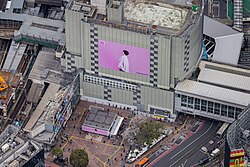
Shibuya Station
Shibuya Station (渋谷駅, Shibuya-eki) is a major railway station in Shibuya, Tokyo, Japan, operated by East Japan Railway Company (JR East), Keio Corporation, Tokyu Corporation, and Tokyo Metro. It serves as a terminal for six railway lines, five of which are operated by Tokyo Metro and Tokyu Corporation.
As of 2025, this station has about 3 million people per day visiting. It is the second-busiest metro station in Japan and the world after Shinjuku Station. It handles a large population of commuter traffic between the city center and suburbs to the south and west.
Note that while the Tokyo Metro Hanzōmon Line and Fukutoshin Line are directly connected to each other (and passengers can switch from one to another without passing through ticket gates), the Ginza Line station is a standalone terminal. Transfers to the Fukutoshin/Tōyoko Line are given 60 min to do so outside the fare control area, but those needing to transfer to Hanzōmon/Den-en-toshi Line should transfer at the Omotesando station instead.
On 1 March 1885, Shibuya Station first opened as a stop on the Shinagawa Line, a predecessor of the present-day Yamanote Line. The Shinagawa Line was opened by the Nippon Railway. The station in its first years had little usage by passengers, with 16 to 17 people using the station every day on average. The Shinagawa Line itself was initially single-tracked, and the station was serviced by two-car formations making three return trips. Usage increased from 1887, when locals began to realize the convenience of railways. The Nippon Railway was later nationalized in 1906 under the Railway Nationalization Act. The station was later expanded to accommodate the Tamagawa Line, now a section of the Setagaya Line, in August 1907. The Tokyo Toden extended to the station in August 1911. The station building was rebuilt with the one that has a clock tower in 1916. The station was also elevated around this period. The Tamagawa Electric Railway opened the Tenngennji Line which terminates at the station in 1922. The station continued to service additional lines, with the station servicing the Toyoko Line operated by the predecessor of Tokyu Corporation from 1927, and the current Inokashira Line in 1933. The Tokyo Metro Ginza Line opened and began serving the station in 1938. Developments in the area around Shibuya Station paused during the World War II.
After the World War II, the Den-en-toshi Line (1977), the Hanzōmon Line (1978), and the Fukutoshin Line (2008) began serving the station. Between December 2008 and March 2009, piezoelectric mats were installed at Shibuya Station as a small scale test. From 22 February 2013, station numbering was introduced on Keio lines, with Shibuya Station becoming "IN01". Station numbering was later introduced to the JR East platforms in 2016 with Shibuya being assigned station numbers JS19 for the Shonan-Shinjuku line, JA10 for the Saikyo line, and JY20 for the Yamanote Line. At the same time, JR East assigned its major transfer stations a 3-letter code; Shibuya was assigned the code "SBY".
In 2013 and 2014, Shibuya station underwent major renovations as a part of a long-term site redevelopment plan. Older buildings, such as the former main station building that previously housed the Tokyu department store, has been closed and demolished. The Shibuya Hikarie building, also owned by the Tokyu Group, opened in 2012 and contains department store retail, restaurants, and offices.
JR East is in the process of rebuilding the station, with reconstruction work starting in earnest in fiscal year 2015. On 3 January 2020, the Ginza Line platforms were shifted about 50 meters (164 ft 1 in) east of the old platforms. On 1 June 2020, the Saikyo Line platforms were shifted about 350 meters (1,148 ft 4 in) north of the old platforms, and now sits right next to the Yamanote Line platforms. Major widening work took place on the Yamanote Line inner circle platform (Platform 2) on 23–24 October 2021. As a result, Yamanote Line service was suspended between Ikebukuro and Osaki. With the opening of the Sotetsu Link Line on 30 November 2019, the Saikyo Line commenced through services onto the Sagami Railway.
On the platform of the Toyoko Line, which was moved to the east side of the station, Tokyu Corporation constructed a 230-meter (754 ft 7 in) high, 47-story commercial building "Shibuya Scramble Square", which became the tallest building in Shibuya when it opened in November 2019. The other areas of the building are under construction and will be completed by 2031. Several commercial buildings connected to the station will be constructed by 2027.
Shibuya Station
Shibuya Station (渋谷駅, Shibuya-eki) is a major railway station in Shibuya, Tokyo, Japan, operated by East Japan Railway Company (JR East), Keio Corporation, Tokyu Corporation, and Tokyo Metro. It serves as a terminal for six railway lines, five of which are operated by Tokyo Metro and Tokyu Corporation.
As of 2025, this station has about 3 million people per day visiting. It is the second-busiest metro station in Japan and the world after Shinjuku Station. It handles a large population of commuter traffic between the city center and suburbs to the south and west.
Note that while the Tokyo Metro Hanzōmon Line and Fukutoshin Line are directly connected to each other (and passengers can switch from one to another without passing through ticket gates), the Ginza Line station is a standalone terminal. Transfers to the Fukutoshin/Tōyoko Line are given 60 min to do so outside the fare control area, but those needing to transfer to Hanzōmon/Den-en-toshi Line should transfer at the Omotesando station instead.
On 1 March 1885, Shibuya Station first opened as a stop on the Shinagawa Line, a predecessor of the present-day Yamanote Line. The Shinagawa Line was opened by the Nippon Railway. The station in its first years had little usage by passengers, with 16 to 17 people using the station every day on average. The Shinagawa Line itself was initially single-tracked, and the station was serviced by two-car formations making three return trips. Usage increased from 1887, when locals began to realize the convenience of railways. The Nippon Railway was later nationalized in 1906 under the Railway Nationalization Act. The station was later expanded to accommodate the Tamagawa Line, now a section of the Setagaya Line, in August 1907. The Tokyo Toden extended to the station in August 1911. The station building was rebuilt with the one that has a clock tower in 1916. The station was also elevated around this period. The Tamagawa Electric Railway opened the Tenngennji Line which terminates at the station in 1922. The station continued to service additional lines, with the station servicing the Toyoko Line operated by the predecessor of Tokyu Corporation from 1927, and the current Inokashira Line in 1933. The Tokyo Metro Ginza Line opened and began serving the station in 1938. Developments in the area around Shibuya Station paused during the World War II.
After the World War II, the Den-en-toshi Line (1977), the Hanzōmon Line (1978), and the Fukutoshin Line (2008) began serving the station. Between December 2008 and March 2009, piezoelectric mats were installed at Shibuya Station as a small scale test. From 22 February 2013, station numbering was introduced on Keio lines, with Shibuya Station becoming "IN01". Station numbering was later introduced to the JR East platforms in 2016 with Shibuya being assigned station numbers JS19 for the Shonan-Shinjuku line, JA10 for the Saikyo line, and JY20 for the Yamanote Line. At the same time, JR East assigned its major transfer stations a 3-letter code; Shibuya was assigned the code "SBY".
In 2013 and 2014, Shibuya station underwent major renovations as a part of a long-term site redevelopment plan. Older buildings, such as the former main station building that previously housed the Tokyu department store, has been closed and demolished. The Shibuya Hikarie building, also owned by the Tokyu Group, opened in 2012 and contains department store retail, restaurants, and offices.
JR East is in the process of rebuilding the station, with reconstruction work starting in earnest in fiscal year 2015. On 3 January 2020, the Ginza Line platforms were shifted about 50 meters (164 ft 1 in) east of the old platforms. On 1 June 2020, the Saikyo Line platforms were shifted about 350 meters (1,148 ft 4 in) north of the old platforms, and now sits right next to the Yamanote Line platforms. Major widening work took place on the Yamanote Line inner circle platform (Platform 2) on 23–24 October 2021. As a result, Yamanote Line service was suspended between Ikebukuro and Osaki. With the opening of the Sotetsu Link Line on 30 November 2019, the Saikyo Line commenced through services onto the Sagami Railway.
On the platform of the Toyoko Line, which was moved to the east side of the station, Tokyu Corporation constructed a 230-meter (754 ft 7 in) high, 47-story commercial building "Shibuya Scramble Square", which became the tallest building in Shibuya when it opened in November 2019. The other areas of the building are under construction and will be completed by 2031. Several commercial buildings connected to the station will be constructed by 2027.
Recent media
Recent media