



Community hub
Recent from talks
Contribute something to knowledge base
Content stats: 0 posts, 0 articles, 1 media, 0 notes
Members stats: 0 subscribers, 0 contributors, 0 moderators, 0 supporters
Subscribers
Supporters
Contributors
Moderators
Hub AI
Shikoku Broadcasting AI simulator
(@Shikoku Broadcasting_simulator)
Hub AI
Shikoku Broadcasting AI simulator
(@Shikoku Broadcasting_simulator)
Shikoku Broadcasting
Shikoku Broadcasting Co., Ltd. is a Japanese regional broadcaster based in Tokushima. The station's radio division, Shikoku Broadcasting Radio, callsign JOJR is affiliated with the Japan Radio Network and the National Radio Network while its television division, Shikoku Broadcasting Television, callsign JOJR-DTV (channel 1) serves as an affiliate of the Nippon News Network and the Nippon Television Network System. Both stations serve Tokushima Prefecture with its headquarters and studios being located in the Nakatokushima ward of Tokushima.
Despite holding a local monopoly in commercial television to the prefecture, commercial television stations from the Kansai region are easily available.
After the establishment of the "Three Radio Laws" (Radio Law, Broadcasting Law, and Radio Supervisory Committee Establishment Law) in 1950, Japan established a system where public broadcasting (NHK) and commercial broadcasting coexisted. Uesaki Ryujiro and other Tokushima businessmen established Shikoku Broadcasting in August of the same year and applied for a private broadcasting license In April of the following year, Shikoku Broadcasting obtained a preparatory license for that aim. On March 31, 1952, Shikoku Broadcasting held its founding general meeting with a capital of 25 million yen and 50,000 shares issued. At the same time, Shikoku Broadcasting decided to build a headquarters building in Shinmachi, Tokushima City. In June of the same year, Shikoku Broadcasting officially obtained a broadcasting license after successfully launching test broadcasts.
On July 1, 1952, Shikoku Broadcasting, branded as JR (as in JOJR) officially started broadcasting, becoming the first private broadcasting station in Shikoku. In the second year of broadcasting, Shikoku Broadcasting achieved a balance of payments and established a branch in Wakayama. In order to reduce program production costs and increase advertising revenue, Shikoku Broadcasting also formed a Shikoku Broadcasting Alliance with Kagawa Radio (now Nishinippon Broadcasting) that year to simulcast radio programs. With the improvement of the operating conditions of the two stations and the improvement of the program self-control ability, the alliance was dissolved in 1956. In 1954, the president of Shikoku Broadcasting was changed to Maekawa Shizuo of Tokushima Shimbun. On the same year, Shikoku Broadcasting also increased the transmission power to 10 kilowatts (500 watts at night), which expanded the signal coverage area by 30%. The Shikoku Broadcasting Wakayama Branch set up a recording studio in 1956, making the Wakayama Branch not only an advertising business base, but also a base to produce its own programs, which gained local audiences. When the Nankai Maru shipwreck occurred in 1958, Shikoku Broadcasting quickly mobilized employees other than journalists to report on the accident, for which they were awarded the President's Award by the Federation of Democratic People's Liberation.
On August 18, 1955, Shikoku Broadcasting applied for a TV broadcasting license, and obtained a preliminary license in October 1957. At the end of 1958, Shikoku Broadcasting decided that the TV department would join the Nippon Television Network, and obtained the official broadcasting license on March 23 of the following year, and began trial broadcasting on March 25. Shikoku Broadcasting originally planned to start broadcasting TV in July 1959, but was stimulated by NHK Tokushima's start of television broadcasts on March 15, and decided to advance the launch date to April 1. In 1961, Shikoku Broadcasting began to build the second phase of the headquarters building and it was completed in March of the following year. In 1963, Shikoku Broadcasting sent a cameraman to Burma to shoot a documentary, which was the first overseas interview by Shikoku Broadcasting.
On October 1, the eve of the opening of the 1964 Tokyo Olympics, Shikoku Broadcasting broadcast a program in color for the first time. At that time, Shikoku Broadcasting broadcast 2.5 hours of color programs every day. Five years later, in 1969, Shikoku Broadcasting's self-produced programs also began to be produced in color. The total revenue of Shikoku Broadcasting exceeded 1 billion yen for the first time in 1967, and exceeded 2 billion yen in 1972 on the 20th anniversary of its launch. In 1975, with the launch of Wakayama TV, Shikoku Broadcasting closed the Wakayama branch. In the same year, Shikoku Broadcasting's turnover exceeded 3 billion yen.
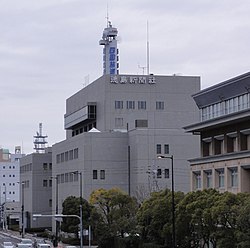
Starting in 1978, Shikoku Broadcasting became one of the organizers of the Awa Tanuki Festival. In the same year, Shikoku Broadcasting sent reporters to the NNN Bangkok branch, becoming the first overseas correspondent of Shikoku Broadcasting. The following year, Shikoku Broadcasting introduced the electronic news gathering (ENG) system to improve the efficiency of news gathering and editing. In 1982, Shikoku Broadcasting began to use "JRT" as the company abbreviation. In January 1983, Shikoku Broadcasting began construction of a new headquarters building in Nakatokushima Town, Tokushima City, and it was completed in November of the following year. The building has one floor underground and seven floors above ground, with a total floor area of 20,790 square meters. The north side of the first to fifth floors and the sixth floor are used by Shikoku Broadcasting, and the south side of the first to fifth floors is used by Tokushima Shimbun. There are two television studios in this building, and the main television control room is located on the third floor. In 1988, Shikoku Broadcasting's profit reached a record high of 1.06 billion yen. In the same year, Shikoku Broadcasting also began broadcasting stereo TV programs. In 1989, Shikoku Broadcasting and NHK jointly produced a special program on Awa Odori. In 1990, Shikoku Broadcasting's turnover exceeded 7 billion yen for the first time.
In order to adapt to the arrival of the digital TV era, Shikoku Broadcasting realized the digitization of the main control room in 1997. On October 1, 2006, Shikoku Broadcasting began broadcasting digital TV signals, and stopped broadcasting analog TV signals on July 24, 2011.
Shikoku Broadcasting
Shikoku Broadcasting Co., Ltd. is a Japanese regional broadcaster based in Tokushima. The station's radio division, Shikoku Broadcasting Radio, callsign JOJR is affiliated with the Japan Radio Network and the National Radio Network while its television division, Shikoku Broadcasting Television, callsign JOJR-DTV (channel 1) serves as an affiliate of the Nippon News Network and the Nippon Television Network System. Both stations serve Tokushima Prefecture with its headquarters and studios being located in the Nakatokushima ward of Tokushima.
Despite holding a local monopoly in commercial television to the prefecture, commercial television stations from the Kansai region are easily available.
After the establishment of the "Three Radio Laws" (Radio Law, Broadcasting Law, and Radio Supervisory Committee Establishment Law) in 1950, Japan established a system where public broadcasting (NHK) and commercial broadcasting coexisted. Uesaki Ryujiro and other Tokushima businessmen established Shikoku Broadcasting in August of the same year and applied for a private broadcasting license In April of the following year, Shikoku Broadcasting obtained a preparatory license for that aim. On March 31, 1952, Shikoku Broadcasting held its founding general meeting with a capital of 25 million yen and 50,000 shares issued. At the same time, Shikoku Broadcasting decided to build a headquarters building in Shinmachi, Tokushima City. In June of the same year, Shikoku Broadcasting officially obtained a broadcasting license after successfully launching test broadcasts.
On July 1, 1952, Shikoku Broadcasting, branded as JR (as in JOJR) officially started broadcasting, becoming the first private broadcasting station in Shikoku. In the second year of broadcasting, Shikoku Broadcasting achieved a balance of payments and established a branch in Wakayama. In order to reduce program production costs and increase advertising revenue, Shikoku Broadcasting also formed a Shikoku Broadcasting Alliance with Kagawa Radio (now Nishinippon Broadcasting) that year to simulcast radio programs. With the improvement of the operating conditions of the two stations and the improvement of the program self-control ability, the alliance was dissolved in 1956. In 1954, the president of Shikoku Broadcasting was changed to Maekawa Shizuo of Tokushima Shimbun. On the same year, Shikoku Broadcasting also increased the transmission power to 10 kilowatts (500 watts at night), which expanded the signal coverage area by 30%. The Shikoku Broadcasting Wakayama Branch set up a recording studio in 1956, making the Wakayama Branch not only an advertising business base, but also a base to produce its own programs, which gained local audiences. When the Nankai Maru shipwreck occurred in 1958, Shikoku Broadcasting quickly mobilized employees other than journalists to report on the accident, for which they were awarded the President's Award by the Federation of Democratic People's Liberation.
On August 18, 1955, Shikoku Broadcasting applied for a TV broadcasting license, and obtained a preliminary license in October 1957. At the end of 1958, Shikoku Broadcasting decided that the TV department would join the Nippon Television Network, and obtained the official broadcasting license on March 23 of the following year, and began trial broadcasting on March 25. Shikoku Broadcasting originally planned to start broadcasting TV in July 1959, but was stimulated by NHK Tokushima's start of television broadcasts on March 15, and decided to advance the launch date to April 1. In 1961, Shikoku Broadcasting began to build the second phase of the headquarters building and it was completed in March of the following year. In 1963, Shikoku Broadcasting sent a cameraman to Burma to shoot a documentary, which was the first overseas interview by Shikoku Broadcasting.
On October 1, the eve of the opening of the 1964 Tokyo Olympics, Shikoku Broadcasting broadcast a program in color for the first time. At that time, Shikoku Broadcasting broadcast 2.5 hours of color programs every day. Five years later, in 1969, Shikoku Broadcasting's self-produced programs also began to be produced in color. The total revenue of Shikoku Broadcasting exceeded 1 billion yen for the first time in 1967, and exceeded 2 billion yen in 1972 on the 20th anniversary of its launch. In 1975, with the launch of Wakayama TV, Shikoku Broadcasting closed the Wakayama branch. In the same year, Shikoku Broadcasting's turnover exceeded 3 billion yen.
Starting in 1978, Shikoku Broadcasting became one of the organizers of the Awa Tanuki Festival. In the same year, Shikoku Broadcasting sent reporters to the NNN Bangkok branch, becoming the first overseas correspondent of Shikoku Broadcasting. The following year, Shikoku Broadcasting introduced the electronic news gathering (ENG) system to improve the efficiency of news gathering and editing. In 1982, Shikoku Broadcasting began to use "JRT" as the company abbreviation. In January 1983, Shikoku Broadcasting began construction of a new headquarters building in Nakatokushima Town, Tokushima City, and it was completed in November of the following year. The building has one floor underground and seven floors above ground, with a total floor area of 20,790 square meters. The north side of the first to fifth floors and the sixth floor are used by Shikoku Broadcasting, and the south side of the first to fifth floors is used by Tokushima Shimbun. There are two television studios in this building, and the main television control room is located on the third floor. In 1988, Shikoku Broadcasting's profit reached a record high of 1.06 billion yen. In the same year, Shikoku Broadcasting also began broadcasting stereo TV programs. In 1989, Shikoku Broadcasting and NHK jointly produced a special program on Awa Odori. In 1990, Shikoku Broadcasting's turnover exceeded 7 billion yen for the first time.
In order to adapt to the arrival of the digital TV era, Shikoku Broadcasting realized the digitization of the main control room in 1997. On October 1, 2006, Shikoku Broadcasting began broadcasting digital TV signals, and stopped broadcasting analog TV signals on July 24, 2011.
Recent media
Recent media