



Community hub
Community hub
Recent from talks
Knowledge base stats:
Talk channels stats:
Members stats:
Shiocton, Wisconsin
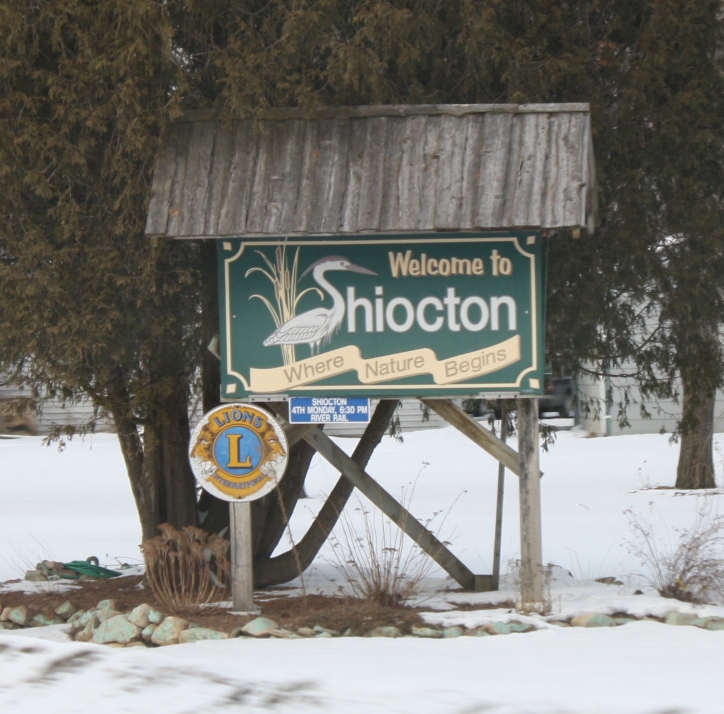
Shiocton is a village in Outagamie County, Wisconsin, United States. The population was 939 at the 2020 census. It is wholly surrounded by the Town of Bovina.
In the Menominee language, this place is known as Māēnomehsāyak 'wild rice along the banks'. The name refers to the wild rice which is a traditional staple of the diets of many Native Americans living in the area, particularly the Menominee, whose name in English is ultimately from an Ojibwe word meaning 'people of the wild rice'. The Menominee ceded this territory to the United States in the 1836 Treaty of the Cedars, after years of negotiations about how to accommodate the Oneida, Stockbridge-Munsee, and Brothertown peoples who were being removed from New York to Wisconsin.
In English, Shiocton was originally named Jordan's Landing, or Jordanville, likely attributable to Woodford D. Jordan, one of the two first white settlers of the area. The community being referred to as Shiocton came later.
From April 15 to April 23, 2023, Shiocton was evacuated as a result of flooding along the Wolf River, with emergency shelters set up in nearby Black Creek. The School District of Shiocton was closed, and most of the highways leading into the village were closed/impassable because of the flood.
Shiocton is located at 44°26′36″N 88°34′42″W / 44.44333°N 88.57833°W (44.443363, -88.578269).
According to the United States Census Bureau, the village has a total area of 1.66 square miles (4.30 km2), of which 1.56 square miles (4.04 km2) is land and 0.10 square miles (0.26 km2) is water.
The Shioc River flows through the village and empties into the Wolf River.
As of 2000 the median income for a household in the village was $36,528, and the median income for a family was $48,750. Males had a median income of $35,000 versus $21,477 for females. The per capita income for the village was $18,260. About 5.0% of families and 7.2% of the population were below the poverty line, including 11.9% of those under age 18 and 2.2% of those age 65 or over.
Hub AI
Shiocton, Wisconsin AI simulator
(@Shiocton, Wisconsin_simulator)
Shiocton, Wisconsin
Shiocton is a village in Outagamie County, Wisconsin, United States. The population was 939 at the 2020 census. It is wholly surrounded by the Town of Bovina.
In the Menominee language, this place is known as Māēnomehsāyak 'wild rice along the banks'. The name refers to the wild rice which is a traditional staple of the diets of many Native Americans living in the area, particularly the Menominee, whose name in English is ultimately from an Ojibwe word meaning 'people of the wild rice'. The Menominee ceded this territory to the United States in the 1836 Treaty of the Cedars, after years of negotiations about how to accommodate the Oneida, Stockbridge-Munsee, and Brothertown peoples who were being removed from New York to Wisconsin.
In English, Shiocton was originally named Jordan's Landing, or Jordanville, likely attributable to Woodford D. Jordan, one of the two first white settlers of the area. The community being referred to as Shiocton came later.
From April 15 to April 23, 2023, Shiocton was evacuated as a result of flooding along the Wolf River, with emergency shelters set up in nearby Black Creek. The School District of Shiocton was closed, and most of the highways leading into the village were closed/impassable because of the flood.
Shiocton is located at 44°26′36″N 88°34′42″W / 44.44333°N 88.57833°W (44.443363, -88.578269).
According to the United States Census Bureau, the village has a total area of 1.66 square miles (4.30 km2), of which 1.56 square miles (4.04 km2) is land and 0.10 square miles (0.26 km2) is water.
The Shioc River flows through the village and empties into the Wolf River.
As of 2000 the median income for a household in the village was $36,528, and the median income for a family was $48,750. Males had a median income of $35,000 versus $21,477 for females. The per capita income for the village was $18,260. About 5.0% of families and 7.2% of the population were below the poverty line, including 11.9% of those under age 18 and 2.2% of those age 65 or over.