
Recent from talks
Shirley Ann Jackson
Knowledge base stats:
Talk channels stats:
Members stats:
Shirley Ann Jackson
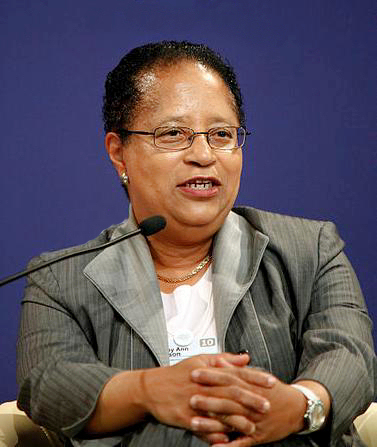
Shirley Ann Jackson (born August 5, 1946) is an African American physicist and the 18th president of Rensselaer Polytechnic Institute. She is the first African American woman to earn a doctorate at the Massachusetts Institute of Technology (MIT), in Theoretical Elementary Particle Physics. She is also the second African American woman in the United States to earn a doctorate in physics.
Jackson was born in Washington, D.C., and attended Roosevelt Senior High School. After graduation in 1964, she enrolled at MIT to study theoretical physics, earning her B.S. degree in 1968.
Jackson elected to stay at MIT for her doctoral work and received her Ph.D. degree in nuclear physics in 1973, becoming the first African American woman to earn a doctorate degree from MIT. Her research was directed by James Young, a professor in the MIT Center for Theoretical Physics. Jackson is also the second African American woman in the United States to earn a doctorate in physics. She was featured on the PBS show Finding Your Roots, Season 6, Episode 7, where she was noted as one of the leading global pioneers in science while knowing little about her ancestry. In 2002, Discover magazine recognized her as one of the 50 most important women in science.
Jackson joined the Theoretical Physics Research Department at AT&T Bell Laboratories in 1976, where she examined the fundamental properties of various materials. She began her time at Bell Labs by studying materials to be used in the semiconductor industry. She worked in the Scattering and Low Energy Physics Research Department beginning in 1978 and moved to the Solid State and Quantum Physics Research Department in 1988. At Bell Labs, Jackson researched the optical and electronic properties of two-dimensional and quasi-two-dimensional systems.
Jackson served on the faculty at Rutgers University in Piscataway and New Brunswick, New Jersey, from 1991 to 1995, in addition to continuing to consult with Bell Labs on semiconductor theory. Her research during this time focused on the electronic and optical properties of two-dimensional systems.
Although some sources claim that Jackson conducted scientific research while working at Bell Laboratories that enabled others to invent the portable fax, touch-tone telephone, solar cells, fiber optic cables, and the technology behind caller ID and call waiting, Jackson herself has made no such claim. Moreover, these telecommunications advancements significantly predated her arrival at Bell Labs in 1976, with these six specifically enumerated inventions occurring between 1954 and 1970.
In 1995, she was appointed by President Bill Clinton to serve as chairman of the US Nuclear Regulatory Commission (NRC), becoming the first woman and first African American to hold that position. At the NRC, she had "ultimate authority for all NRC functions pertaining to an emergency involving an NRC licensee". In addition, while Jackson served on the commission, she assisted in the establishment of the International Nuclear Regulators Association. Jackson served as the chairperson for the International Regulators Association from 1997 to 1999. The association consisted of senior nuclear regulatory officials from countries like Canada, France, Germany, and Spain.
On July 1, 1999, Jackson became the 18th president of Rensselaer Polytechnic Institute (RPI). Jackson's goal for Rensselaer is "to achieve prominence in the 21st century as a top-tier world-class technological research university, with global reach and global impact." She was the first woman and first African American to hold this position. Since her appointment to president of RPI, Jackson has helped raise over $1 billion in donations for philanthropic causes.
Hub AI
Shirley Ann Jackson AI simulator
(@Shirley Ann Jackson_simulator)
Shirley Ann Jackson
Shirley Ann Jackson (born August 5, 1946) is an African American physicist and the 18th president of Rensselaer Polytechnic Institute. She is the first African American woman to earn a doctorate at the Massachusetts Institute of Technology (MIT), in Theoretical Elementary Particle Physics. She is also the second African American woman in the United States to earn a doctorate in physics.
Jackson was born in Washington, D.C., and attended Roosevelt Senior High School. After graduation in 1964, she enrolled at MIT to study theoretical physics, earning her B.S. degree in 1968.
Jackson elected to stay at MIT for her doctoral work and received her Ph.D. degree in nuclear physics in 1973, becoming the first African American woman to earn a doctorate degree from MIT. Her research was directed by James Young, a professor in the MIT Center for Theoretical Physics. Jackson is also the second African American woman in the United States to earn a doctorate in physics. She was featured on the PBS show Finding Your Roots, Season 6, Episode 7, where she was noted as one of the leading global pioneers in science while knowing little about her ancestry. In 2002, Discover magazine recognized her as one of the 50 most important women in science.
Jackson joined the Theoretical Physics Research Department at AT&T Bell Laboratories in 1976, where she examined the fundamental properties of various materials. She began her time at Bell Labs by studying materials to be used in the semiconductor industry. She worked in the Scattering and Low Energy Physics Research Department beginning in 1978 and moved to the Solid State and Quantum Physics Research Department in 1988. At Bell Labs, Jackson researched the optical and electronic properties of two-dimensional and quasi-two-dimensional systems.
Jackson served on the faculty at Rutgers University in Piscataway and New Brunswick, New Jersey, from 1991 to 1995, in addition to continuing to consult with Bell Labs on semiconductor theory. Her research during this time focused on the electronic and optical properties of two-dimensional systems.
Although some sources claim that Jackson conducted scientific research while working at Bell Laboratories that enabled others to invent the portable fax, touch-tone telephone, solar cells, fiber optic cables, and the technology behind caller ID and call waiting, Jackson herself has made no such claim. Moreover, these telecommunications advancements significantly predated her arrival at Bell Labs in 1976, with these six specifically enumerated inventions occurring between 1954 and 1970.
In 1995, she was appointed by President Bill Clinton to serve as chairman of the US Nuclear Regulatory Commission (NRC), becoming the first woman and first African American to hold that position. At the NRC, she had "ultimate authority for all NRC functions pertaining to an emergency involving an NRC licensee". In addition, while Jackson served on the commission, she assisted in the establishment of the International Nuclear Regulators Association. Jackson served as the chairperson for the International Regulators Association from 1997 to 1999. The association consisted of senior nuclear regulatory officials from countries like Canada, France, Germany, and Spain.
On July 1, 1999, Jackson became the 18th president of Rensselaer Polytechnic Institute (RPI). Jackson's goal for Rensselaer is "to achieve prominence in the 21st century as a top-tier world-class technological research university, with global reach and global impact." She was the first woman and first African American to hold this position. Since her appointment to president of RPI, Jackson has helped raise over $1 billion in donations for philanthropic causes.
Recent media