
Recent from talks
Shishumar-class submarine
Knowledge base stats:
Talk channels stats:
Members stats:
Shishumar-class submarine
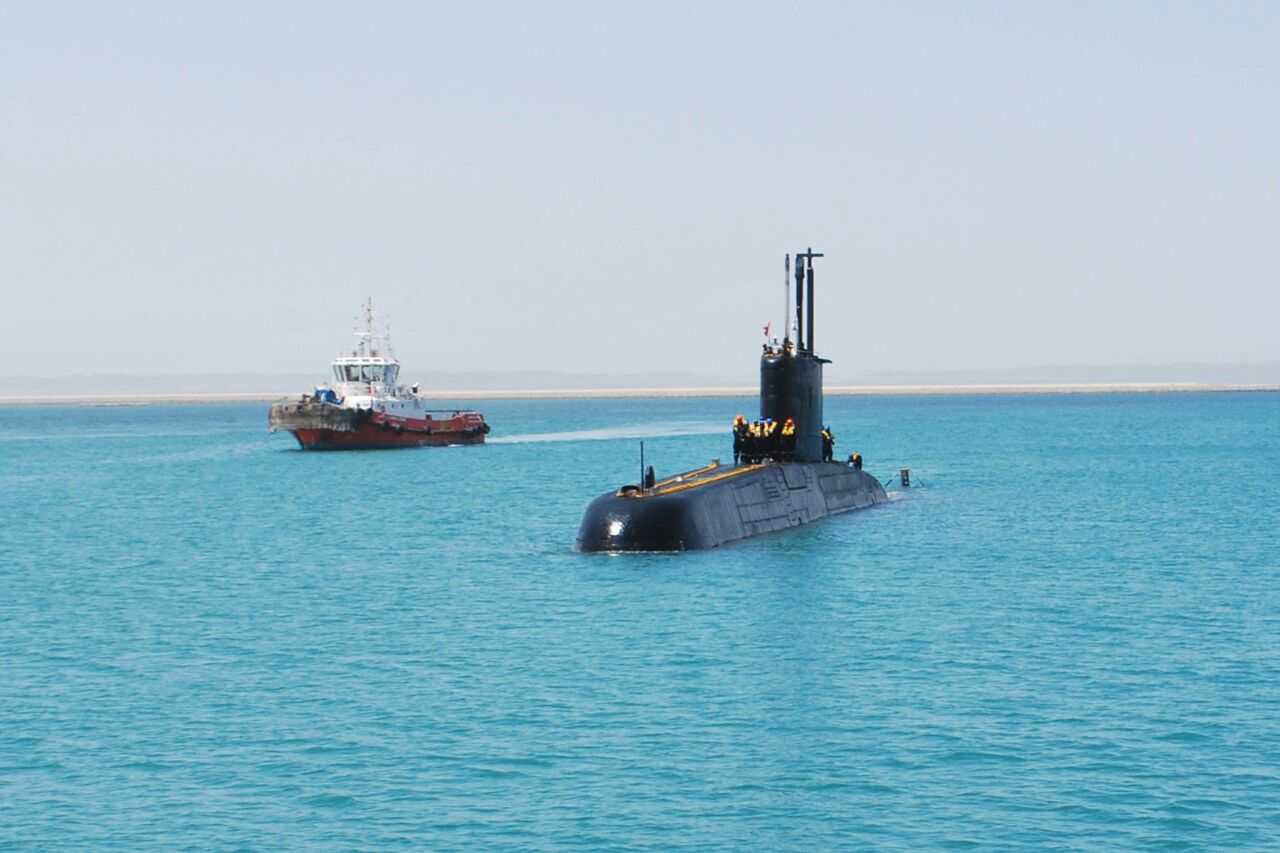
The Shishumar-class submarines (lit. 'Dolphin') are diesel-electric attack submarines, currently in active service with the Indian Navy. These submarines are an Indian variant of the Type 209 submarines developed by the German yard Howaldtswerke-Deutsche Werft under the internal designation "Type 1500". The first two vessels were built by HDW at Kiel, Germany, while the remainder were built by Mazagon Dock Limited, at Mumbai, India, under a technology transfer agreement. The submarines were commissioned between 1986 and 1994. These submarines have a displacement of 1,660 tons when surfaced, a speed of 22 knots (41 km/h; 25 mph), and a complement of 40 including eight officers.
The Shishumar class is unique among Type 209s for having an IKL-designed integrated escape sphere. The sphere has accommodations for the entire crew with an eight-hour air supply.
The submarines form the 10th Submarine Squadron at INS Vajrabahu, Mumbai.
India signed the agreement for these submarines with Howaldtswerke-Deutsche Werft (HDW) on 11 December 1981. The agreement called for building of two submarines in West Germany, the supply of knocked-down kits for assembling two more submarines in Mazagon Dock Limited (MDL), and training for construction and logistics services. An agreement was announced in 1984 for the construction of two additional submarines in MDL, but was subsequently cancelled due to economic crisis in the late 1980s. The four submarines that were finally built form the 10th submarine squadron based at Mumbai.
Source:
By mid-1987, only two submarines were delivered. Meanwhile, the then Defence Minister V. P. Singh, under the Rajiv Gandhi Ministry, he was informed that the Germans might have overcharged India and attempted so that the next batch of two submarines could be priced correctly. However, things took a turn when J. C. Ajmani, the Indian ambassador to Bonn, telegrammed the Defence Minister on 24 February 1987 that the Gernans alleged that the price could not be reduced since the contract included 7% commissions.
V. P. Singh first saw this message in April and ordered an immediate inquiry in 9 April. On 12 April, Singh resigned from the ministry. In May 1990, the Central Bureau of Investigation (CBI) filed a First Information Report (FIR) in a New Delhi court identifying seven persons as principal conspirators in a criminal plot to award the contract to HDW, including S. K. Bhatnagar, former Defence Secretary; S. S. Sidhu, former Additional Secretary of Defence and the then secretary-general, International Civil Aviation Organization (ICAO); Captain M. Kondath, former Director (Submarines); B. S. Ramaswamy, former financial adviser to the Defence Ministry; Directors and agents of HDW; Directors and agents of AEG-T West Germany (torpedo supplier) and Directors of Ferrostaal. The charges included the failure of Indian Civil Servants to stand against HDW during negotiations and their acquiescence to its unrealistic financial demands, incorrect calculation of the HDW deal cost by Defence Ministry officials, manipulations to various technical and financial parameters of the HDW offer by senior officials and the members of the committee so as to rank HDW first against its earlier second preference and the change of price quotations by HDW, AEG-T and Ferrostaal without informing the government. The payments spanned between 1982 and mid-1988.
S. S. Sidhu was the prime accused as per the CBI investigation. Allegations registered against him ranged from manipulation of techno-commercial data as well as declaring himself chairman of negotiating committee without documentation which was accepted as a fait accompli and misinforming the CCPA about the Germans willing to sign a memorandum of understanding on transfer of technology. The Germans under the norms of NATO security compulsions were not meant to transfer the technology and they ultimately did not do so.
Hub AI
Shishumar-class submarine AI simulator
(@Shishumar-class submarine_simulator)
Shishumar-class submarine
The Shishumar-class submarines (lit. 'Dolphin') are diesel-electric attack submarines, currently in active service with the Indian Navy. These submarines are an Indian variant of the Type 209 submarines developed by the German yard Howaldtswerke-Deutsche Werft under the internal designation "Type 1500". The first two vessels were built by HDW at Kiel, Germany, while the remainder were built by Mazagon Dock Limited, at Mumbai, India, under a technology transfer agreement. The submarines were commissioned between 1986 and 1994. These submarines have a displacement of 1,660 tons when surfaced, a speed of 22 knots (41 km/h; 25 mph), and a complement of 40 including eight officers.
The Shishumar class is unique among Type 209s for having an IKL-designed integrated escape sphere. The sphere has accommodations for the entire crew with an eight-hour air supply.
The submarines form the 10th Submarine Squadron at INS Vajrabahu, Mumbai.
India signed the agreement for these submarines with Howaldtswerke-Deutsche Werft (HDW) on 11 December 1981. The agreement called for building of two submarines in West Germany, the supply of knocked-down kits for assembling two more submarines in Mazagon Dock Limited (MDL), and training for construction and logistics services. An agreement was announced in 1984 for the construction of two additional submarines in MDL, but was subsequently cancelled due to economic crisis in the late 1980s. The four submarines that were finally built form the 10th submarine squadron based at Mumbai.
Source:
By mid-1987, only two submarines were delivered. Meanwhile, the then Defence Minister V. P. Singh, under the Rajiv Gandhi Ministry, he was informed that the Germans might have overcharged India and attempted so that the next batch of two submarines could be priced correctly. However, things took a turn when J. C. Ajmani, the Indian ambassador to Bonn, telegrammed the Defence Minister on 24 February 1987 that the Gernans alleged that the price could not be reduced since the contract included 7% commissions.
V. P. Singh first saw this message in April and ordered an immediate inquiry in 9 April. On 12 April, Singh resigned from the ministry. In May 1990, the Central Bureau of Investigation (CBI) filed a First Information Report (FIR) in a New Delhi court identifying seven persons as principal conspirators in a criminal plot to award the contract to HDW, including S. K. Bhatnagar, former Defence Secretary; S. S. Sidhu, former Additional Secretary of Defence and the then secretary-general, International Civil Aviation Organization (ICAO); Captain M. Kondath, former Director (Submarines); B. S. Ramaswamy, former financial adviser to the Defence Ministry; Directors and agents of HDW; Directors and agents of AEG-T West Germany (torpedo supplier) and Directors of Ferrostaal. The charges included the failure of Indian Civil Servants to stand against HDW during negotiations and their acquiescence to its unrealistic financial demands, incorrect calculation of the HDW deal cost by Defence Ministry officials, manipulations to various technical and financial parameters of the HDW offer by senior officials and the members of the committee so as to rank HDW first against its earlier second preference and the change of price quotations by HDW, AEG-T and Ferrostaal without informing the government. The payments spanned between 1982 and mid-1988.
S. S. Sidhu was the prime accused as per the CBI investigation. Allegations registered against him ranged from manipulation of techno-commercial data as well as declaring himself chairman of negotiating committee without documentation which was accepted as a fait accompli and misinforming the CCPA about the Germans willing to sign a memorandum of understanding on transfer of technology. The Germans under the norms of NATO security compulsions were not meant to transfer the technology and they ultimately did not do so.
Recent media