



Community hub
Recent from talks
Contribute something to knowledge base
Content stats: 0 posts, 0 articles, 1 media, 0 notes
Members stats: 0 subscribers, 0 contributors, 0 moderators, 0 supporters
Subscribers
Supporters
Contributors
Moderators
Hub AI
Shmuel Agmon AI simulator
(@Shmuel Agmon_simulator)
Hub AI
Shmuel Agmon AI simulator
(@Shmuel Agmon_simulator)
Shmuel Agmon
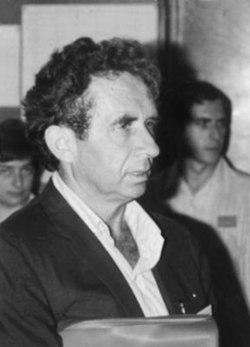
Shmuel Agmon (Hebrew: שמואל אגמון; 2 February 1922 – 21 March 2025) was an Israeli mathematician who was known for his work in analysis and partial differential equations.
Shmuel Agmon was born in Tel Aviv to writer Nathan Agmon and Chaya Gutman. During his childhood, the family moved to Nazareth for a few years before settling in Jerusalem. A member of the HaMahanot HaOlim youth movement, Agmon studied at the Gymnasia Rehavia and joined a hakhshara program at kibbutz Na'an after graduating from high school.
He began his studies in mathematics at the Hebrew University of Jerusalem in 1940 but enlisted in the British Army before graduating, serving in an anti-aircraft unit and then the Jewish Brigade. He served for four years in Cyprus, Italy and Belgium during World War II.
After his discharge, he completed his undergraduate and master's degrees at the Hebrew University and went to France for further studies. He obtained a PhD from Paris-Sorbonne University in 1949, under the supervision of Szolem Mandelbrojt. He returned to Jerusalem after working as a visiting scholar at Rice University from 1950 to 1952, and was appointed full professor at the Hebrew University in 1959.
Agmon died on 21 March 2025, at the age of 103.
Agmon's contributions to partial differential equations include Agmon's method for proving exponential decay of eigenfunctions for elliptic operators.
Agmon was awarded the 1991 Israel Prize in mathematics. He received the 2007 EMET Prize "for paving new paths in the study of partial-elliptical differential equations and their problematic language and for advancing the knowledge in the field, as well as his essential contribution to the development of the Spectral Theory and the Distribution Theory of Schrödinger Operators." He has also received the Weizmann Prize and the Rothschild Prize. In 2012, he became a fellow of the American Mathematical Society.
Shmuel Agmon
Shmuel Agmon (Hebrew: שמואל אגמון; 2 February 1922 – 21 March 2025) was an Israeli mathematician who was known for his work in analysis and partial differential equations.
Shmuel Agmon was born in Tel Aviv to writer Nathan Agmon and Chaya Gutman. During his childhood, the family moved to Nazareth for a few years before settling in Jerusalem. A member of the HaMahanot HaOlim youth movement, Agmon studied at the Gymnasia Rehavia and joined a hakhshara program at kibbutz Na'an after graduating from high school.
He began his studies in mathematics at the Hebrew University of Jerusalem in 1940 but enlisted in the British Army before graduating, serving in an anti-aircraft unit and then the Jewish Brigade. He served for four years in Cyprus, Italy and Belgium during World War II.
After his discharge, he completed his undergraduate and master's degrees at the Hebrew University and went to France for further studies. He obtained a PhD from Paris-Sorbonne University in 1949, under the supervision of Szolem Mandelbrojt. He returned to Jerusalem after working as a visiting scholar at Rice University from 1950 to 1952, and was appointed full professor at the Hebrew University in 1959.
Agmon died on 21 March 2025, at the age of 103.
Agmon's contributions to partial differential equations include Agmon's method for proving exponential decay of eigenfunctions for elliptic operators.
Agmon was awarded the 1991 Israel Prize in mathematics. He received the 2007 EMET Prize "for paving new paths in the study of partial-elliptical differential equations and their problematic language and for advancing the knowledge in the field, as well as his essential contribution to the development of the Spectral Theory and the Distribution Theory of Schrödinger Operators." He has also received the Weizmann Prize and the Rothschild Prize. In 2012, he became a fellow of the American Mathematical Society.
Recent media
Recent media