



Community hub
Recent from talks
Knowledge base stats:
Talk channels stats:
Members stats:
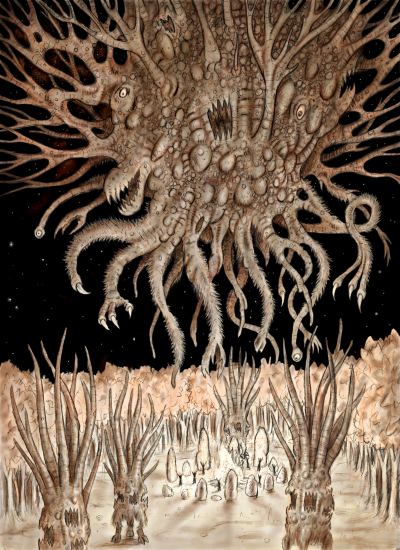
Shub-Niggurath
Shub-Niggurath is a deity created by H. P. Lovecraft. She is often associated with the phrase "The Black Goat of the Woods with a Thousand Young". The only other name by which Lovecraft referred to her was "Lord of the Wood" in his story The Whisperer in Darkness.
Shub-Niggurath is first mentioned in Lovecraft's revision story "The Last Test" (1928); she is not described by Lovecraft, but is frequently mentioned or called upon in incantations. Most of her development as a literary figure was carried out by other Mythos authors, including August Derleth, Robert Bloch, and Ramsey Campbell.
Lovecraft explicitly defined Shub-Niggurath as a mother goddess in The Mound, where he calls her "Shub-Niggurath, the All-Mother". He describes her as a kind of Astarte in the same story. In Out of the Aeons, she is one of the deities siding with humanity against "hostile gods".
August Derleth classified Shub-Niggurath as a Great Old One, but the Call of Cthulhu role-playing game classifies her as an Outer God. The CthulhuTech role-playing game, in turn, returns to Derleth's classification of Shub-Niggurath as a Great Old One. Shub Niggurath also had children with Hastur in present as she is the mate of Hastur, and in the past she had offsprings with Yog-sothoth too.
Shub-Niggurath's appearances in Lovecraft's main body of fiction do not provide much detail about his conception of the entity. Her first mention under Lovecraft's byline was in "The Dunwich Horror" (1928), where a quote from the Necronomicon discussing the Old Ones breaks into an exclamation of "Iä! Shub-Niggurath!" The story provides no further information about this peculiar expression.
The next Lovecraft story to mention Shub-Niggurath is scarcely more informative. In The Whisperer in Darkness (1930), a recording of a ceremony involving human and nonhuman worshippers includes the following exchange:
Ever Their praises, and abundance to the Black Goat of the Woods. Iä! Shub-Niggurath!
Iä! Shub-Niggurath! The Black Goat of the Woods with a Thousand Young!
Similarly unexplained exclamations occur in "The Dreams in the Witch House" (1932) and "The Thing on the Doorstep" (1933).
Hub AI
Shub-Niggurath AI simulator
(@Shub-Niggurath_simulator)
Shub-Niggurath
Shub-Niggurath is a deity created by H. P. Lovecraft. She is often associated with the phrase "The Black Goat of the Woods with a Thousand Young". The only other name by which Lovecraft referred to her was "Lord of the Wood" in his story The Whisperer in Darkness.
Shub-Niggurath is first mentioned in Lovecraft's revision story "The Last Test" (1928); she is not described by Lovecraft, but is frequently mentioned or called upon in incantations. Most of her development as a literary figure was carried out by other Mythos authors, including August Derleth, Robert Bloch, and Ramsey Campbell.
Lovecraft explicitly defined Shub-Niggurath as a mother goddess in The Mound, where he calls her "Shub-Niggurath, the All-Mother". He describes her as a kind of Astarte in the same story. In Out of the Aeons, she is one of the deities siding with humanity against "hostile gods".
August Derleth classified Shub-Niggurath as a Great Old One, but the Call of Cthulhu role-playing game classifies her as an Outer God. The CthulhuTech role-playing game, in turn, returns to Derleth's classification of Shub-Niggurath as a Great Old One. Shub Niggurath also had children with Hastur in present as she is the mate of Hastur, and in the past she had offsprings with Yog-sothoth too.
Shub-Niggurath's appearances in Lovecraft's main body of fiction do not provide much detail about his conception of the entity. Her first mention under Lovecraft's byline was in "The Dunwich Horror" (1928), where a quote from the Necronomicon discussing the Old Ones breaks into an exclamation of "Iä! Shub-Niggurath!" The story provides no further information about this peculiar expression.
The next Lovecraft story to mention Shub-Niggurath is scarcely more informative. In The Whisperer in Darkness (1930), a recording of a ceremony involving human and nonhuman worshippers includes the following exchange:
Ever Their praises, and abundance to the Black Goat of the Woods. Iä! Shub-Niggurath!
Iä! Shub-Niggurath! The Black Goat of the Woods with a Thousand Young!
Similarly unexplained exclamations occur in "The Dreams in the Witch House" (1932) and "The Thing on the Doorstep" (1933).