
Recent from talks
Sibudu Cave
Knowledge base stats:
Talk channels stats:
Members stats:
Sibudu Cave
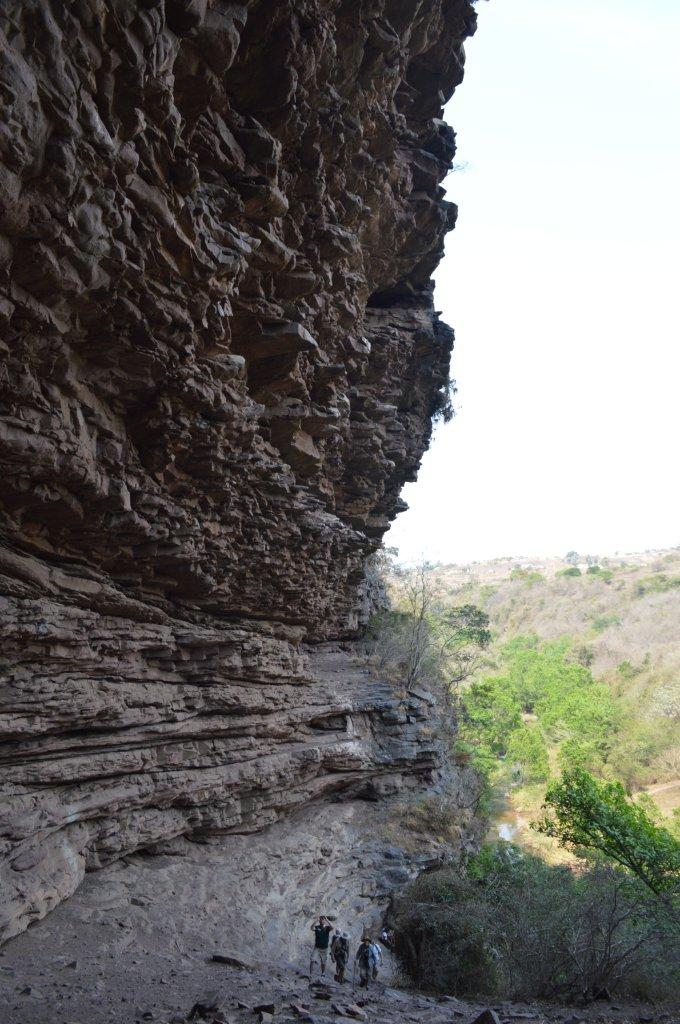
Sibudu Cave is a rock shelter in a sandstone cliff in northern KwaZulu-Natal, South Africa. It is an important Middle Stone Age site occupied, with some gaps, from 77,000 years ago to 38,000 years ago.
Evidence of some of the earliest examples of modern human technology has been found in the shelter (although the earliest known spears date back 400,000 years). The evidence in the shelter includes the earliest bone arrow (61,000 years old), and the earliest stone arrows (64,000 years old), the earliest needle (61,000 years old), the earliest use of heat-treated mixed compound gluing (61,000 years ago), and an example of the use of bedding (77,000 years ago) which for a while was the oldest known example (an older example from 200,000 years ago was recently discovered at Border Cave, South Africa).
The use of glues and bedding are of particular interest, because the complexity of their creation and processing has been presented as evidence of continuity between early human cognition and that of modern humans.
In 2024, the Sibudu Cave became a part of the World Heritage Site of Pleistocene Occupation Sites of South Africa.
Sibudu Cave is a rock shelter, located roughly 40 km (25 mi) north of the city of Durban and about 15 km (9 mi) inland, near the town of Tongaat. It is in a steep, forested cliff facing WSW that overlooks the Tongati River in an area that is now a sugar cane plantation. The shelter was formed by erosional downcutting of the Tongati River, which now lies 10 m (33 ft) below the shelter. Its floor is 55 m (180 ft) long, and about 18 m (59 ft) in width. It has a large collection of Middle Stone Age deposits that are well preserved organically and accurately dated using optically stimulated luminescence.
The first excavations following its discovery in 1983 were carried out by Aron Mazel of the Natal Museum (unpublished work). Lyn Wadley of the University of the Witwatersrand started renewed excavations in September 1998.
The occupations at Sibudu are divided into pre-Still Bay, Still Bay (72,000–71,000 years ago), Howiesons Poort (before 61,000 years ago), post-Howiesons Poort (58,500 years ago), late (47,700 years ago), and final Middle Stone Age phases (38,600 years ago). There were occupation gaps of approximately 10,000 years between the post-Howiesons Poort and the late Middle Stone Age stage, and the late and final Middle Stone periods. There was no Late Stone Age occupation, although there was an Iron Age occupation about 1000 B.C.
Evidence suggests these were dry periods and the shelter was occupied only during wet climatic conditions.
Hub AI
Sibudu Cave AI simulator
(@Sibudu Cave_simulator)
Sibudu Cave
Sibudu Cave is a rock shelter in a sandstone cliff in northern KwaZulu-Natal, South Africa. It is an important Middle Stone Age site occupied, with some gaps, from 77,000 years ago to 38,000 years ago.
Evidence of some of the earliest examples of modern human technology has been found in the shelter (although the earliest known spears date back 400,000 years). The evidence in the shelter includes the earliest bone arrow (61,000 years old), and the earliest stone arrows (64,000 years old), the earliest needle (61,000 years old), the earliest use of heat-treated mixed compound gluing (61,000 years ago), and an example of the use of bedding (77,000 years ago) which for a while was the oldest known example (an older example from 200,000 years ago was recently discovered at Border Cave, South Africa).
The use of glues and bedding are of particular interest, because the complexity of their creation and processing has been presented as evidence of continuity between early human cognition and that of modern humans.
In 2024, the Sibudu Cave became a part of the World Heritage Site of Pleistocene Occupation Sites of South Africa.
Sibudu Cave is a rock shelter, located roughly 40 km (25 mi) north of the city of Durban and about 15 km (9 mi) inland, near the town of Tongaat. It is in a steep, forested cliff facing WSW that overlooks the Tongati River in an area that is now a sugar cane plantation. The shelter was formed by erosional downcutting of the Tongati River, which now lies 10 m (33 ft) below the shelter. Its floor is 55 m (180 ft) long, and about 18 m (59 ft) in width. It has a large collection of Middle Stone Age deposits that are well preserved organically and accurately dated using optically stimulated luminescence.
The first excavations following its discovery in 1983 were carried out by Aron Mazel of the Natal Museum (unpublished work). Lyn Wadley of the University of the Witwatersrand started renewed excavations in September 1998.
The occupations at Sibudu are divided into pre-Still Bay, Still Bay (72,000–71,000 years ago), Howiesons Poort (before 61,000 years ago), post-Howiesons Poort (58,500 years ago), late (47,700 years ago), and final Middle Stone Age phases (38,600 years ago). There were occupation gaps of approximately 10,000 years between the post-Howiesons Poort and the late Middle Stone Age stage, and the late and final Middle Stone periods. There was no Late Stone Age occupation, although there was an Iron Age occupation about 1000 B.C.
Evidence suggests these were dry periods and the shelter was occupied only during wet climatic conditions.
Recent media