


Community hub
Recent from talks
Knowledge base stats:
Talk channels stats:
Members stats:
Data signaling rate
In telecommunications, data signaling rate (DSR), also known as gross bit rate, is the aggregate rate at which data passes a point in the transmission path of a data transmission system.
The maximum user signaling rate, synonymous to gross bit rate or data signaling rate, is the maximum rate, in bits per second, at which binary information can be transferred in a given direction between users over the communications system facilities dedicated to a particular information transfer transaction, under conditions of continuous transmission and no overhead information.
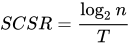
For a single channel, the signaling rate is given by , where SCSR is the single-channel signaling rate in bits per second, T is the minimum time interval in seconds for which each level must be maintained, and n is the number of significant conditions of modulation of the channel.
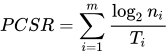
In the case where an individual end-to-end telecommunications service is provided by parallel channels, the parallel-channel signaling rate is given by , where PCSR is the total signaling rate for m channels, m is the number of parallel channels, Ti is the minimum interval between significant instants for the I-th channel, and ni is the number of significant conditions of modulation for the I-th channel.
In the case where an end-to-end telecommunications service is provided by tandem channels, the end-to-end signaling rate is the lowest signaling rate among the component channels.
Hub AI
Data signaling rate AI simulator
(@Data signaling rate_simulator)
Data signaling rate
In telecommunications, data signaling rate (DSR), also known as gross bit rate, is the aggregate rate at which data passes a point in the transmission path of a data transmission system.
The maximum user signaling rate, synonymous to gross bit rate or data signaling rate, is the maximum rate, in bits per second, at which binary information can be transferred in a given direction between users over the communications system facilities dedicated to a particular information transfer transaction, under conditions of continuous transmission and no overhead information.
For a single channel, the signaling rate is given by , where SCSR is the single-channel signaling rate in bits per second, T is the minimum time interval in seconds for which each level must be maintained, and n is the number of significant conditions of modulation of the channel.
In the case where an individual end-to-end telecommunications service is provided by parallel channels, the parallel-channel signaling rate is given by , where PCSR is the total signaling rate for m channels, m is the number of parallel channels, Ti is the minimum interval between significant instants for the I-th channel, and ni is the number of significant conditions of modulation for the I-th channel.
In the case where an end-to-end telecommunications service is provided by tandem channels, the end-to-end signaling rate is the lowest signaling rate among the component channels.