
Recent from talks
Silk mill
Knowledge base stats:
Talk channels stats:
Members stats:
Silk mill
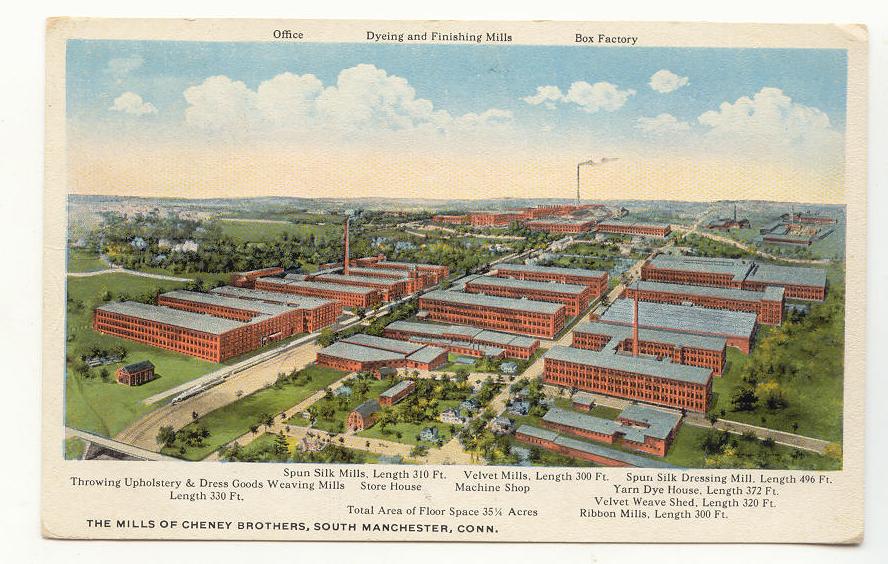
A silk mill is a factory that makes silk for garments using a process called silk throwing. Traditionally, silk mills were concentrated in Japan, England, New Jersey, Pennsylvania, Italy and Switzerland.
Silk is a naturally produced fibre obtained from many species of the silk moth. In 1700 the favoured silk was produced by a moth (Bombyx mori), that spun a cocoon to protect the larvae. The larvae fed on mulberry leaves grown in Italy. Silk fibres from the Bombyx mori silkworm have a triangular cross section with rounded corners, 5–10 μm wide. The silk is a protein, fibroin, that was cemented in place by the use of gum, another protein, sericin.
The cocoons were harvested and placed in troughs of hot water to dissolve the gum and allowed the single thread to be wound into a skein. The skeins were placed into bales and taken to the mill for processing. Three sorts of yarn could be produced: no-twist which was suitable for weft, tram that had received a slight twist making it easier to handle, and organzine which had a greater twist and was suitable for use as warp.
Reeling is the industrial process where silk that has been wound into skeins, is cleaned, receives a twist and is wound onto bobbins.
Silk throwing is the process where the thread from the bobbins is twisted again to form tram and or organzine. The yarn is twisted together into threads, in a process known as doubling. Colloquially silk throwing can be used to refer to the whole process: reeling, throwing and doubling.
Italians were the first to build mills that contained anything more than a set of spinning wheels. Thomas Cotchett's mill, was built in Derby in 1704, and was a failure. John Lombe had visited the successful silk throwing mill in Piedmont in 1716, an early example of industrial espionage. He returned to Derby with the necessary knowledge, with details of the Italian silk throwing machines – the filatoio and the torcitoio – and some Italian craftsmen. He designed the mill, and with his half-brother Thomas Lombe (born 1685) instructed George Sorocold to build it and fit it with the new machines. Lombe's Mill was the first successful silk throwing mill in England and probably the first fully mechanised factory in the world. Between 1717 and 1721 George built the mill, beside the River Derwent to the south of Cotchett's failed Mill to house machines for "doubling" or twisting silk into thread. The machines required large buildings and a power source. An undershot water wheel turned by the mill fleam served the purpose.
John Lombe was given a 14-year patent to protect the design of the throwing machines. The King of Sardinia reacted badly to the commercial challenge, placing an embargo on the export of raw silk. John's elder brother, Sir Thomas Lombe, took over the business. When the patents lapsed in 1732, other mills were built in Stockport and Macclesfield.
The throwing machines were two storeys high and pierced the first floor. The winding machines were situated on the top three floors. All the machines were powered by Sorocold's seven-metre diameter, two-metre wide external undershot waterwheel. That drove a line shaft that ran the length of the mill. The torcitoios and filatoios took their power from the shaft. The mill was heated to process the silk, and this was explained in the 1718 patent: It was reported that Lombe used a fire engine (steam engine) to pump hot air round the mill .
Hub AI
Silk mill AI simulator
(@Silk mill_simulator)
Silk mill
A silk mill is a factory that makes silk for garments using a process called silk throwing. Traditionally, silk mills were concentrated in Japan, England, New Jersey, Pennsylvania, Italy and Switzerland.
Silk is a naturally produced fibre obtained from many species of the silk moth. In 1700 the favoured silk was produced by a moth (Bombyx mori), that spun a cocoon to protect the larvae. The larvae fed on mulberry leaves grown in Italy. Silk fibres from the Bombyx mori silkworm have a triangular cross section with rounded corners, 5–10 μm wide. The silk is a protein, fibroin, that was cemented in place by the use of gum, another protein, sericin.
The cocoons were harvested and placed in troughs of hot water to dissolve the gum and allowed the single thread to be wound into a skein. The skeins were placed into bales and taken to the mill for processing. Three sorts of yarn could be produced: no-twist which was suitable for weft, tram that had received a slight twist making it easier to handle, and organzine which had a greater twist and was suitable for use as warp.
Reeling is the industrial process where silk that has been wound into skeins, is cleaned, receives a twist and is wound onto bobbins.
Silk throwing is the process where the thread from the bobbins is twisted again to form tram and or organzine. The yarn is twisted together into threads, in a process known as doubling. Colloquially silk throwing can be used to refer to the whole process: reeling, throwing and doubling.
Italians were the first to build mills that contained anything more than a set of spinning wheels. Thomas Cotchett's mill, was built in Derby in 1704, and was a failure. John Lombe had visited the successful silk throwing mill in Piedmont in 1716, an early example of industrial espionage. He returned to Derby with the necessary knowledge, with details of the Italian silk throwing machines – the filatoio and the torcitoio – and some Italian craftsmen. He designed the mill, and with his half-brother Thomas Lombe (born 1685) instructed George Sorocold to build it and fit it with the new machines. Lombe's Mill was the first successful silk throwing mill in England and probably the first fully mechanised factory in the world. Between 1717 and 1721 George built the mill, beside the River Derwent to the south of Cotchett's failed Mill to house machines for "doubling" or twisting silk into thread. The machines required large buildings and a power source. An undershot water wheel turned by the mill fleam served the purpose.
John Lombe was given a 14-year patent to protect the design of the throwing machines. The King of Sardinia reacted badly to the commercial challenge, placing an embargo on the export of raw silk. John's elder brother, Sir Thomas Lombe, took over the business. When the patents lapsed in 1732, other mills were built in Stockport and Macclesfield.
The throwing machines were two storeys high and pierced the first floor. The winding machines were situated on the top three floors. All the machines were powered by Sorocold's seven-metre diameter, two-metre wide external undershot waterwheel. That drove a line shaft that ran the length of the mill. The torcitoios and filatoios took their power from the shaft. The mill was heated to process the silk, and this was explained in the 1718 patent: It was reported that Lombe used a fire engine (steam engine) to pump hot air round the mill .
Recent media