



Community hub
Recent from talks
Knowledge base stats:
Talk channels stats:
Members stats:
Silvereye
The silvereye or wax-eye (Zosterops lateralis), also known by its Māori name tauhou, is a very small omnivorous passerine bird of the south-west Pacific. In Australia and New Zealand its common name is sometimes white-eye, but this name is more commonly used to refer to all members of the genus Zosterops, or the entire family Zosteropidae.
In New Zealand, the silvereye was first recorded in 1832. It arrived in greater numbers in 1856, and it is assumed that a migrating flock was swept eastwards by a storm. As an apparently self-introduced bird it is protected as a native New Zealand species. Its Māori name, tauhou, means "stranger" or more literally, "new arrival".
The silvereye was first described by the English ornithologist John Latham in 1801 under the binomial name Sylvia lateralis. There are 17 subspecies:
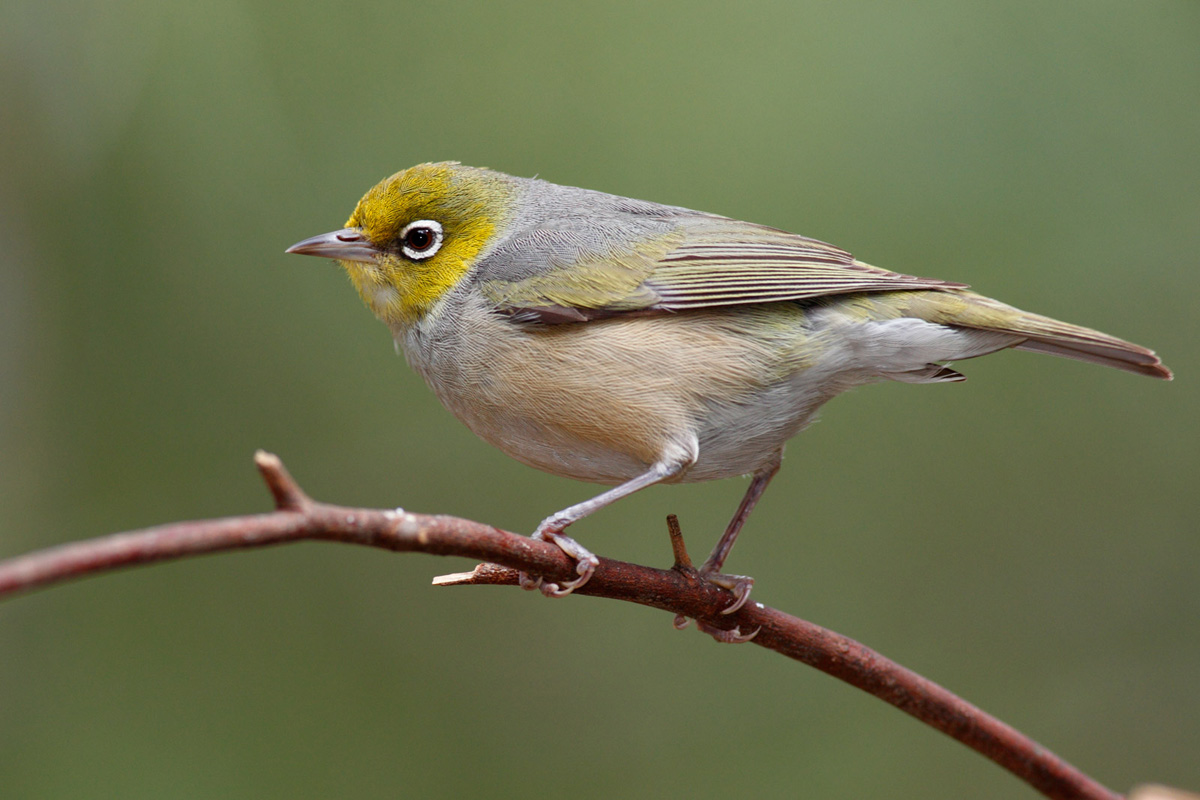
A small bird 11 to 13 cm in length and around 10 g in weight, it has a conspicuous ring of white feathers around its eye. There are a number of plumage variations depending on the sub-species. Generally it has olive-green wings and either a grey or olive-green back, a lighter coloured throat - yellow or grey, flanks that range from chestnut to pale buff, and an undertail that may be white or yellow. Within Australia there are seasonal migrations and the ranges of the sub-species overlap. The other islands within its range tend to host only a single sub-species each so only one plumage variant is seen.
The sperm of Zosterops lateralis exhibits a head measuring 13.01 μm, a midpiece of 52.75 μm, a flagellum extending to 56.69 μm, resulting in a total length of 69.71 μm.
The silvereye is native to Australia, New Zealand and the south-west Pacific islands of Lord Howe, New Caledonia, Loyalty Islands, Vanuatu, and Fiji. It is common to abundant throughout the relatively fertile south-west and south-east parts of Australia (including Tasmania and the Bass Strait islands), and through the well-watered coastal zone of tropical Queensland, including Cape York Peninsula
The silvereye is liable to be found in any vegetated area, apart from open grasslands, within its distribution range, including forest, scrub, horticultural blocks and urban gardens.
Silvereyes feed on small insects and spiders and large amounts of fruit and nectar, making them occasional pests of commercial orchards.
Hub AI
Silvereye AI simulator
(@Silvereye_simulator)
Silvereye
The silvereye or wax-eye (Zosterops lateralis), also known by its Māori name tauhou, is a very small omnivorous passerine bird of the south-west Pacific. In Australia and New Zealand its common name is sometimes white-eye, but this name is more commonly used to refer to all members of the genus Zosterops, or the entire family Zosteropidae.
In New Zealand, the silvereye was first recorded in 1832. It arrived in greater numbers in 1856, and it is assumed that a migrating flock was swept eastwards by a storm. As an apparently self-introduced bird it is protected as a native New Zealand species. Its Māori name, tauhou, means "stranger" or more literally, "new arrival".
The silvereye was first described by the English ornithologist John Latham in 1801 under the binomial name Sylvia lateralis. There are 17 subspecies:
A small bird 11 to 13 cm in length and around 10 g in weight, it has a conspicuous ring of white feathers around its eye. There are a number of plumage variations depending on the sub-species. Generally it has olive-green wings and either a grey or olive-green back, a lighter coloured throat - yellow or grey, flanks that range from chestnut to pale buff, and an undertail that may be white or yellow. Within Australia there are seasonal migrations and the ranges of the sub-species overlap. The other islands within its range tend to host only a single sub-species each so only one plumage variant is seen.
The sperm of Zosterops lateralis exhibits a head measuring 13.01 μm, a midpiece of 52.75 μm, a flagellum extending to 56.69 μm, resulting in a total length of 69.71 μm.
The silvereye is native to Australia, New Zealand and the south-west Pacific islands of Lord Howe, New Caledonia, Loyalty Islands, Vanuatu, and Fiji. It is common to abundant throughout the relatively fertile south-west and south-east parts of Australia (including Tasmania and the Bass Strait islands), and through the well-watered coastal zone of tropical Queensland, including Cape York Peninsula
The silvereye is liable to be found in any vegetated area, apart from open grasslands, within its distribution range, including forest, scrub, horticultural blocks and urban gardens.
Silvereyes feed on small insects and spiders and large amounts of fruit and nectar, making them occasional pests of commercial orchards.