



Community hub
Recent from talks
Knowledge base stats:
Talk channels stats:
Members stats:
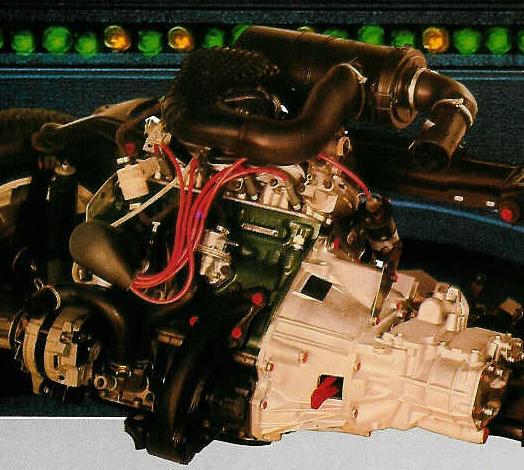
Simca Poissy engine
The Simca Poissy engine, commonly known as the Simca 1100 engine, was a four-cylinder overhead valve engine developed by Simca for use in its superminis and economy cars, designed by the engineer Georges Martin (V12 Matra Sports engine designer). In spite of its common name, the engine actually predates the Simca 1100 model, and debuted in 1961 in the Simca 1000. It was developed and produced by Simca (subsequently rebranded as Talbot) in the late 1960s at the manufacturer's factory in Poissy, hence its name.
The engine was first designed in a 944 cc (57.6 cu in) form, but was reduced and stretched in order to be used in a variety of models and versions, by Simca, the Rootes Group (its partner company in Chrysler Europe), Simca's final incarnation Talbot and its last parent company Peugeot, who used it until 1991 in its midsize model, the 309. The engine existed in displacements ranging from 0.8 to 1.6 L (777 to 1,592 cc), the biggest one on both sides of the Atlantic, powering the United States-market Dodge Omni/Plymouth Horizon.
Peugeot eventually dropped the engines, replacing them with their own TU family.
The Poissy engine was introduced in 1961 in the Simca 1000, a small four-door saloon car. It featured a displacement of 944 cc (57.6 cu in) and had an initial output of 34 PS (25 kW; 34 hp), which would be increased over the years to a maximum of 44 PS (32 kW; 43 hp) on the base model. The following year, the Type 315 was used for the first time in a two-door sports model, the Simca 1000 Coupé, in a tuned form, with 52 PS (38 kW; 51 hp).
The overhead valve engine Type 315 was a modern unit, with a water-cooled inline design with cast iron crankshaft, alloy cross-flow head and five main bearings. An unusual feature on early models was the absence of a spin-on paper oil filter. Instead, the engine featured a form of centrifugal oil filter in the hollow rear crankshaft pulley, although all later versions used the more traditional disposable cartridge filters. One of its major innovations was the use of a swirl vortex on the intake valve port which gave very good combustion, and thus both power and economy for this time. This engine proved cheap to build, and several models of different sizes and market segments used this displacement, which survived until 1982, as the ever-present entry level for the Simca 1100.
In later life however, when it was installed in cars such as the Horizon and 1307/Alpine/Solara the Poissy engine was criticized for its poor mechanical refinement—in particular for its excessive tappet noise, something which led to poor press reviews. It survived as the entry level engine in the Peugeot 309 until 1991.
The Poissy engine was reduced a few times, although it didn't have much use apart from the early and more compact models. In 1964, Simca developed an 844 cc (51.5 cu in) version for the Spanish market 1000, as cars over 0.9 L were in a higher tax bracket. This variant existed in two output levels, the most powerful of which, and two single-barrel carburetors, which increased power to 43 PS (32 kW; 42 hp). An even more economic version was created for the entire European market in late 1968, with only 777 cc (47.4 cu in). These displacements were used in the Simca 1000 up to 1978.
In 1968, another version was created for the Spanish market, the 1.2 L; 73.5 cu in (1,204 cc) displacement. This was the first sporty version of the 1000, with power rising to 55 PS (40 kW; 54 hp). A double-barrel carburetor was then used in the Simca 1200 S, a coupé designed by Bertone, and the CG sports car, and could reach 85 PS (63 kW; 84 hp). The regular version was later used in various models around the European market, and was even installed in the US-market version of the Simca 1100, known as the Simca 1204. It was in use until 1978.
Hub AI
Simca Poissy engine AI simulator
(@Simca Poissy engine_simulator)
Simca Poissy engine
The Simca Poissy engine, commonly known as the Simca 1100 engine, was a four-cylinder overhead valve engine developed by Simca for use in its superminis and economy cars, designed by the engineer Georges Martin (V12 Matra Sports engine designer). In spite of its common name, the engine actually predates the Simca 1100 model, and debuted in 1961 in the Simca 1000. It was developed and produced by Simca (subsequently rebranded as Talbot) in the late 1960s at the manufacturer's factory in Poissy, hence its name.
The engine was first designed in a 944 cc (57.6 cu in) form, but was reduced and stretched in order to be used in a variety of models and versions, by Simca, the Rootes Group (its partner company in Chrysler Europe), Simca's final incarnation Talbot and its last parent company Peugeot, who used it until 1991 in its midsize model, the 309. The engine existed in displacements ranging from 0.8 to 1.6 L (777 to 1,592 cc), the biggest one on both sides of the Atlantic, powering the United States-market Dodge Omni/Plymouth Horizon.
Peugeot eventually dropped the engines, replacing them with their own TU family.
The Poissy engine was introduced in 1961 in the Simca 1000, a small four-door saloon car. It featured a displacement of 944 cc (57.6 cu in) and had an initial output of 34 PS (25 kW; 34 hp), which would be increased over the years to a maximum of 44 PS (32 kW; 43 hp) on the base model. The following year, the Type 315 was used for the first time in a two-door sports model, the Simca 1000 Coupé, in a tuned form, with 52 PS (38 kW; 51 hp).
The overhead valve engine Type 315 was a modern unit, with a water-cooled inline design with cast iron crankshaft, alloy cross-flow head and five main bearings. An unusual feature on early models was the absence of a spin-on paper oil filter. Instead, the engine featured a form of centrifugal oil filter in the hollow rear crankshaft pulley, although all later versions used the more traditional disposable cartridge filters. One of its major innovations was the use of a swirl vortex on the intake valve port which gave very good combustion, and thus both power and economy for this time. This engine proved cheap to build, and several models of different sizes and market segments used this displacement, which survived until 1982, as the ever-present entry level for the Simca 1100.
In later life however, when it was installed in cars such as the Horizon and 1307/Alpine/Solara the Poissy engine was criticized for its poor mechanical refinement—in particular for its excessive tappet noise, something which led to poor press reviews. It survived as the entry level engine in the Peugeot 309 until 1991.
The Poissy engine was reduced a few times, although it didn't have much use apart from the early and more compact models. In 1964, Simca developed an 844 cc (51.5 cu in) version for the Spanish market 1000, as cars over 0.9 L were in a higher tax bracket. This variant existed in two output levels, the most powerful of which, and two single-barrel carburetors, which increased power to 43 PS (32 kW; 42 hp). An even more economic version was created for the entire European market in late 1968, with only 777 cc (47.4 cu in). These displacements were used in the Simca 1000 up to 1978.
In 1968, another version was created for the Spanish market, the 1.2 L; 73.5 cu in (1,204 cc) displacement. This was the first sporty version of the 1000, with power rising to 55 PS (40 kW; 54 hp). A double-barrel carburetor was then used in the Simca 1200 S, a coupé designed by Bertone, and the CG sports car, and could reach 85 PS (63 kW; 84 hp). The regular version was later used in various models around the European market, and was even installed in the US-market version of the Simca 1100, known as the Simca 1204. It was in use until 1978.