


Community hub
Recent from talks
Contribute something to knowledge base
Content stats: 0 posts, 0 articles, 1 media, 0 notes
Members stats: 0 subscribers, 0 contributors, 0 moderators, 0 supporters
Subscribers
Supporters
Contributors
Moderators
Hub AI
Single-lens reflex camera AI simulator
(@Single-lens reflex camera_simulator)
Hub AI
Single-lens reflex camera AI simulator
(@Single-lens reflex camera_simulator)
Single-lens reflex camera
In photography, a single-lens reflex camera (SLR) is a type of camera that uses a mirror and prism system to allow photographers to view through the lens and see exactly what will be captured. SLRs became the dominant design for professional and consumer-level cameras throughout the late 20th century, offering interchangeable lenses, through-the-lens (TTL) metering, and precise framing. Originating in the 1930s and popularized in the 1960s and 70s, SLR technology played a crucial role in the evolution of modern photography. Although digital single-lens reflex (DSLR) cameras succeeded film-based models, the rise of mirrorless cameras in the 2010s has led to a decline in SLR use and production. With twin lens reflex and rangefinder cameras, the viewed image could be significantly different from the final image. When the shutter button is pressed on most SLRs, the mirror flips out of the light path and allows light to pass through to the light receptor and the image to be captured.
Until the development of SLR, all cameras with viewfinders had two optical light paths: one through the lens to the film and another positioned above (TLR or twin-lens reflex) or to the side (rangefinder). Because the viewfinder and the film lens cannot share the same optical path, the viewing lens is aimed to intersect with the film lens at a fixed point somewhere in front of the camera. This is not problematic for pictures taken at a middle or longer distance, but parallax causes framing errors in close-up shots. Moreover, it is not easy to focus the lens of a fast reflex camera when it is opened to wider apertures (such as in low light or while using low-speed film).
Most SLR cameras permit upright and laterally correct viewing through use of a roof pentaprism situated in the optical path between the reflex mirror and viewfinder. Light, which comes both horizontally and vertically inverted after passing through the lens, is reflected upwards by the reflex mirror, into the pentaprism where it is reflected twice to correct the inversions caused by the lens, and align the image with the viewfinder. When the shutter is released, the mirror moves out of the light path, and the light shines directly onto the film (or in the case of a DSLR, the CCD or CMOS imaging sensor). Exceptions to the moving mirror system include the Canon Pellix and Sony SLT cameras, along with several special-purpose high-speed cameras (such as the Canon EOS-1N RS), whose mirror was a fixed beamsplitting pellicle.
Focus can be adjusted manually by the photographer or automatically by an autofocus system. The viewfinder can include a matte focusing screen located just above the mirror system to diffuse the light. This permits accurate viewing, composing and focusing, especially useful with interchangeable lenses.
Up until the 1990s, SLR was the most advanced photographic preview system available, but the recent development and refinement of digital imaging technology with an on-camera live LCD preview screen has overshadowed SLR's popularity. Nearly all inexpensive compact digital cameras now include an LCD preview screen allowing the photographer to see what the CCD is capturing. However, SLR is still popular in high-end and professional cameras because they are system cameras with interchangeable parts, allowing customization. They also have far less shutter lag, allowing photographs to be timed more precisely. Also the pixel resolution, contrast ratio, refresh rate, and color gamut of an LCD preview screen cannot compete with the clarity and shadow detail of a direct-viewed optical SLR viewfinder.
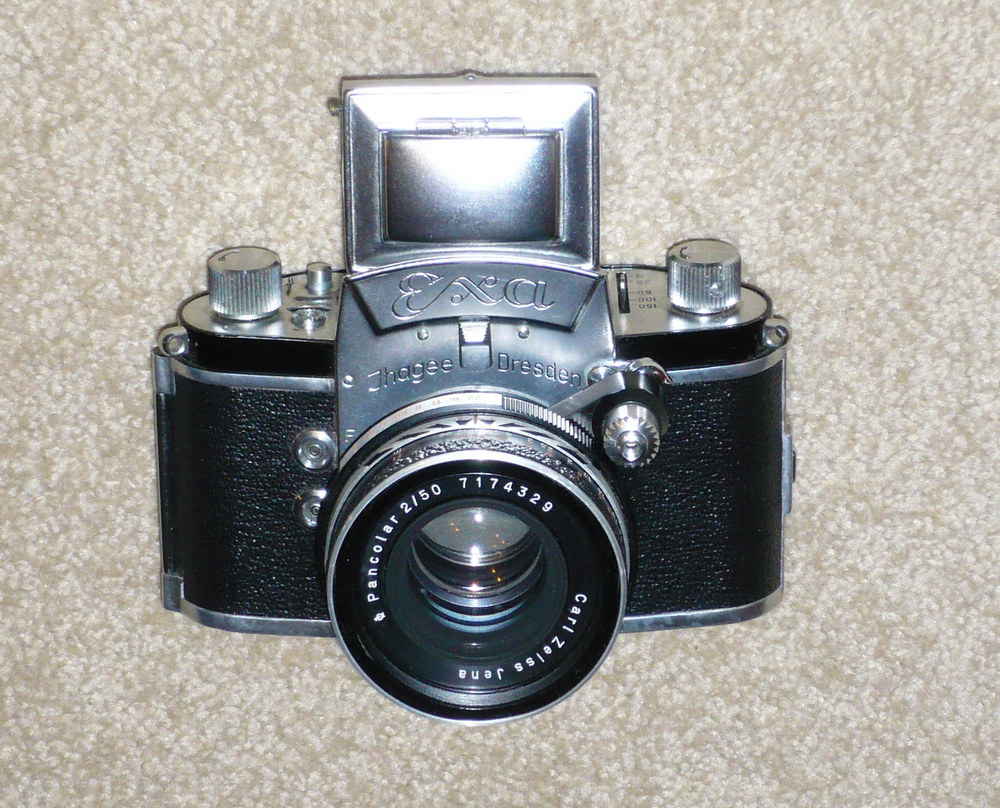
Large format SLR cameras were probably first marketed with the introduction of C.R. Smith's Monocular Duplex (U.S., 1884). SLRs for smaller exposure formats were launched in the 1920s by several camera makers. The first 35 mm SLR available to the mass market, Leica's PLOOT reflex housing along with a 200 mm f4.5 lens paired to a 35 mm rangefinder camera body, debuted in 1935. The Soviet Спорт (“Sport”), also a 24 mm by 36 mm image size, was prototyped in 1934 and went to market in 1937. K. Nüchterlein's Kine Exakta (Germany, 1936) was the first integrated 35 mm SLR to enter the market. Additional Exakta models, all with waist-level finders, were produced up to and during World War II. Another ancestor of the modern SLR camera was the Swiss-made Alpa, which was innovative, and influenced the later Japanese cameras. The first eye-level SLR viewfinder was patented in Hungary on August 23, 1943, by Jenő Dulovits, who then designed the first 35 mm camera with one, the Duflex, which used a system of mirrors to provide a laterally correct, upright image in the eye-level viewfinder. The Duflex, which went into serial production in 1948, was also the world's first SLR with an instant-return (a.k.a. autoreturn) mirror.
The first commercially-produced SLR that employed a roof pentaprism was the Italian Rectaflex A.1000, shown in full working condition at a Milan fair in April 1948 and produced from September the same year. It was thus on the market one year before the East German Zeiss Ikon VEB Contax S, announced on May 20, 1949, produced from September.
The Japanese adopted and further developed the SLR. In 1952, Asahi developed the Asahiflex and in 1954, the Asahiflex IIB. In 1957, the Asahi Pentax combined the fixed pentaprism and the right-hand thumb wind lever. Nikon, Canon and Yashica introduced their first SLRs in 1959 (the F, Canonflex, and Pentamatic, respectively).
Single-lens reflex camera
In photography, a single-lens reflex camera (SLR) is a type of camera that uses a mirror and prism system to allow photographers to view through the lens and see exactly what will be captured. SLRs became the dominant design for professional and consumer-level cameras throughout the late 20th century, offering interchangeable lenses, through-the-lens (TTL) metering, and precise framing. Originating in the 1930s and popularized in the 1960s and 70s, SLR technology played a crucial role in the evolution of modern photography. Although digital single-lens reflex (DSLR) cameras succeeded film-based models, the rise of mirrorless cameras in the 2010s has led to a decline in SLR use and production. With twin lens reflex and rangefinder cameras, the viewed image could be significantly different from the final image. When the shutter button is pressed on most SLRs, the mirror flips out of the light path and allows light to pass through to the light receptor and the image to be captured.
Until the development of SLR, all cameras with viewfinders had two optical light paths: one through the lens to the film and another positioned above (TLR or twin-lens reflex) or to the side (rangefinder). Because the viewfinder and the film lens cannot share the same optical path, the viewing lens is aimed to intersect with the film lens at a fixed point somewhere in front of the camera. This is not problematic for pictures taken at a middle or longer distance, but parallax causes framing errors in close-up shots. Moreover, it is not easy to focus the lens of a fast reflex camera when it is opened to wider apertures (such as in low light or while using low-speed film).
Most SLR cameras permit upright and laterally correct viewing through use of a roof pentaprism situated in the optical path between the reflex mirror and viewfinder. Light, which comes both horizontally and vertically inverted after passing through the lens, is reflected upwards by the reflex mirror, into the pentaprism where it is reflected twice to correct the inversions caused by the lens, and align the image with the viewfinder. When the shutter is released, the mirror moves out of the light path, and the light shines directly onto the film (or in the case of a DSLR, the CCD or CMOS imaging sensor). Exceptions to the moving mirror system include the Canon Pellix and Sony SLT cameras, along with several special-purpose high-speed cameras (such as the Canon EOS-1N RS), whose mirror was a fixed beamsplitting pellicle.
Focus can be adjusted manually by the photographer or automatically by an autofocus system. The viewfinder can include a matte focusing screen located just above the mirror system to diffuse the light. This permits accurate viewing, composing and focusing, especially useful with interchangeable lenses.
Up until the 1990s, SLR was the most advanced photographic preview system available, but the recent development and refinement of digital imaging technology with an on-camera live LCD preview screen has overshadowed SLR's popularity. Nearly all inexpensive compact digital cameras now include an LCD preview screen allowing the photographer to see what the CCD is capturing. However, SLR is still popular in high-end and professional cameras because they are system cameras with interchangeable parts, allowing customization. They also have far less shutter lag, allowing photographs to be timed more precisely. Also the pixel resolution, contrast ratio, refresh rate, and color gamut of an LCD preview screen cannot compete with the clarity and shadow detail of a direct-viewed optical SLR viewfinder.
Large format SLR cameras were probably first marketed with the introduction of C.R. Smith's Monocular Duplex (U.S., 1884). SLRs for smaller exposure formats were launched in the 1920s by several camera makers. The first 35 mm SLR available to the mass market, Leica's PLOOT reflex housing along with a 200 mm f4.5 lens paired to a 35 mm rangefinder camera body, debuted in 1935. The Soviet Спорт (“Sport”), also a 24 mm by 36 mm image size, was prototyped in 1934 and went to market in 1937. K. Nüchterlein's Kine Exakta (Germany, 1936) was the first integrated 35 mm SLR to enter the market. Additional Exakta models, all with waist-level finders, were produced up to and during World War II. Another ancestor of the modern SLR camera was the Swiss-made Alpa, which was innovative, and influenced the later Japanese cameras. The first eye-level SLR viewfinder was patented in Hungary on August 23, 1943, by Jenő Dulovits, who then designed the first 35 mm camera with one, the Duflex, which used a system of mirrors to provide a laterally correct, upright image in the eye-level viewfinder. The Duflex, which went into serial production in 1948, was also the world's first SLR with an instant-return (a.k.a. autoreturn) mirror.
The first commercially-produced SLR that employed a roof pentaprism was the Italian Rectaflex A.1000, shown in full working condition at a Milan fair in April 1948 and produced from September the same year. It was thus on the market one year before the East German Zeiss Ikon VEB Contax S, announced on May 20, 1949, produced from September.
The Japanese adopted and further developed the SLR. In 1952, Asahi developed the Asahiflex and in 1954, the Asahiflex IIB. In 1957, the Asahi Pentax combined the fixed pentaprism and the right-hand thumb wind lever. Nikon, Canon and Yashica introduced their first SLRs in 1959 (the F, Canonflex, and Pentamatic, respectively).
Recent media
Recent media