
Recent from talks
Six-day racing
Knowledge base stats:
Talk channels stats:
Members stats:
Six-day racing
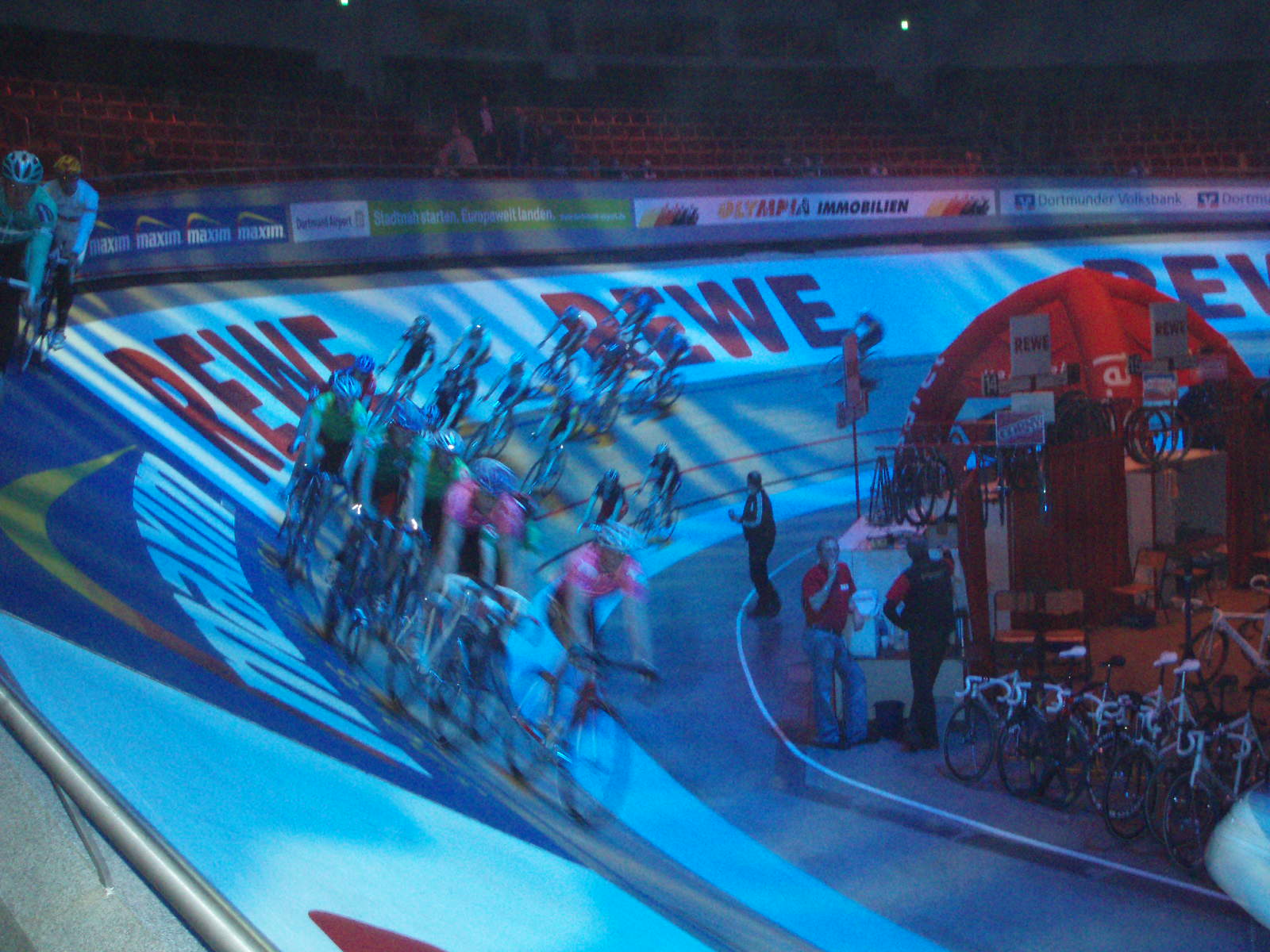
Six-day cycling is a track cycling event that takes place over six days. Six-day races started in Britain, spread to many regions of the world, were brought to their modern style in the United States and are now mainly a European event. Initially, individuals competed alone, the winner being the individual who completed the most laps. However, the format was changed to allow teams (usually of two riders each), one rider racing while the other rested. The 24-hours a day regime has also been relaxed, so that most six-day races involve six nights of racing, typically from 6pm to 2am, on indoor tracks (velodromes).
The overall winner is the team which completes most laps. In the event of teams completing the same number of laps, the winner is the team with most points won in intermediate competitions (see points race). As well as the 'chase' to gain laps over competitors, a typical six-day programme will include time trials, motor-paced, intermediate sprint and elimination races. In the main 'chase' or Madison events (named after Madison Square Garden in New York City, where the two-rider format was devised), both riders may be on the track at the same time, taking it in turns to race, hand-slinging each other back into action.
In 2024, the only remaining six-day races that are still annually ridden are those of Rotterdam and Gent. Others, including major historic events such as Berlin, Copenhagen, London, Bremen, Fiorenzuola, Melbourne, and Zürich, have seen their six-day races either truncated to three or four day events, or canceled altogether.
The first six-day event was an individual time trial at the Agricultural Hall in Islington, London, in 1878, when a professional called David Stanton sought a bet that he could ride 1,000 miles in six successive days, riding 18 hours a day. A Mr Davis put up £100 and the stake was held by the Sporting Life newspaper. Stanton started at 6am on 25 February and won the bet in 73 hours, riding on a high-wheeled machine at an average speed of 13.5 mph.
Six-day cycle races involving more than one rider grew out of the 19th-century enthusiasm for endurance and other novelty competitions. A promoter at the Agricultural Hall held a six-day walking contest in April 1877. It was enough of a success for another to be held the following year. That inspired another organiser, name no longer known, to organise a six-day race in the same hall but for cyclists, also in 1878. He hoped to attract the crowd of 20,000 a day that had turned out for the walkers.
The Islington Gazette reported:
"A bicycle contest was commenced at the Agricultural Hall, on Monday last, for which £150 is offered in prizes for a six days' competition, the money to be allocated thus: £100 for the first man, £25 for the second, £15 for the third, and £10 for the fourth."
The race started at 6am with only four of the 12 entrants on the track. Although it is often said that the first six-day was a non-stop, no-sleeping event that ran without pause for six days, in fact riders joined in when they chose and slept as they wished.
Hub AI
Six-day racing AI simulator
(@Six-day racing_simulator)
Six-day racing
Six-day cycling is a track cycling event that takes place over six days. Six-day races started in Britain, spread to many regions of the world, were brought to their modern style in the United States and are now mainly a European event. Initially, individuals competed alone, the winner being the individual who completed the most laps. However, the format was changed to allow teams (usually of two riders each), one rider racing while the other rested. The 24-hours a day regime has also been relaxed, so that most six-day races involve six nights of racing, typically from 6pm to 2am, on indoor tracks (velodromes).
The overall winner is the team which completes most laps. In the event of teams completing the same number of laps, the winner is the team with most points won in intermediate competitions (see points race). As well as the 'chase' to gain laps over competitors, a typical six-day programme will include time trials, motor-paced, intermediate sprint and elimination races. In the main 'chase' or Madison events (named after Madison Square Garden in New York City, where the two-rider format was devised), both riders may be on the track at the same time, taking it in turns to race, hand-slinging each other back into action.
In 2024, the only remaining six-day races that are still annually ridden are those of Rotterdam and Gent. Others, including major historic events such as Berlin, Copenhagen, London, Bremen, Fiorenzuola, Melbourne, and Zürich, have seen their six-day races either truncated to three or four day events, or canceled altogether.
The first six-day event was an individual time trial at the Agricultural Hall in Islington, London, in 1878, when a professional called David Stanton sought a bet that he could ride 1,000 miles in six successive days, riding 18 hours a day. A Mr Davis put up £100 and the stake was held by the Sporting Life newspaper. Stanton started at 6am on 25 February and won the bet in 73 hours, riding on a high-wheeled machine at an average speed of 13.5 mph.
Six-day cycle races involving more than one rider grew out of the 19th-century enthusiasm for endurance and other novelty competitions. A promoter at the Agricultural Hall held a six-day walking contest in April 1877. It was enough of a success for another to be held the following year. That inspired another organiser, name no longer known, to organise a six-day race in the same hall but for cyclists, also in 1878. He hoped to attract the crowd of 20,000 a day that had turned out for the walkers.
The Islington Gazette reported:
"A bicycle contest was commenced at the Agricultural Hall, on Monday last, for which £150 is offered in prizes for a six days' competition, the money to be allocated thus: £100 for the first man, £25 for the second, £15 for the third, and £10 for the fourth."
The race started at 6am with only four of the 12 entrants on the track. Although it is often said that the first six-day was a non-stop, no-sleeping event that ran without pause for six days, in fact riders joined in when they chose and slept as they wished.
Recent media