
Recent from talks
Six Flags AstroWorld
Knowledge base stats:
Talk channels stats:
Members stats:
Six Flags AstroWorld
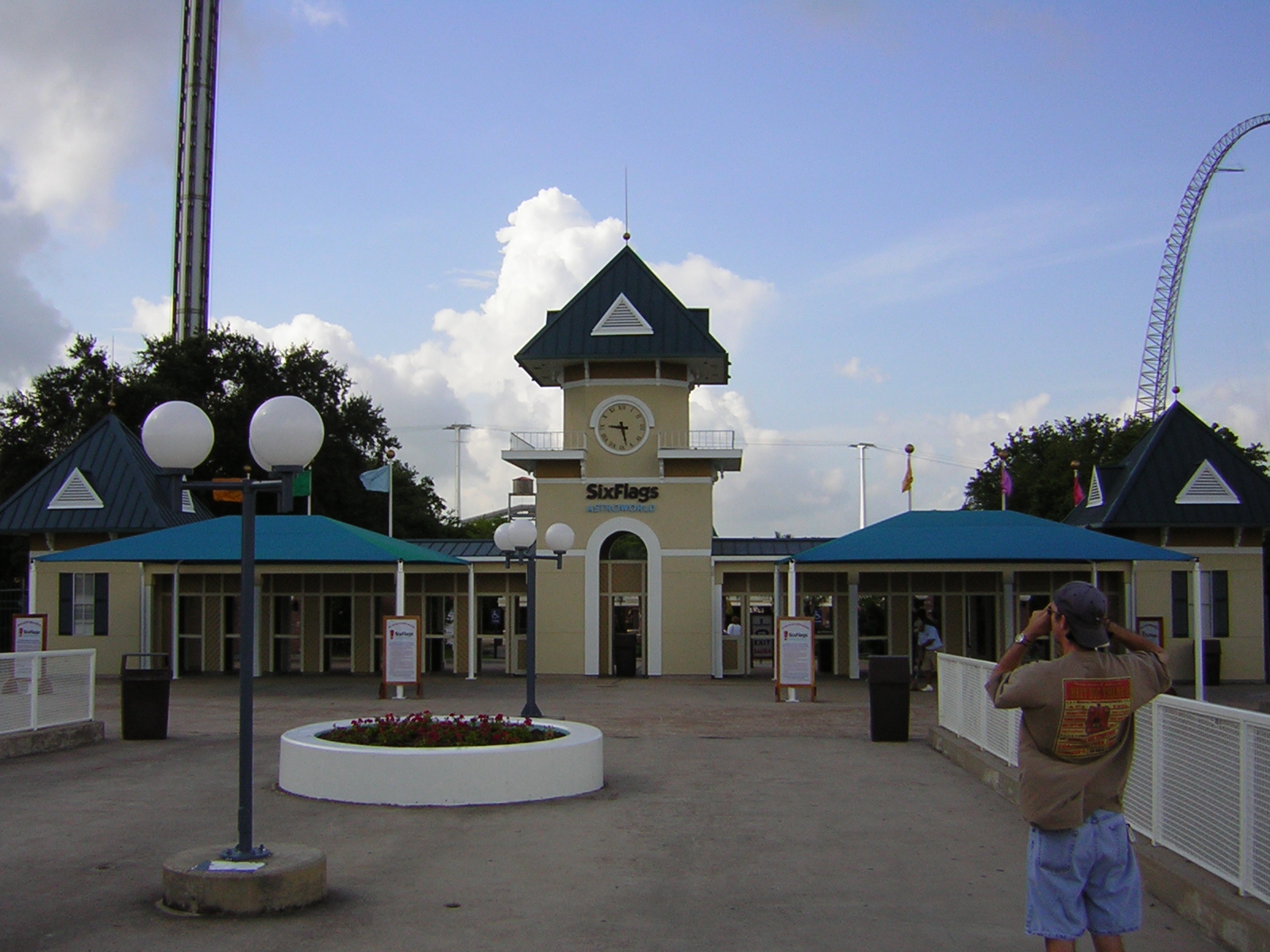
Six Flags AstroWorld, also known simply as AstroWorld, was a seasonally operated amusement park in Houston, Texas. Owned and operated by Six Flags, the park was situated between Kirby Drive and Fannin Street, directly south of I-610. The park opened on June 1, 1968, and was developed originally and constructed as part of the Astrodomain, the brainchild of local philanthropist and former Houston mayor Roy Hofheinz, who intended it to complement the Astrodome. The Hofheinz family sold AstroWorld to Six Flags in 1978.
Notable rides featured at the park included the Texas Cyclone, a wooden roller coaster built in 1976 that was modeled after the well-known Coney Island Cyclone, and Thunder River, considered the world's first successful river rapids ride when it opened in 1980. WaterWorld, an adjacent water park, was acquired and added to AstroWorld in 2002. Following declining revenue, rising property value, and other issues facing Six Flags, the company closed AstroWorld permanently after its final day of operations on October 30, 2005, the final night of Fright Fest. Many rides were sold at auction or relocated to other Six Flags' properties, and demolition of the remaining structures was completed by mid-2006.
Judge Roy Hofheinz, who was one of the original owners of the Houston Astros baseball team and spearheaded the lobbying effort that resulted in Harris County financing the construction of the Astrodome, founded the "Astrodomain" holding company after the Astrodome's opening in 1965. It owned 116 acres (47 ha) in south Houston surrounding the Astrodome. Hofheinz continued to develop the Astrodomain, creating AstroWorld (1968), the Astrohall convention center (which hosted twice-daily stagings of the Ringling Bros. and Barnum & Bailey Circus in 1969; Hofheinz had acquired the circus in December 1967), and four hotels with a capacity of 5,600 guests to serve visitors: the Astroworld Motor Hotel (with a private suite for Hofheinz on the ninth floor), Holiday Inn-Astroworld, Howard Johnson Motor Lodge-Astroworld, and Sheraton Inn-Astroworld.
In 1967, Hofheinz initially denied that preliminary work for an amusement park had been underway, but later announced on September 16 that approximately half of the remaining land, 57-acre (23 ha), was being developed for a park to be named "Astroworld". Hofheinz showed an architectural model of the park and announced that Randall Duell and Associates had designed it; Duell, a Hollywood set designer and architect, had previously designed Six Flags Over Texas. An initial $25 million investment paid for extensive landscaping and a long pedestrian viaduct spanning the I-610 freeway, the first privately owned, publicly accessible span over a federal highway. Lloyd, Morgan & Jones designed the bridge.
Additional design work for the park was performed by I. A. Naman & Associates (air conditioning); Lockwood, Andrews & Newnam (electrical); Walter P Moore (structural); Turner, Collie & Braden (civil engineering); and Linesch & Reynolds (landscape architects). 500,000 cu yd (380,000 m3) of fill was required for the site, because of its low elevation and drainage issues. Dozier Specialty, who had previously worked on Colt Stadium, was the general contractor. The name AstroWorld was selected following Houston's designation as the home of the Johnson Space Center in 1965, paying homage to the nation's crewed space programs.
Executives commissioned Ed Henderson, a Disney animator, to build a scale replica of the park and design maps for park guests. Henderson's model of AstroWorld, measuring 8 by 10 feet (2.4 m × 3.0 m), was built as a publicity preview of the park in 1967. Architecture students at Rice University and the University of Houston sculpted many of the buildings. It was displayed in the window of Foley's, a downtown department store, then moved to Hofheinz's Astrodome suite once the park opened; as an Easter egg, a model of Hofheinz's black Cadillac is parked in a private lot in the northwest corner of the park's model. After the park closed in 2005, the model was discovered, sawed into six pieces in a warehouse, then returned to Henderson. He stored it in his garage before it was displayed in fall 2010 at the Optical Project gallery, operated by artists Bill Davenport and Francesca Fuchs. In 2011, it was sold to I. A. Naman and Associates, the same firm that had designed the park's outdoor air conditioning; they donated the model to the Houston Public Library.
The Hofheinz family, Roy and his three children (Roy Jr., Fred, and Dene), shared ownership of the park. Hofheinz hosted a press preview in May 1968; Leonard Traube wrote the park "has a beautifully realized continuity and layout calculated to move traffic in such a way as to make practical the policy of a single gate admission for virtually everything on the grounds", referring to the Duell loop that routes visitors through each part of the park.
AstroWorld opened on June 1, 1968, just south of the Astrodome, creating a multi-facility entertainment complex; 50,000 guests visited the park during the first weekend. Hofheinz enlisted two of his grandchildren to launch the amusement park with the release of 2,000 balloons. An initial workforce of 1,200 collected tickets at a price of $4.50 for adults and $3.50 for children. Stan McIlvaine, who had formerly operated Six Flags Over Texas, was the first general manager of AstroWorld. Two of the park's sixteen attractions were not operational on opening day.
Hub AI
Six Flags AstroWorld AI simulator
(@Six Flags AstroWorld_simulator)
Six Flags AstroWorld
Six Flags AstroWorld, also known simply as AstroWorld, was a seasonally operated amusement park in Houston, Texas. Owned and operated by Six Flags, the park was situated between Kirby Drive and Fannin Street, directly south of I-610. The park opened on June 1, 1968, and was developed originally and constructed as part of the Astrodomain, the brainchild of local philanthropist and former Houston mayor Roy Hofheinz, who intended it to complement the Astrodome. The Hofheinz family sold AstroWorld to Six Flags in 1978.
Notable rides featured at the park included the Texas Cyclone, a wooden roller coaster built in 1976 that was modeled after the well-known Coney Island Cyclone, and Thunder River, considered the world's first successful river rapids ride when it opened in 1980. WaterWorld, an adjacent water park, was acquired and added to AstroWorld in 2002. Following declining revenue, rising property value, and other issues facing Six Flags, the company closed AstroWorld permanently after its final day of operations on October 30, 2005, the final night of Fright Fest. Many rides were sold at auction or relocated to other Six Flags' properties, and demolition of the remaining structures was completed by mid-2006.
Judge Roy Hofheinz, who was one of the original owners of the Houston Astros baseball team and spearheaded the lobbying effort that resulted in Harris County financing the construction of the Astrodome, founded the "Astrodomain" holding company after the Astrodome's opening in 1965. It owned 116 acres (47 ha) in south Houston surrounding the Astrodome. Hofheinz continued to develop the Astrodomain, creating AstroWorld (1968), the Astrohall convention center (which hosted twice-daily stagings of the Ringling Bros. and Barnum & Bailey Circus in 1969; Hofheinz had acquired the circus in December 1967), and four hotels with a capacity of 5,600 guests to serve visitors: the Astroworld Motor Hotel (with a private suite for Hofheinz on the ninth floor), Holiday Inn-Astroworld, Howard Johnson Motor Lodge-Astroworld, and Sheraton Inn-Astroworld.
In 1967, Hofheinz initially denied that preliminary work for an amusement park had been underway, but later announced on September 16 that approximately half of the remaining land, 57-acre (23 ha), was being developed for a park to be named "Astroworld". Hofheinz showed an architectural model of the park and announced that Randall Duell and Associates had designed it; Duell, a Hollywood set designer and architect, had previously designed Six Flags Over Texas. An initial $25 million investment paid for extensive landscaping and a long pedestrian viaduct spanning the I-610 freeway, the first privately owned, publicly accessible span over a federal highway. Lloyd, Morgan & Jones designed the bridge.
Additional design work for the park was performed by I. A. Naman & Associates (air conditioning); Lockwood, Andrews & Newnam (electrical); Walter P Moore (structural); Turner, Collie & Braden (civil engineering); and Linesch & Reynolds (landscape architects). 500,000 cu yd (380,000 m3) of fill was required for the site, because of its low elevation and drainage issues. Dozier Specialty, who had previously worked on Colt Stadium, was the general contractor. The name AstroWorld was selected following Houston's designation as the home of the Johnson Space Center in 1965, paying homage to the nation's crewed space programs.
Executives commissioned Ed Henderson, a Disney animator, to build a scale replica of the park and design maps for park guests. Henderson's model of AstroWorld, measuring 8 by 10 feet (2.4 m × 3.0 m), was built as a publicity preview of the park in 1967. Architecture students at Rice University and the University of Houston sculpted many of the buildings. It was displayed in the window of Foley's, a downtown department store, then moved to Hofheinz's Astrodome suite once the park opened; as an Easter egg, a model of Hofheinz's black Cadillac is parked in a private lot in the northwest corner of the park's model. After the park closed in 2005, the model was discovered, sawed into six pieces in a warehouse, then returned to Henderson. He stored it in his garage before it was displayed in fall 2010 at the Optical Project gallery, operated by artists Bill Davenport and Francesca Fuchs. In 2011, it was sold to I. A. Naman and Associates, the same firm that had designed the park's outdoor air conditioning; they donated the model to the Houston Public Library.
The Hofheinz family, Roy and his three children (Roy Jr., Fred, and Dene), shared ownership of the park. Hofheinz hosted a press preview in May 1968; Leonard Traube wrote the park "has a beautifully realized continuity and layout calculated to move traffic in such a way as to make practical the policy of a single gate admission for virtually everything on the grounds", referring to the Duell loop that routes visitors through each part of the park.
AstroWorld opened on June 1, 1968, just south of the Astrodome, creating a multi-facility entertainment complex; 50,000 guests visited the park during the first weekend. Hofheinz enlisted two of his grandchildren to launch the amusement park with the release of 2,000 balloons. An initial workforce of 1,200 collected tickets at a price of $4.50 for adults and $3.50 for children. Stan McIlvaine, who had formerly operated Six Flags Over Texas, was the first general manager of AstroWorld. Two of the park's sixteen attractions were not operational on opening day.
Recent media