



Community hub
Recent from talks
Knowledge base stats:
Talk channels stats:
Members stats:
Slough Trading Estate
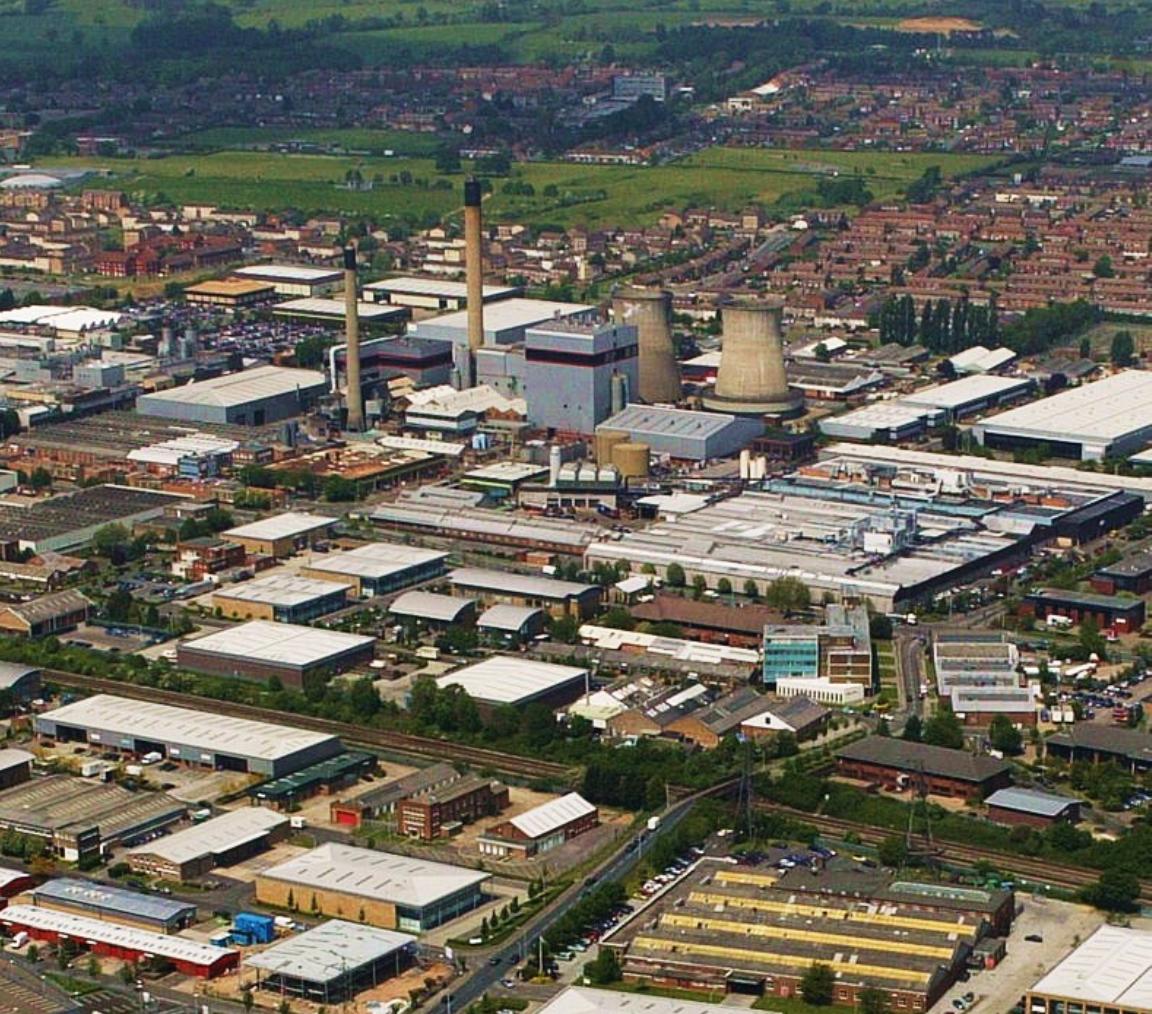
The Slough Trading Estate, founded in Slough in Buckinghamshire in 1920, is a business park in Britain. According to the estate's owners and operators, Segro, Slough Trading Estate consists of 2 km2 of commercial property in Slough and provides 0.7 km2 of accommodation to 500 businesses and has a working population of about 20 000 people. Slough Trading Estate is the largest industrial estate in single private ownership in Europe. The estate is home to over 600 buildings and 400 tenants from countries such as the US, France, Italy, Japan, Germany, and South Korea. Companies using the park include Fiat, Centrica, Hibu, Electrolux, GSK, Mars Confectionery, Akzo Nobel, Virgin Media, O2, AxFlow UK, the datacentre operator Network-i and OKI Printing Solutions. It is also home to important small, medium, and large businesses.
The estate's power station supplies heat and power to local customers by burning waste.
In June 1918, land to the west of Slough (now in Berkshire) and adjacent to the Great Western Railway main line, mainly forming part of Cippenham Court Farm but also including the site of an isolation hospital, was bought by the government to form a motor repair depot for army transport. The depot was intended to receive broken down vehicles by train from the battlefront, repair them, and return them to service.
The project was not regarded as a success. The depot was believed to be so urgent that construction work (eventually by construction company Sir Robert McAlpine) began in July 1918 without harvesting the crops on the land, but the site was still under construction when the armistice was agreed in November 1918.
Although the depot's fundamental purpose went with the end of the war, General Jan Smuts proposed a post-war use for the depot which was implemented. Rather than scrapping the many army surplus vehicles, they were sent to Slough for repair prior to sale. Because of this use, for many years (until at least the 1980s), the site was known locally and colloquially as 'the dump', and at the time of the depot's development it was also known as 'The White Elephant'.
Relations between management and workforce were so poor (partly due to the militancy of Wal Hannington) that in April 1920 the entire workforce was sacked. The Government Surplus Disposal Board sold the 2.7 square kilometre (600 acre) site and its contents (17,000 used cars, trucks and motorcycles, and 170,000 square metres (1.8 million sq ft) of covered workshops) for over seven million pounds. Sir Percival Perry, who had effectively established the British operations of the Ford Motor Company and who had been appointed Assistant Controller of the UK government's Agricultural Machinery Department during the war, and Sir Noel Mobbs, led the group of investors who acquired the depot, establishing the Slough Trading Company Limited and Reduced.
Repair and sale of ex-army vehicles continued until the Slough Trading Company Act 1925 (15 & 16 Geo. 5. c. xcv) was passed allowing the company (renamed in 1926 to Slough Estates Ltd) to establish an industrial estate. The existing army buildings were tenanted as factories, and additional units were built. Those on the Bath Road and Farnham Road frontages were designed with fundamentally uniform simple Art Deco offices on the front. Shared facilities were provided for workforce and employers, including a fire station, restaurant, shops and banks, a large community centre (1937) and the Slough Industrial Health Service (1947).
Early businesses established on the trading estate included Citroën (1926), Gillette, Johnson & Johnson and High Duty Alloys. In 1932, they were joined by Mars Ltd and Berlei (UK) Limited. In late 1933 the Slough Estates Journal reported there were 'more than 150 companies' based on the estate.
Hub AI
Slough Trading Estate AI simulator
(@Slough Trading Estate_simulator)
Slough Trading Estate
The Slough Trading Estate, founded in Slough in Buckinghamshire in 1920, is a business park in Britain. According to the estate's owners and operators, Segro, Slough Trading Estate consists of 2 km2 of commercial property in Slough and provides 0.7 km2 of accommodation to 500 businesses and has a working population of about 20 000 people. Slough Trading Estate is the largest industrial estate in single private ownership in Europe. The estate is home to over 600 buildings and 400 tenants from countries such as the US, France, Italy, Japan, Germany, and South Korea. Companies using the park include Fiat, Centrica, Hibu, Electrolux, GSK, Mars Confectionery, Akzo Nobel, Virgin Media, O2, AxFlow UK, the datacentre operator Network-i and OKI Printing Solutions. It is also home to important small, medium, and large businesses.
The estate's power station supplies heat and power to local customers by burning waste.
In June 1918, land to the west of Slough (now in Berkshire) and adjacent to the Great Western Railway main line, mainly forming part of Cippenham Court Farm but also including the site of an isolation hospital, was bought by the government to form a motor repair depot for army transport. The depot was intended to receive broken down vehicles by train from the battlefront, repair them, and return them to service.
The project was not regarded as a success. The depot was believed to be so urgent that construction work (eventually by construction company Sir Robert McAlpine) began in July 1918 without harvesting the crops on the land, but the site was still under construction when the armistice was agreed in November 1918.
Although the depot's fundamental purpose went with the end of the war, General Jan Smuts proposed a post-war use for the depot which was implemented. Rather than scrapping the many army surplus vehicles, they were sent to Slough for repair prior to sale. Because of this use, for many years (until at least the 1980s), the site was known locally and colloquially as 'the dump', and at the time of the depot's development it was also known as 'The White Elephant'.
Relations between management and workforce were so poor (partly due to the militancy of Wal Hannington) that in April 1920 the entire workforce was sacked. The Government Surplus Disposal Board sold the 2.7 square kilometre (600 acre) site and its contents (17,000 used cars, trucks and motorcycles, and 170,000 square metres (1.8 million sq ft) of covered workshops) for over seven million pounds. Sir Percival Perry, who had effectively established the British operations of the Ford Motor Company and who had been appointed Assistant Controller of the UK government's Agricultural Machinery Department during the war, and Sir Noel Mobbs, led the group of investors who acquired the depot, establishing the Slough Trading Company Limited and Reduced.
Repair and sale of ex-army vehicles continued until the Slough Trading Company Act 1925 (15 & 16 Geo. 5. c. xcv) was passed allowing the company (renamed in 1926 to Slough Estates Ltd) to establish an industrial estate. The existing army buildings were tenanted as factories, and additional units were built. Those on the Bath Road and Farnham Road frontages were designed with fundamentally uniform simple Art Deco offices on the front. Shared facilities were provided for workforce and employers, including a fire station, restaurant, shops and banks, a large community centre (1937) and the Slough Industrial Health Service (1947).
Early businesses established on the trading estate included Citroën (1926), Gillette, Johnson & Johnson and High Duty Alloys. In 1932, they were joined by Mars Ltd and Berlei (UK) Limited. In late 1933 the Slough Estates Journal reported there were 'more than 150 companies' based on the estate.