


Community hub
Recent from talks
Contribute something to knowledge base
Content stats: 0 posts, 0 articles, 1 media, 0 notes
Members stats: 0 subscribers, 0 contributors, 0 moderators, 0 supporters
Subscribers
Supporters
Contributors
Moderators
Hub AI
Small for gestational age AI simulator
(@Small for gestational age_simulator)
Hub AI
Small for gestational age AI simulator
(@Small for gestational age_simulator)
Small for gestational age
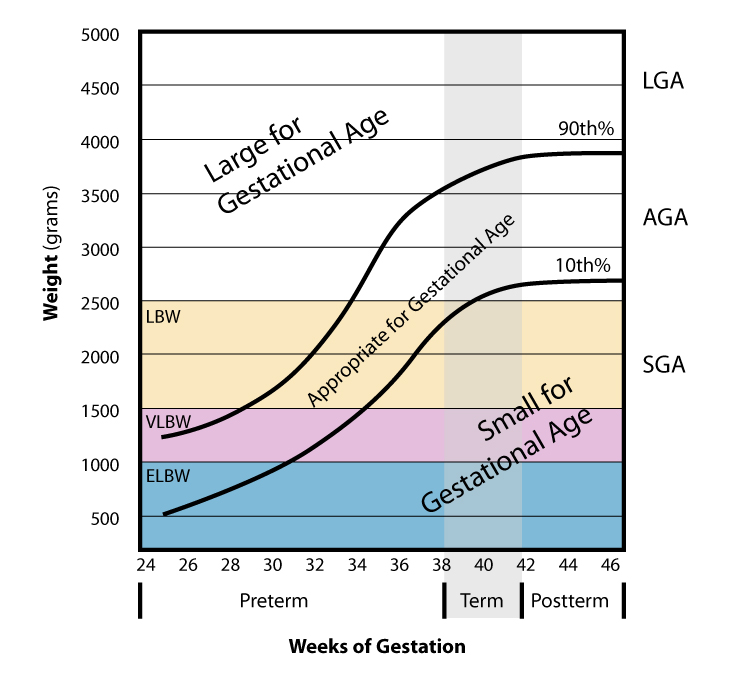
Small for gestational age (SGA) newborns are those who are smaller in size than normal for the gestational age. SGA is most commonly defined as a weight below the 10th percentile for the gestational age. SGA predicts susceptibility to hypoglycemia, hypothermia, and polycythemia. By definition, at least 10% of all newborns will be labeled SGA. All SGA babies should be watched for signs of failure to thrive, hypoglycemia, and other health conditions.
Being small for gestational age is broadly either:
The condition is defined by birth weight and/or length.[citation needed]
Intrauterine growth restriction is generally diagnosed by measuring the mother's uterus, with the fundal height being less than it should be for that stage of the pregnancy. If it is suspected, the mother will usually be sent for an ultrasound to confirm.[citation needed]
There are numerous Single Nucleotide Polymorphisms (SNPs), or other genetic mutations, that increase the risk of having a small for gestational age baby.
Ninety percent of babies born SGA catch up in growth by the time they reach two years old. For the ten percent of those without catch-up growth by two years old, an endocrinologist should be consulted. Some cases warrant growth hormone therapy.[citation needed]
Hypoglycemia is common in asymmetrical SGA babies because their larger brains burn calories at a faster rate than their usually limited fat stores can hold. Hypoglycemia is treated by frequent feedings and/or additions of cornstarch-based products (such as Duocal powder) to the feedings.[citation needed]
Some common conditions and disorders are found in many babies who are SGA (and especially those without catch-up growth by two years old).[citation needed]
Small for gestational age
Small for gestational age (SGA) newborns are those who are smaller in size than normal for the gestational age. SGA is most commonly defined as a weight below the 10th percentile for the gestational age. SGA predicts susceptibility to hypoglycemia, hypothermia, and polycythemia. By definition, at least 10% of all newborns will be labeled SGA. All SGA babies should be watched for signs of failure to thrive, hypoglycemia, and other health conditions.
Being small for gestational age is broadly either:
The condition is defined by birth weight and/or length.[citation needed]
Intrauterine growth restriction is generally diagnosed by measuring the mother's uterus, with the fundal height being less than it should be for that stage of the pregnancy. If it is suspected, the mother will usually be sent for an ultrasound to confirm.[citation needed]
There are numerous Single Nucleotide Polymorphisms (SNPs), or other genetic mutations, that increase the risk of having a small for gestational age baby.
Ninety percent of babies born SGA catch up in growth by the time they reach two years old. For the ten percent of those without catch-up growth by two years old, an endocrinologist should be consulted. Some cases warrant growth hormone therapy.[citation needed]
Hypoglycemia is common in asymmetrical SGA babies because their larger brains burn calories at a faster rate than their usually limited fat stores can hold. Hypoglycemia is treated by frequent feedings and/or additions of cornstarch-based products (such as Duocal powder) to the feedings.[citation needed]
Some common conditions and disorders are found in many babies who are SGA (and especially those without catch-up growth by two years old).[citation needed]
Recent media
Recent media