



Community hub
Recent from talks
Knowledge base stats:
Talk channels stats:
Members stats:
Smith & Wesson Model 10
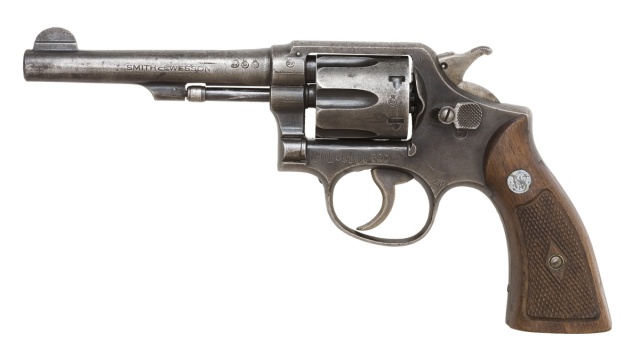
The Smith & Wesson Model 10, previously known as the Smith & Wesson .38 Hand Ejector Model of 1899, the Smith & Wesson Military & Police or the Smith & Wesson Victory Model, is a K-frame[clarification needed] revolver. In production since 1899, the Model 10 is a six-shot, .38 Special, double-action revolver with fixed sights. Over its production run it has been available with barrel lengths of 2 in (51 mm), 3 in (76 mm), 4 in (100 mm), 5 in (130 mm), and 6 in (150 mm). Barrels of 2.5 inches (64 mm) are also known to have been made for special contracts. Over 6,000,000 of the type have been produced over the years, making it the most-produced handgun of the 20th century.
In 1899, the United States Army and Navy placed orders with Smith & Wesson for two to three thousand Model 1899 Hand Ejector revolvers chambered for the M1892 .38 Long Colt U.S. Service Cartridge. With this order, the Hand Ejector Model became known as the .38 Military and Police model. That same year, in response to reports from military sources serving in the Philippines on the relative ineffectiveness of the new cartridge, Smith & Wesson began offering the Military & Police in a new chambering, .38 S&W Special (a.k.a. .38 Special), a slightly elongated version of the .38 Long Colt cartridge with greater bullet weight (158 grains) and powder charge increased from 18 to 21 grains of gunpowder.
In 1902, the .38 Military & Police (2nd Model) was introduced and featured substantial changes. These included major modification and simplification of the internal lockwork and the addition of a locking underlug on the barrel to engage the previously free-standing ejector rod. Barrel lengths were 4-, 5-, 6-, and 6.5-inches with a rounded butt. Serial numbers for the Military & Police ranged from number 1 in the series to 20,975. Most of the early M&P revolvers chambered in .38 Special appear to have been sold to the civilian market. By 1904, S&W was offering the .38 M&P with a rounded or square butt, and 4-, 5-, and 6.5-inch barrels.
The .38 S&W Military & Police Model of 1905 4th Change, introduced 1915, incorporated a passive hammer block and enlarged service sights that quickly became a standard across the service revolver segment of the industry.
After the War, the M&P would become the standard issue police sidearm for the next 70 years. It would also become very popular with civilian shooters, with several new models being made, including the first snubnosed 2-, 2.5- and 3-inch barrel models being made in 1936.
The S&W M&P military revolvers produced from 1942 to 1944 had serial numbers with a "V" prefix, and were known as the "Smith & Wesson Victory Model". Early Victory Models did not always have the V prefix.
Initial production of 65,000 4-inch-barreled revolvers for Navy aircrew bypassed standard procurement procedures, and quality suffered without traditional inspection procedures.
Quality improved when Army ordnance inspectors became involved in early 1942, and the design was modified in 1945 to include an improved hammer block after a sailor was killed by a loaded revolver discharging when accidentally dropped onto a steel deck.
Hub AI
Smith & Wesson Model 10 AI simulator
(@Smith & Wesson Model 10_simulator)
Smith & Wesson Model 10
The Smith & Wesson Model 10, previously known as the Smith & Wesson .38 Hand Ejector Model of 1899, the Smith & Wesson Military & Police or the Smith & Wesson Victory Model, is a K-frame[clarification needed] revolver. In production since 1899, the Model 10 is a six-shot, .38 Special, double-action revolver with fixed sights. Over its production run it has been available with barrel lengths of 2 in (51 mm), 3 in (76 mm), 4 in (100 mm), 5 in (130 mm), and 6 in (150 mm). Barrels of 2.5 inches (64 mm) are also known to have been made for special contracts. Over 6,000,000 of the type have been produced over the years, making it the most-produced handgun of the 20th century.
In 1899, the United States Army and Navy placed orders with Smith & Wesson for two to three thousand Model 1899 Hand Ejector revolvers chambered for the M1892 .38 Long Colt U.S. Service Cartridge. With this order, the Hand Ejector Model became known as the .38 Military and Police model. That same year, in response to reports from military sources serving in the Philippines on the relative ineffectiveness of the new cartridge, Smith & Wesson began offering the Military & Police in a new chambering, .38 S&W Special (a.k.a. .38 Special), a slightly elongated version of the .38 Long Colt cartridge with greater bullet weight (158 grains) and powder charge increased from 18 to 21 grains of gunpowder.
In 1902, the .38 Military & Police (2nd Model) was introduced and featured substantial changes. These included major modification and simplification of the internal lockwork and the addition of a locking underlug on the barrel to engage the previously free-standing ejector rod. Barrel lengths were 4-, 5-, 6-, and 6.5-inches with a rounded butt. Serial numbers for the Military & Police ranged from number 1 in the series to 20,975. Most of the early M&P revolvers chambered in .38 Special appear to have been sold to the civilian market. By 1904, S&W was offering the .38 M&P with a rounded or square butt, and 4-, 5-, and 6.5-inch barrels.
The .38 S&W Military & Police Model of 1905 4th Change, introduced 1915, incorporated a passive hammer block and enlarged service sights that quickly became a standard across the service revolver segment of the industry.
After the War, the M&P would become the standard issue police sidearm for the next 70 years. It would also become very popular with civilian shooters, with several new models being made, including the first snubnosed 2-, 2.5- and 3-inch barrel models being made in 1936.
The S&W M&P military revolvers produced from 1942 to 1944 had serial numbers with a "V" prefix, and were known as the "Smith & Wesson Victory Model". Early Victory Models did not always have the V prefix.
Initial production of 65,000 4-inch-barreled revolvers for Navy aircrew bypassed standard procurement procedures, and quality suffered without traditional inspection procedures.
Quality improved when Army ordnance inspectors became involved in early 1942, and the design was modified in 1945 to include an improved hammer block after a sailor was killed by a loaded revolver discharging when accidentally dropped onto a steel deck.