



Community hub
Recent from talks
Knowledge base stats:
Talk channels stats:
Members stats:
Sunspot number
The Wolf number (also known as the relative sunspot number or Zürich number) is a quantity that measures the number of sunspots and groups of sunspots present on the surface of the Sun. Historically, it was only possible to detect sunspots on the far side of the Sun indirectly using helioseismology. Since 2006, NASA's STEREO spacecrafts allow their direct observation.
Astronomers have been observing the Sun recording information about sunspots since the advent of the telescope in 1609. However, the idea of compiling the information about the sunspot number from various observers originates in Rudolf Wolf in 1848 in Zürich, Switzerland. The produced series initially had his name, but now it is more commonly referred to as the international sunspot number series.
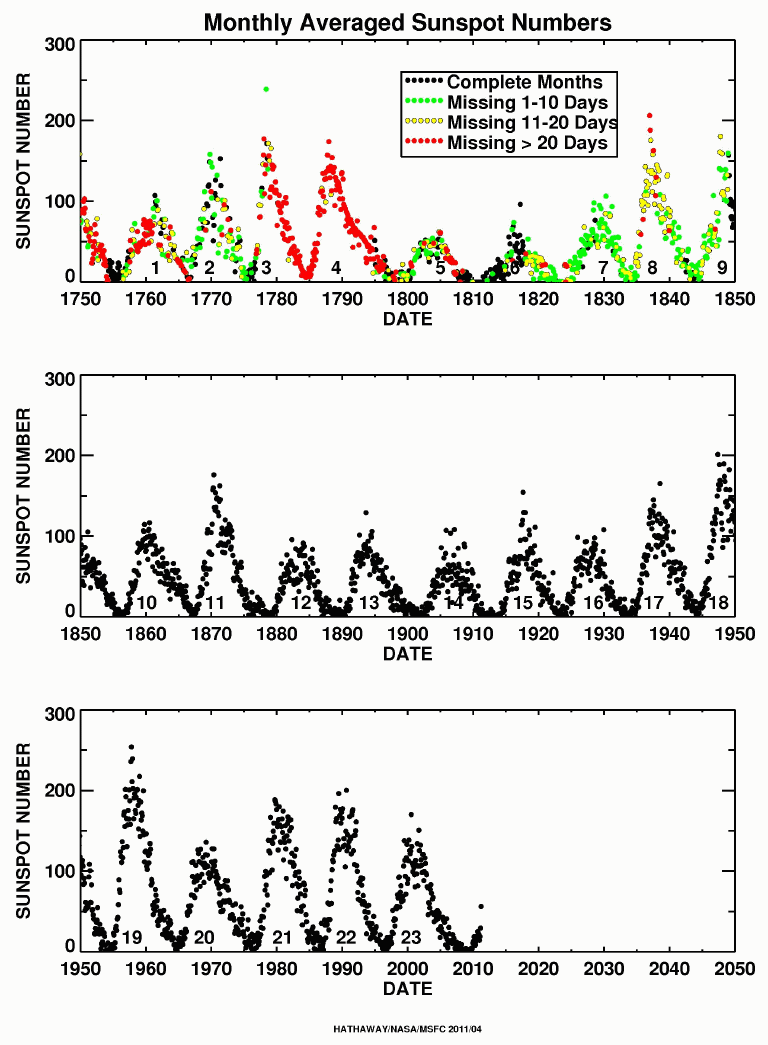
The international sunspot number series is still being produced today at the observatory of Brussels. The international number series shows an approximate periodicity of 11 years, the solar cycle, which was first found by Heinrich Schwabe in 1843, thus sometimes it is also referred to as the Schwabe cycle. The periodicity is not constant but varies roughly in the range 9.5 to 11 years. The international sunspot number series extends back to 1700 with annual values while daily values exist only since 1818.
Since 1 July 2015 a revised and updated international sunspot number series has been made available. The biggest difference is an overall increase by a factor of 1.6 to the entire series. Traditionally, a scaling of 0.6 was applied to all sunspot counts after 1893, to compensate for Alfred Wolfer's better equipment, after taking over from Wolf. This scaling has been dropped from the revised series, making modern counts closer to their raw values. Also, counts were reduced slightly after 1947 to compensate for bias introduced by a new counting method adopted that year, in which sunspots are weighted according to their size.
The relative sunspot number is computed using the formula

where
The observatory factor compensates for the differing number of recorded individual sunspots and sunspot groups by different observers. These differences in recorded values occur due to differences in instrumentation, local seeing, personal experience, and other factors between observers. Since Wolf was the primary observer for the relative sunspot number, his observatory factor was 1.
To calculate the 13-month smoothed monthly mean sunspot number, which is commonly used to calculate the minima and maxima of solar cycles, a tapered-boxcar smoothing function is used. For a given month , with a monthly sunspot number of , the smoothed monthly mean can be expressed as


Hub AI
Sunspot number AI simulator
(@Sunspot number_simulator)
Sunspot number
The Wolf number (also known as the relative sunspot number or Zürich number) is a quantity that measures the number of sunspots and groups of sunspots present on the surface of the Sun. Historically, it was only possible to detect sunspots on the far side of the Sun indirectly using helioseismology. Since 2006, NASA's STEREO spacecrafts allow their direct observation.
Astronomers have been observing the Sun recording information about sunspots since the advent of the telescope in 1609. However, the idea of compiling the information about the sunspot number from various observers originates in Rudolf Wolf in 1848 in Zürich, Switzerland. The produced series initially had his name, but now it is more commonly referred to as the international sunspot number series.
The international sunspot number series is still being produced today at the observatory of Brussels. The international number series shows an approximate periodicity of 11 years, the solar cycle, which was first found by Heinrich Schwabe in 1843, thus sometimes it is also referred to as the Schwabe cycle. The periodicity is not constant but varies roughly in the range 9.5 to 11 years. The international sunspot number series extends back to 1700 with annual values while daily values exist only since 1818.
Since 1 July 2015 a revised and updated international sunspot number series has been made available. The biggest difference is an overall increase by a factor of 1.6 to the entire series. Traditionally, a scaling of 0.6 was applied to all sunspot counts after 1893, to compensate for Alfred Wolfer's better equipment, after taking over from Wolf. This scaling has been dropped from the revised series, making modern counts closer to their raw values. Also, counts were reduced slightly after 1947 to compensate for bias introduced by a new counting method adopted that year, in which sunspots are weighted according to their size.
The relative sunspot number is computed using the formula
where
The observatory factor compensates for the differing number of recorded individual sunspots and sunspot groups by different observers. These differences in recorded values occur due to differences in instrumentation, local seeing, personal experience, and other factors between observers. Since Wolf was the primary observer for the relative sunspot number, his observatory factor was 1.
To calculate the 13-month smoothed monthly mean sunspot number, which is commonly used to calculate the minima and maxima of solar cycles, a tapered-boxcar smoothing function is used. For a given month , with a monthly sunspot number of , the smoothed monthly mean can be expressed as