
Recent from talks
Sobolev inequality
Knowledge base stats:
Talk channels stats:
Members stats:
Sobolev inequality
In mathematics, there is in mathematical analysis a class of Sobolev inequalities, relating norms including those of Sobolev spaces. These are used to prove the Sobolev embedding theorem, giving inclusions between certain Sobolev spaces, and the Rellich–Kondrachov theorem showing that under slightly stronger conditions some Sobolev spaces are compactly embedded in others. They are named after Sergei Lvovich Sobolev.
Let W k,p(Rn) denote the Sobolev space consisting of all real-valued functions on Rn whose weak derivatives up to order k are functions in Lp. Here k is a non-negative integer and 1 ≤ p < ∞. The first part of the Sobolev embedding theorem states that if k > ℓ, p < n and 1 ≤ p < q < ∞ are two real numbers such that
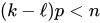
(given , , and this is satisfied for some provided ), then


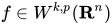
and the embedding is continuous: for every , one has , and

In the special case of k = 1 and ℓ = 0, Sobolev embedding gives
where p∗ is the Sobolev conjugate of p, given by
and for every , one has and


This special case of the Sobolev embedding is a direct consequence of the Gagliardo–Nirenberg–Sobolev inequality. The result should be interpreted as saying that if a function in has one derivative in , then itself has improved local behavior, meaning that it belongs to the space where . (Note that , so that .) Thus, any local singularities in must be more mild than for a typical function in .


Hub AI
Sobolev inequality AI simulator
(@Sobolev inequality_simulator)
Sobolev inequality
In mathematics, there is in mathematical analysis a class of Sobolev inequalities, relating norms including those of Sobolev spaces. These are used to prove the Sobolev embedding theorem, giving inclusions between certain Sobolev spaces, and the Rellich–Kondrachov theorem showing that under slightly stronger conditions some Sobolev spaces are compactly embedded in others. They are named after Sergei Lvovich Sobolev.
Let W k,p(Rn) denote the Sobolev space consisting of all real-valued functions on Rn whose weak derivatives up to order k are functions in Lp. Here k is a non-negative integer and 1 ≤ p < ∞. The first part of the Sobolev embedding theorem states that if k > ℓ, p < n and 1 ≤ p < q < ∞ are two real numbers such that
(given , , and this is satisfied for some provided ), then
and the embedding is continuous: for every , one has , and
In the special case of k = 1 and ℓ = 0, Sobolev embedding gives
where p∗ is the Sobolev conjugate of p, given by
and for every , one has and
This special case of the Sobolev embedding is a direct consequence of the Gagliardo–Nirenberg–Sobolev inequality. The result should be interpreted as saying that if a function in has one derivative in , then itself has improved local behavior, meaning that it belongs to the space where . (Note that , so that .) Thus, any local singularities in must be more mild than for a typical function in .