



Community hub
Recent from talks
Contribute something
Nothing was collected or created yet.
Weak derivative
View on Wikipedia | This article includes a list of general references, but it lacks sufficient corresponding inline citations. (May 2014) |
In mathematics, a weak derivative is a generalization of the concept of the derivative of a function (strong derivative) for functions not assumed differentiable, but only integrable, i.e., to lie in the Lp space .
![{\displaystyle L^{1}([a,b])}](https://wikimedia.org/api/rest_v1/media/math/render/svg/8cf02a5838299a9ec9af75e35122831d9c15e173)
The method of integration by parts holds that for smooth functions and we have


![{\displaystyle {\begin{aligned}\int _{a}^{b}u(x)\varphi '(x)\,dx&={\Big [}u(x)\varphi (x){\Big ]}_{a}^{b}-\int _{a}^{b}u'(x)\varphi (x)\,dx.\\[6pt]\end{aligned}}}](https://wikimedia.org/api/rest_v1/media/math/render/svg/9152c536ec17126a040beaddec24f7f51d61884b)
A function u' being the weak derivative of u is essentially defined by the requirement that this equation must hold for all smooth functions vanishing at the boundary points ().

Definition
[edit]Let be a function in the Lebesgue space . We say that in is a weak derivative of if


for all infinitely differentiable functions with .[1][2]
Generalizing to dimensions, if and are in the space of locally integrable functions for some open set , and if is a multi-index, we say that is the -weak derivative of if


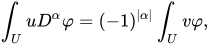
for all , that is, for all infinitely differentiable functions with compact support in . Here is defined as


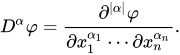
If has a weak derivative, it is often written since weak derivatives are unique (at least, up to a set of measure zero, see below).[3]

Examples
[edit]- The absolute value function , which is not differentiable at has a weak derivative known as the sign function, and given by This is not the only weak derivative for u: any w that is equal to v almost everywhere is also a weak derivative for u. For example, the definition of v(0) above could be replaced with any desired real number. Usually, the existence of multiple solutions is not a problem, since functions are considered to be equivalent in the theory of Lp spaces and Sobolev spaces if they are equal almost everywhere.
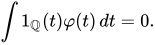
- The characteristic function of the rational numbers is nowhere differentiable yet has a weak derivative. Since the Lebesgue measure of the rational numbers is zero, Thus is a weak derivative of . Note that this does agree with our intuition since when considered as a member of an Lp space, is identified with the zero function.
- The Cantor function c does not have a weak derivative, despite being differentiable almost everywhere. This is because any weak derivative of c would have to be equal almost everywhere to the classical derivative of c, which is zero almost everywhere. But the zero function is not a weak derivative of c, as can be seen by comparing against an appropriate test function . More theoretically, c does not have a weak derivative because its distributional derivative, namely the Cantor distribution, is a singular measure and therefore cannot be represented by a function.



![{\displaystyle v(t)={\begin{cases}1&{\text{if }}t>0;\\[6pt]0&{\text{if }}t=0;\\[6pt]-1&{\text{if }}t<0.\end{cases}}}](https://wikimedia.org/api/rest_v1/media/math/render/svg/3bc47bdd3cb90fe8efbe43a5450c4f31ef1b506f)


Properties
[edit]If two functions are weak derivatives of the same function, they are equal except on a set with Lebesgue measure zero, i.e., they are equal almost everywhere. If we consider equivalence classes of functions such that two functions are equivalent if they are equal almost everywhere, then the weak derivative is unique.
Also, if u is differentiable in the conventional sense then its weak derivative is identical (in the sense given above) to its conventional (strong) derivative. Thus the weak derivative is a generalization of the strong one. Furthermore, the classical rules for derivatives of sums and products of functions also hold for the weak derivative.
Extensions
[edit]This concept gives rise to the definition of weak solutions in Sobolev spaces, which are useful for problems of differential equations and in functional analysis.
See also
[edit]References
[edit]- ^ Evans, Lawrence C. (1998). Partial differential equations. Graduate studies in mathematics. Providence (R. I.): American mathematical society. p. 242. ISBN 978-0-8218-0772-9.
- ^ Gilbarg, David; Trudinger, Neil S. (2001). Elliptic partial differential equations of second order. Classics in mathematics (2nd ed., rev. 3rd printing ed.). Berlin New York: Springer. p. 149. ISBN 978-3-540-41160-4.
- ^ Knabner, Peter; Angermann, Lutz (2003). Numerical Methods for Elliptic and Parabolic Partial Differential Equations. Texts in Applied Mathematics. New York, NY: Springer New York. p. 53. ISBN 978-0-387-95449-3.