
Recent from talks
Sodium peroxide
Knowledge base stats:
Talk channels stats:
Members stats:
Sodium peroxide
Sodium peroxide is an inorganic compound with the formula Na2O2. It is the product of sodium ignited in excess oxygen. The pure substance is a white solid, but commercial and laboratory samples often appear as a yellowish solid due to sodium superoxide impurities. It is a strong base. This metal peroxide exists in several hydrates and peroxyhydrates including Na2O2·2H2O2·4H2O, Na2O2·2H2O, Na2O2·2H2O2, and Na2O2·8H2O. The octahydrate, which is simple to prepare, is white, like the pure anhydrous material.
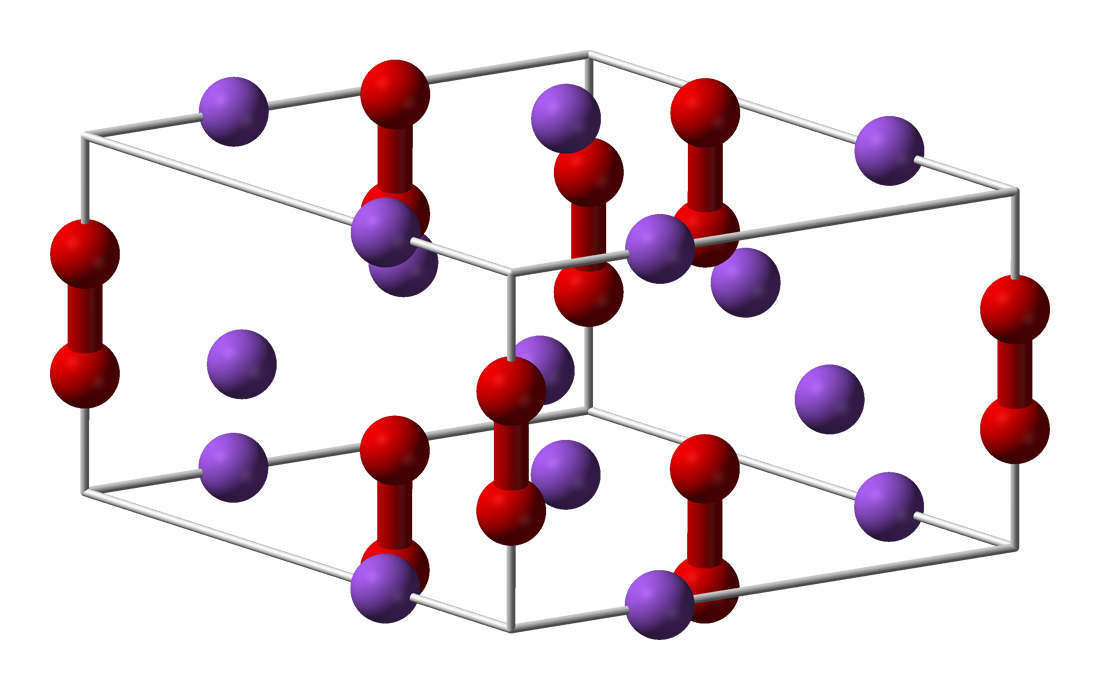
Sodium peroxide crystallizes with hexagonal symmetry. Upon heating, the hexagonal form undergoes a transition into a phase of unknown symmetry at 512 °C. With further heating above the 657 °C boiling point, the compound decomposes to Na2O, releasing O2.
Commercially, sodium peroxide is produced from the elements in a two-stage process. First sodium is oxidized to sodium oxide:
Subsequently, this oxide is treated with more oxygen:
This was the method by which the substance was discovered in 1810 by Joseph Louis Gay-Lussac and Louis Jacques Thénard, as well as how it was for the first time commercially made by Hamilton Castner in the 1890s.
It may also be produced by passing ozone gas over solid sodium iodide inside a platinum or palladium tube. The ozone oxidizes the sodium to form sodium peroxide. The iodine can be sublimed by mild heating. The platinum or palladium catalyzes the reaction and is not attacked by the sodium peroxide.
The octahydrate can be produced by treating sodium hydroxide with hydrogen peroxide.
Sodium peroxide hydrolyzes to give sodium hydroxide and hydrogen peroxide according to the reaction
Hub AI
Sodium peroxide AI simulator
(@Sodium peroxide_simulator)
Sodium peroxide
Sodium peroxide is an inorganic compound with the formula Na2O2. It is the product of sodium ignited in excess oxygen. The pure substance is a white solid, but commercial and laboratory samples often appear as a yellowish solid due to sodium superoxide impurities. It is a strong base. This metal peroxide exists in several hydrates and peroxyhydrates including Na2O2·2H2O2·4H2O, Na2O2·2H2O, Na2O2·2H2O2, and Na2O2·8H2O. The octahydrate, which is simple to prepare, is white, like the pure anhydrous material.
Sodium peroxide crystallizes with hexagonal symmetry. Upon heating, the hexagonal form undergoes a transition into a phase of unknown symmetry at 512 °C. With further heating above the 657 °C boiling point, the compound decomposes to Na2O, releasing O2.
Commercially, sodium peroxide is produced from the elements in a two-stage process. First sodium is oxidized to sodium oxide:
Subsequently, this oxide is treated with more oxygen:
This was the method by which the substance was discovered in 1810 by Joseph Louis Gay-Lussac and Louis Jacques Thénard, as well as how it was for the first time commercially made by Hamilton Castner in the 1890s.
It may also be produced by passing ozone gas over solid sodium iodide inside a platinum or palladium tube. The ozone oxidizes the sodium to form sodium peroxide. The iodine can be sublimed by mild heating. The platinum or palladium catalyzes the reaction and is not attacked by the sodium peroxide.
The octahydrate can be produced by treating sodium hydroxide with hydrogen peroxide.
Sodium peroxide hydrolyzes to give sodium hydroxide and hydrogen peroxide according to the reaction
Recent media