
Recent from talks
Solar eclipse of August 29, 1886
Knowledge base stats:
Talk channels stats:
Members stats:
Solar eclipse of August 29, 1886
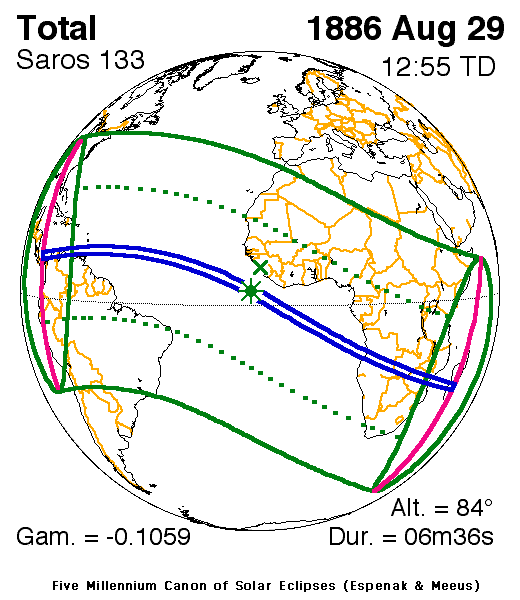
A total solar eclipse occurred at the Moon's ascending node of orbit on Sunday, August 29, 1886, with a magnitude of 1.0735. A solar eclipse occurs when the Moon passes between Earth and the Sun, thereby totally or partly obscuring the image of the Sun for a viewer on Earth. A total solar eclipse occurs when the Moon's apparent diameter is larger than the Sun's, blocking all direct sunlight, turning day into darkness. Totality occurs in a narrow path across Earth's surface, with the partial solar eclipse visible over a surrounding region thousands of kilometres wide. Occurring about 4 hours after perigee (on August 29, 1886, at 8:55 UTC), the Moon's apparent diameter was larger.
The path of totality was visible from parts of modern-day Panama, Colombia, Venezuela, Grenada, Tobago, Saint Vincent and the Grenadines, Barbados, Angola, Zambia, Zimbabwe, Mozambique, and Madagascar. A partial solar eclipse was also visible for parts of eastern North America, Central America, the Caribbean, northern South America, and Africa.
A team of astronomers travelled to the island of Grenada in the Caribbean to observe this eclipse. Their observation station was placed in Fort St. George.
Shown below are two tables displaying details about this particular solar eclipse. The first table outlines times at which the Moon's penumbra or umbra attains the specific parameter, and the second table describes various other parameters pertaining to this eclipse.
This eclipse is part of an eclipse season, a period, roughly every six months, when eclipses occur. Only two (or occasionally three) eclipse seasons occur each year, and each season lasts about 35 days and repeats just short of six months (173 days) later; thus two full eclipse seasons always occur each year. Either two or three eclipses happen each eclipse season. In the sequence below, each eclipse is separated by a fortnight. The first and last eclipse in this sequence is separated by one synodic month.
This eclipse is a member of a semester series. An eclipse in a semester series of solar eclipses repeats approximately every 177 days and 4 hours (a semester) at alternating nodes of the Moon's orbit.
The partial solar eclipses on April 25, 1884 and October 19, 1884 occur in the previous lunar year eclipse set, and the partial solar eclipse on July 9, 1888 occurs in the next lunar year eclipse set.
This eclipse is a part of Saros series 133, repeating every 18 years, 11 days, and containing 72 events. The series started with a partial solar eclipse on July 13, 1219. It contains annular eclipses from November 20, 1435 through January 13, 1526; a hybrid eclipse on January 24, 1544; and total eclipses from February 3, 1562 through June 21, 2373. The series ends at member 72 as a partial eclipse on September 5, 2499. Its eclipses are tabulated in three columns; every third eclipse in the same column is one exeligmos apart, so they all cast shadows over approximately the same parts of the Earth.
Hub AI
Solar eclipse of August 29, 1886 AI simulator
(@Solar eclipse of August 29, 1886_simulator)
Solar eclipse of August 29, 1886
A total solar eclipse occurred at the Moon's ascending node of orbit on Sunday, August 29, 1886, with a magnitude of 1.0735. A solar eclipse occurs when the Moon passes between Earth and the Sun, thereby totally or partly obscuring the image of the Sun for a viewer on Earth. A total solar eclipse occurs when the Moon's apparent diameter is larger than the Sun's, blocking all direct sunlight, turning day into darkness. Totality occurs in a narrow path across Earth's surface, with the partial solar eclipse visible over a surrounding region thousands of kilometres wide. Occurring about 4 hours after perigee (on August 29, 1886, at 8:55 UTC), the Moon's apparent diameter was larger.
The path of totality was visible from parts of modern-day Panama, Colombia, Venezuela, Grenada, Tobago, Saint Vincent and the Grenadines, Barbados, Angola, Zambia, Zimbabwe, Mozambique, and Madagascar. A partial solar eclipse was also visible for parts of eastern North America, Central America, the Caribbean, northern South America, and Africa.
A team of astronomers travelled to the island of Grenada in the Caribbean to observe this eclipse. Their observation station was placed in Fort St. George.
Shown below are two tables displaying details about this particular solar eclipse. The first table outlines times at which the Moon's penumbra or umbra attains the specific parameter, and the second table describes various other parameters pertaining to this eclipse.
This eclipse is part of an eclipse season, a period, roughly every six months, when eclipses occur. Only two (or occasionally three) eclipse seasons occur each year, and each season lasts about 35 days and repeats just short of six months (173 days) later; thus two full eclipse seasons always occur each year. Either two or three eclipses happen each eclipse season. In the sequence below, each eclipse is separated by a fortnight. The first and last eclipse in this sequence is separated by one synodic month.
This eclipse is a member of a semester series. An eclipse in a semester series of solar eclipses repeats approximately every 177 days and 4 hours (a semester) at alternating nodes of the Moon's orbit.
The partial solar eclipses on April 25, 1884 and October 19, 1884 occur in the previous lunar year eclipse set, and the partial solar eclipse on July 9, 1888 occurs in the next lunar year eclipse set.
This eclipse is a part of Saros series 133, repeating every 18 years, 11 days, and containing 72 events. The series started with a partial solar eclipse on July 13, 1219. It contains annular eclipses from November 20, 1435 through January 13, 1526; a hybrid eclipse on January 24, 1544; and total eclipses from February 3, 1562 through June 21, 2373. The series ends at member 72 as a partial eclipse on September 5, 2499. Its eclipses are tabulated in three columns; every third eclipse in the same column is one exeligmos apart, so they all cast shadows over approximately the same parts of the Earth.
Recent media