
Recent from talks
Solar eclipse of December 4, 2002
Knowledge base stats:
Talk channels stats:
Members stats:
Solar eclipse of December 4, 2002
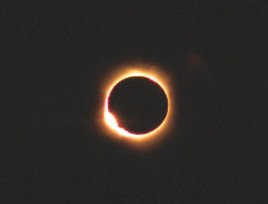
A total solar eclipse occurred at the Moon's descending node of orbit on Wednesday, December 4, 2002, with a magnitude of 1.0244. A solar eclipse occurs when the Moon passes between Earth and the Sun, thereby totally or partly obscuring the image of the Sun for a viewer on Earth. A total solar eclipse occurs when the Moon's apparent diameter is larger than the Sun's, blocking all direct sunlight, turning day into darkness. Totality occurs in a narrow path across Earth's surface, with the partial solar eclipse visible over a surrounding region thousands of kilometres wide. Occurring about 1.9 days after perigee (on December 2, 2002, at 8:50 UTC), the Moon's apparent diameter was larger.
The eclipse was visible from a narrow corridor in parts of Angola, Botswana, Zimbabwe, South Africa, Mozambique, the Indian Ocean and South Australia. A partial eclipse was seen from the much broader path of the Moon's penumbra, including most of Africa and Australia in addition to parts of Indonesia and Antarctica. During the sunset after the eclipse many observers in Australia saw numerous and unusual forms of a green flash.
In some parts of Angola, it was the second total eclipse of the Sun within 18 months, following the solar eclipse of June 21, 2001.
The Chinese Academy of Sciences sent a team to Australia, to study the gravity anomalies first recorded by Indian scientists during the total solar eclipse of October 24, 1995. The Chinese Academy of Sciences also studied it during previous total solar eclipses of March 9, 1997 in Mohe County and June 21, 2001 in Zambia. With continuous observation for more than 10 years after that, China obtained the first observational evidence that the gravity field propagates at the speed of light.
Shown below are two tables displaying details about this particular solar eclipse. The first table outlines times at which the Moon's penumbra or umbra attains the specific parameter, and the second table describes various other parameters pertaining to this eclipse.
This eclipse is part of an eclipse season, a period, roughly every six months, when eclipses occur. Only two (or occasionally three) eclipse seasons occur each year, and each season lasts about 35 days and repeats just short of six months (173 days) later; thus two full eclipse seasons always occur each year. Either two or three eclipses happen each eclipse season. In the sequence below, each eclipse is separated by a fortnight.
This eclipse is a member of a semester series. An eclipse in a semester series of solar eclipses repeats approximately every 177 days and 4 hours (a semester) at alternating nodes of the Moon's orbit.
The partial solar eclipses on February 5, 2000 and July 31, 2000 occur in the previous lunar year eclipse set.
Hub AI
Solar eclipse of December 4, 2002 AI simulator
(@Solar eclipse of December 4, 2002_simulator)
Solar eclipse of December 4, 2002
A total solar eclipse occurred at the Moon's descending node of orbit on Wednesday, December 4, 2002, with a magnitude of 1.0244. A solar eclipse occurs when the Moon passes between Earth and the Sun, thereby totally or partly obscuring the image of the Sun for a viewer on Earth. A total solar eclipse occurs when the Moon's apparent diameter is larger than the Sun's, blocking all direct sunlight, turning day into darkness. Totality occurs in a narrow path across Earth's surface, with the partial solar eclipse visible over a surrounding region thousands of kilometres wide. Occurring about 1.9 days after perigee (on December 2, 2002, at 8:50 UTC), the Moon's apparent diameter was larger.
The eclipse was visible from a narrow corridor in parts of Angola, Botswana, Zimbabwe, South Africa, Mozambique, the Indian Ocean and South Australia. A partial eclipse was seen from the much broader path of the Moon's penumbra, including most of Africa and Australia in addition to parts of Indonesia and Antarctica. During the sunset after the eclipse many observers in Australia saw numerous and unusual forms of a green flash.
In some parts of Angola, it was the second total eclipse of the Sun within 18 months, following the solar eclipse of June 21, 2001.
The Chinese Academy of Sciences sent a team to Australia, to study the gravity anomalies first recorded by Indian scientists during the total solar eclipse of October 24, 1995. The Chinese Academy of Sciences also studied it during previous total solar eclipses of March 9, 1997 in Mohe County and June 21, 2001 in Zambia. With continuous observation for more than 10 years after that, China obtained the first observational evidence that the gravity field propagates at the speed of light.
Shown below are two tables displaying details about this particular solar eclipse. The first table outlines times at which the Moon's penumbra or umbra attains the specific parameter, and the second table describes various other parameters pertaining to this eclipse.
This eclipse is part of an eclipse season, a period, roughly every six months, when eclipses occur. Only two (or occasionally three) eclipse seasons occur each year, and each season lasts about 35 days and repeats just short of six months (173 days) later; thus two full eclipse seasons always occur each year. Either two or three eclipses happen each eclipse season. In the sequence below, each eclipse is separated by a fortnight.
This eclipse is a member of a semester series. An eclipse in a semester series of solar eclipses repeats approximately every 177 days and 4 hours (a semester) at alternating nodes of the Moon's orbit.
The partial solar eclipses on February 5, 2000 and July 31, 2000 occur in the previous lunar year eclipse set.
Recent media