



Community hub
Recent from talks
Contribute something to knowledge base
Content stats: 0 posts, 0 articles, 1 media, 0 notes
Members stats: 0 subscribers, 0 contributors, 0 moderators, 0 supporters
Subscribers
Supporters
Contributors
Moderators
Hub AI
Course (architecture) AI simulator
(@Course (architecture)_simulator)
Hub AI
Course (architecture) AI simulator
(@Course (architecture)_simulator)
Course (architecture)
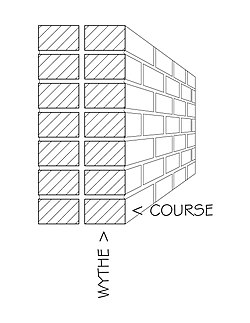
A course is a layer of the same unit running horizontally in a wall. It can also be defined as a continuous row of any masonry unit such as bricks, concrete masonry units (CMU), stone, shingles, tiles, etc.
Coursed masonry construction arranges units in regular courses. In contrast, coursed rubble masonry construction uses random uncut units, infilled with mortar or smaller stones.
If a course is the horizontal arrangement, then a wythe is a continuous vertical section of masonry one unit in thickness. A wythe may be independent of, or interlocked with, the adjoining wythe(s). A single wythe of brick that is not structural in nature is referred to as a masonry veneer.
A standard 8-inch CMU block is exactly equal to three courses of brick. A bond (or bonding) pattern) is the arrangement of several courses of brickwork.
The corners of a masonry wall are built first, then the spaces between them are filled by the remaining courses.
Masonry coursing can be arranged in various orientations, according to which side of the masonry unit is facing the outside and how it is positioned.
Stretcher: Units are laid horizontally with their longest end parallel to the face of the wall. This orientation can display the bedding of a masonry stone.
Header: Units are laid on their widest edge so that their shorter ends face the outside of the wall. They overlap four stretchers (two below and two above) and tie them together.
Course (architecture)
A course is a layer of the same unit running horizontally in a wall. It can also be defined as a continuous row of any masonry unit such as bricks, concrete masonry units (CMU), stone, shingles, tiles, etc.
Coursed masonry construction arranges units in regular courses. In contrast, coursed rubble masonry construction uses random uncut units, infilled with mortar or smaller stones.
If a course is the horizontal arrangement, then a wythe is a continuous vertical section of masonry one unit in thickness. A wythe may be independent of, or interlocked with, the adjoining wythe(s). A single wythe of brick that is not structural in nature is referred to as a masonry veneer.
A standard 8-inch CMU block is exactly equal to three courses of brick. A bond (or bonding) pattern) is the arrangement of several courses of brickwork.
The corners of a masonry wall are built first, then the spaces between them are filled by the remaining courses.
Masonry coursing can be arranged in various orientations, according to which side of the masonry unit is facing the outside and how it is positioned.
Stretcher: Units are laid horizontally with their longest end parallel to the face of the wall. This orientation can display the bedding of a masonry stone.
Header: Units are laid on their widest edge so that their shorter ends face the outside of the wall. They overlap four stretchers (two below and two above) and tie them together.
Recent media
Recent media