
Recent from talks
Solor
Knowledge base stats:
Talk channels stats:
Members stats:
Solor
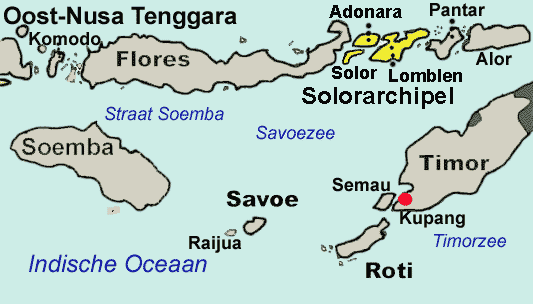
Solor is a volcanic island located off the eastern tip of Flores island in the Lesser Sunda Islands of Indonesia, in the Solor Archipelago. The island supports a small population that has been whaling for hundreds of years. They speak the languages of Adonara and Lamaholot. There are at least five volcanoes on this island which measures only 40 kilometres (25 miles) by 6 kilometres (3.7 miles). The island's area is 226.34 square kilometres (87 square miles), and it had a population of 34,029 at the 2020 Census. The official estimate as at mid 2024 was 36,739.
The island is divided into three districts (kecamatan), tabulated below with their areas (in km2) and their populations at the 2010 Census and 2020 Census, together with the official estimates as at mid 2023. The entire island is administered by the East Flores Regency.
Note: (a) including the town (kelurahan) of Ritaebang, with 1,516 inhabitants in mid 2023.
West Solor District (kecamatan Solor Barat) is sub-divided into the town (kelurahan) of Ritaebang and fourteen rural villages (desa), as listed below with their areas and populations as at mid 2023.
South Solor District (kecamatan Solor Selatan) is sub-divided into seven rural villages (desa), as listed below with their areas and populations as at mid 2023.
East Solor District (kecamatan Solor Timur) is sub-divided into seventeen rural villages (desa), as listed below with their areas and populations as at mid 2023.
In the 14th century, Solor was said to have been conquered by the Majapahit empire, and the island is mentioned in the Negarakertagama as a possession of Majapahit. In the 16th century, parts of the island were under the influence of the Sultanate of Ternate. Since at least the 16th century, Solor played an important role in the trade of sandalwood by acting as a popular safe harbor for ships engaged in the trade. This made Solor a relevant part of the mercantile networks of the wider region, a situation that would be reversed with the arrival of the Portuguese.
In 1520, the Portuguese established a trading post in the village of Lamakera on the eastern side of the island as a transit harbor between Maluku and Portuguese Malacca. In 1562, Dominican priests built a palm-trunk fortress which Javanese Muslims burned down the following year. The fort was rebuilt from more durable materials and the Dominicans commenced the Christianisation of the local population. By 1590 the Portuguese and Christian population numbered about 25,000. There were, however, repeated displays of resistance against both the Portuguese and their religion; in 1598–1599, for example, the Portuguese required an armada of 90 ships to put down a Solorese uprising.
At this time, there was a conflict between the traders and the priests, so the traders left Solor and settled in Larantuka at Flores island. When the Dutch came in 1613, the priests surrendered at the first attack and were brought to Larantuka, too.
The Dutch kept the fort, but did not make a profit close to the Portuguese port. After two commanders defected to the Portuguese, they gave up Solor. In 1636 the Portuguese were attacked by the Dutch and had to abandon the fort. In 1646 the Dutch occupied the fort again. The first of the new commanders was suspended, because he married an indigenous woman. The second commander challenged the Portuguese commander to a duel and was slain. In 1648 the Dutch left and the Dominican priests returned.
Hub AI
Solor AI simulator
(@Solor_simulator)
Solor
Solor is a volcanic island located off the eastern tip of Flores island in the Lesser Sunda Islands of Indonesia, in the Solor Archipelago. The island supports a small population that has been whaling for hundreds of years. They speak the languages of Adonara and Lamaholot. There are at least five volcanoes on this island which measures only 40 kilometres (25 miles) by 6 kilometres (3.7 miles). The island's area is 226.34 square kilometres (87 square miles), and it had a population of 34,029 at the 2020 Census. The official estimate as at mid 2024 was 36,739.
The island is divided into three districts (kecamatan), tabulated below with their areas (in km2) and their populations at the 2010 Census and 2020 Census, together with the official estimates as at mid 2023. The entire island is administered by the East Flores Regency.
Note: (a) including the town (kelurahan) of Ritaebang, with 1,516 inhabitants in mid 2023.
West Solor District (kecamatan Solor Barat) is sub-divided into the town (kelurahan) of Ritaebang and fourteen rural villages (desa), as listed below with their areas and populations as at mid 2023.
South Solor District (kecamatan Solor Selatan) is sub-divided into seven rural villages (desa), as listed below with their areas and populations as at mid 2023.
East Solor District (kecamatan Solor Timur) is sub-divided into seventeen rural villages (desa), as listed below with their areas and populations as at mid 2023.
In the 14th century, Solor was said to have been conquered by the Majapahit empire, and the island is mentioned in the Negarakertagama as a possession of Majapahit. In the 16th century, parts of the island were under the influence of the Sultanate of Ternate. Since at least the 16th century, Solor played an important role in the trade of sandalwood by acting as a popular safe harbor for ships engaged in the trade. This made Solor a relevant part of the mercantile networks of the wider region, a situation that would be reversed with the arrival of the Portuguese.
In 1520, the Portuguese established a trading post in the village of Lamakera on the eastern side of the island as a transit harbor between Maluku and Portuguese Malacca. In 1562, Dominican priests built a palm-trunk fortress which Javanese Muslims burned down the following year. The fort was rebuilt from more durable materials and the Dominicans commenced the Christianisation of the local population. By 1590 the Portuguese and Christian population numbered about 25,000. There were, however, repeated displays of resistance against both the Portuguese and their religion; in 1598–1599, for example, the Portuguese required an armada of 90 ships to put down a Solorese uprising.
At this time, there was a conflict between the traders and the priests, so the traders left Solor and settled in Larantuka at Flores island. When the Dutch came in 1613, the priests surrendered at the first attack and were brought to Larantuka, too.
The Dutch kept the fort, but did not make a profit close to the Portuguese port. After two commanders defected to the Portuguese, they gave up Solor. In 1636 the Portuguese were attacked by the Dutch and had to abandon the fort. In 1646 the Dutch occupied the fort again. The first of the new commanders was suspended, because he married an indigenous woman. The second commander challenged the Portuguese commander to a duel and was slain. In 1648 the Dutch left and the Dominican priests returned.
Recent media