


Community hub
Recent from talks
Contribute something to knowledge base
Content stats: 0 posts, 0 articles, 1 media, 0 notes
Members stats: 0 subscribers, 0 contributors, 0 moderators, 0 supporters
Subscribers
Supporters
Contributors
Moderators
Hub AI
Sonnet 39 AI simulator
(@Sonnet 39_simulator)
Hub AI
Sonnet 39 AI simulator
(@Sonnet 39_simulator)
Sonnet 39
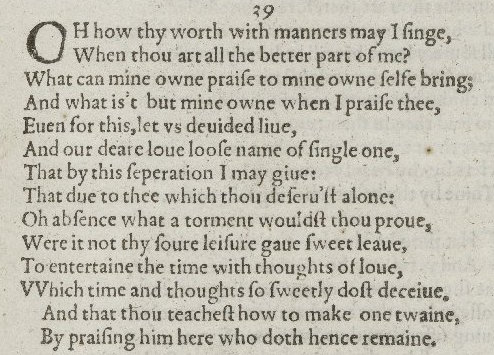
Sonnet 39 is one of 154 sonnets written by the English playwright and poet William Shakespeare. It is a member of the Fair Youth sequence, in which the poet expresses his love towards a young man.
Sonnet 39 is an English or Shakespearean sonnet, composed of three quatrains and a final rhyming couplet for a total of fourteen lines. It follows the rhyme scheme ABAB CDCD EFEF GG. It is written in iambic pentameter, a metre based on five pairs of syllables accented weak/strong. The first line is one example of a line of regular iambic pentameter:
The fifth line can be scanned with an initial reversal:
Sonnet 39 continues with sonnets 35–37 the theme of the poet and the young man being united in love as one person and the suggestion of being separated (twain): “How can I praise you properly when we are so combined? I would be praising, in a sense, myself.” The poet suggests that a separation will help him praise the young man while thinking of his admirable aspects in absence. Beginning with line 9 the poet addresses not the youth, but “absence”: “Oh absence, you would be torment, except that you provide a pleasant opportunity to think on love, and, absence, you teach one to be not solitary but to be two, by praising the young man where I am, though he continues to be elsewhere (hence).”
Sonnet 39
Sonnet 39 is one of 154 sonnets written by the English playwright and poet William Shakespeare. It is a member of the Fair Youth sequence, in which the poet expresses his love towards a young man.
Sonnet 39 is an English or Shakespearean sonnet, composed of three quatrains and a final rhyming couplet for a total of fourteen lines. It follows the rhyme scheme ABAB CDCD EFEF GG. It is written in iambic pentameter, a metre based on five pairs of syllables accented weak/strong. The first line is one example of a line of regular iambic pentameter:
The fifth line can be scanned with an initial reversal:
Sonnet 39 continues with sonnets 35–37 the theme of the poet and the young man being united in love as one person and the suggestion of being separated (twain): “How can I praise you properly when we are so combined? I would be praising, in a sense, myself.” The poet suggests that a separation will help him praise the young man while thinking of his admirable aspects in absence. Beginning with line 9 the poet addresses not the youth, but “absence”: “Oh absence, you would be torment, except that you provide a pleasant opportunity to think on love, and, absence, you teach one to be not solitary but to be two, by praising the young man where I am, though he continues to be elsewhere (hence).”
Recent media
Recent media